
Through The Past, Darkly: The ’60s At 50, Blurred
His overalls are weathered. His white beard is grown out to aging-hippie perfection. The tattoos on his arms tell the story of a moment from the summer of 1969 that has passed into legend – three days of peace and music that became a doorway to defining an era.
Around him sits the patch of upstate New York farmland that gave birth to a piece of modern mythology – Woodstock. At 68, Duke Devlin reflects on the definitive concert of his youth by spinning tales of community and anti-authoritarianism that end, invariably, with the word “man.” As in, “Sometimes I’m amazed that we’re still talking about this, man.”
Of course we’re still talking about it. And, as a historical interpreter at the festival’s site, it’s Devlin’s job to talk about it, to tell the story of the ’60s. Unlike so many today who say they were at Woodstock, he actually was. And still is.
Woodstock was a flashpoint, a culmination, one easy way to distill a complicated decade into something digestible. That it happened as the 1960s ended made it all the more convenient: Here was an empty vessel, complete with soundtrack and instantly mythic imagery, that provided the perfect raw material to build a narrative around an era.
A half century after the 1960s began, that is precisely what we have done with the decade – and with the 10-year periods that came before and after it. We’ve wrestled them into grand stories with convenient contours and reliable patchworks of imagery. And when it comes to the ’60s, what a confusing, disjointed patchwork it is.
For every textured civil-rights documentary, there is a $15.95 inflatable beehive hairdo. For every meticulously researched history of the protest movement, there is a Walmart peace-sign spiral notebook. For every Duke Devlin, there is an Austin Powers.
The 1960s have been idealized and vilified, romanticized and boiled down into a cultural demiglace with an intense taste but very little of the subtlety that the real decade offered.
“It’s no longer self-expression. It’s a fashion,” says Wade Lawrence, director of the Museum at Bethel Woods, which oversees the site where Woodstock happened. “We like simple things. We like sound bites. We like a simple, one-sentence explanation of an era.”
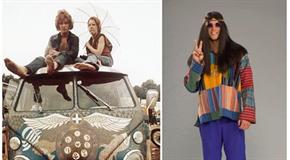
Photo: AP Photo
Left, concert-goers at Woodstock. Right, a Forum Novelties "Generation Hippie" costume for sale.
And so it is with the country’s view of its recent history. In America, the past is raw material. History gets compressed, packaged, marketed. Into the grinder goes complexity; out comes cliche. And we help it along, deciding arbitrarily that a decade – the time between two years that end in zeros and little more – is a useful way to measure history.
Duke Devlin trolls the Woodstock site on a golf cart, his enthusiasm undiminished by time’s passage. “Something happened here,” he says. But as with the rest of that decade in America, what it was still ain’t exactly clear.
FREE
 Daily Pulse
Subscribe
Daily Pulse
Subscribe
 Daily Pulse
Subscribe
Daily Pulse
Subscribe