
How St. Augustine’s Fort Mose Jazz & Blues Series Is Preserving Black History
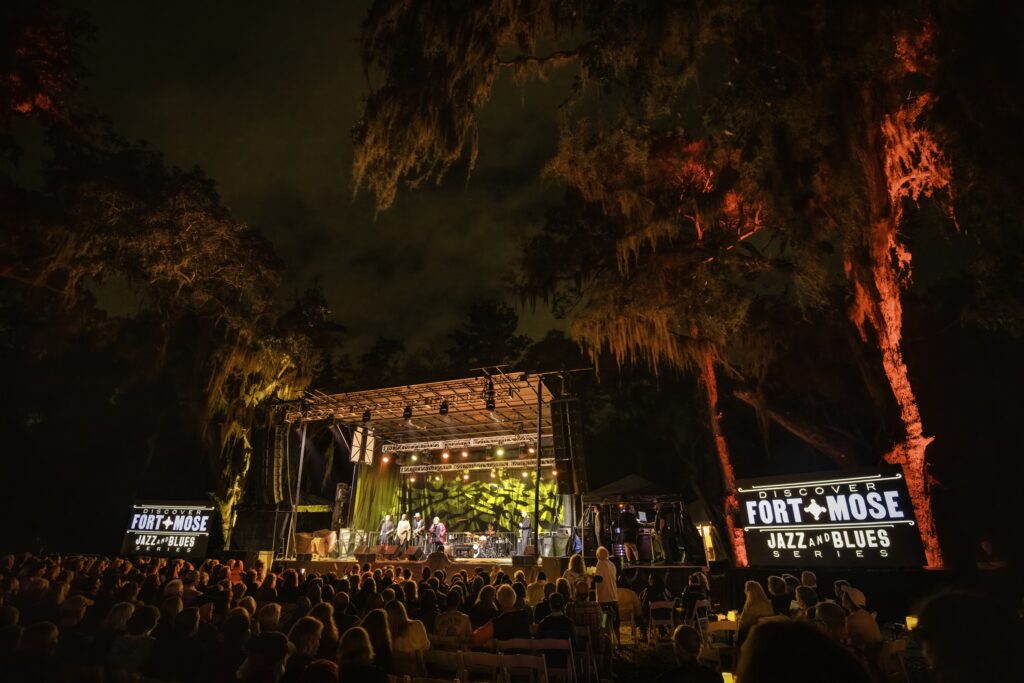
The 40-acre landmark on the edge of a salt marsh on the western edge of a waterway separating the Florida mainland from the coastal barrier islands was a piece of Black history lost to time. But today Fort Mose is celebrated during the Fort Mose Jazz & Blues Series as a powerful example of the resilience of the human spirit.
“It’s so pure,” said Gabe Pellicer, president and CEO of SJC Cultural Events, which produces the music series on the site of the original fort. “It’s an easy thing to work on because it is pretty clear what the intention is.”
Founded by the Spanish, St. Augustine dates back to 1565 and is considered the oldest city in the continental United States. It was established 42 years before Jamestown, Virginia, and 55 years before the Pilgrims landed at Plymouth Rock.
From 1687 onwards, individuals seeking freedom started arriving in St. Augustine. Although they received waged labor, they were still listed as “royal slaves.” In 1693, King Carlos II of Spain issued a royal proclamation granting “liberty to all…the men and the women.”
Providing a haven for former slaves would strike an economic blow to plantations in the English colonies and attract skilled labor to the Spanish settlement. Word spread.
In 1738, Spanish Governor of Florida Manuel de Montiano established Gracia Real de Santa Teresa de Mose on the north side of the city as a free Black settlement – the first legally sanctioned community of former slaves in the United States.
Shortened to Fort Mose (pronounced “Moh-say”) and largely forgotten and buried under decades of neglect and wetlands, the preserve was once a beacon of hope for Colonial slaves from Georgia and the Carolinas who risked their lives for a chance at freedom.
“It was a small price to pay for being able to live free,” said Thomas “TJ” Jackson, a lifelong resident of St. Augustine, a founding member of the Fort Mose Historical Society and a member of the St. Augustine Historical Society.
Plantation and slave owners resented the sanctuary that Spanish Florida afforded escaped slaves. The route was treacherous. Fleeing oppression, former slaves had to cross hundreds of miles on foot travelling at night to avoid slave hunters and capture.
They were alone or in some cases aided by Native Americans who helped them navigate the territory and reach the Spanish settlement. It was the southern precursor of what would later become the Underground Railroad in the north.
The courageous freedom seekers who survived the harsh journey were free, but there were conditions: settlers had to embrace Catholicism and promise allegiance to the Spanish Crown.
Between 100 and 150 men, women and children lived in the wood garrison. They worked as farmers, carpenters and ironsmiths, and the men formed a militia that helped defend the city from British attacks.
“People talk about Fort Mose for what it was, a fort, but we’ve got to remember that families – men and women, infants and children escaped and when they got here, Fort Mose was a community,” said Chip Storey, a member of the Fort Mose Historical Society. “It’s important to remember that in addition to the fort, there were also homes. It was a fort, and it was a community simultaneously.”

In 1763, Florida became an English colony and all of the inhabitants of the Spanish colony sailed to Cuba, including the people of Fort Mose who didn’t want to risk being forced into slavery. As Florida changed hands, the fort was occupied by the military and then finally abandoned in 1812.
The story of Fort Mose is one of hope, endurance and triumph. It embodies the struggle for freedom and self-determination faced by African slaves. But it was also a story buried by time and marshland for more than a century.
“The story was relatively untold,” Pellicer explained. “I grew up in St. Augustine and I didn’t hear the story at all, and I’m actually the eighth-generation. You hear about the conquistadors, the Fountain of Youth, but you never heard about the first free Black settlement…You feel a little betrayed learning about this so late in life.”
“Believe it or not, I didn’t know this story either,” added Jackson. “A lot of times the older generation would say, ‘You know, we had a fort.’ And now I know they were talking about Fort Mose. There was a story here around town that there was an old Negro fort, but there wasn’t a big push to learn more about it.”
The site wasn’t unearthed until 1986 by a team of archeologists and researchers using a 1739 Catholic census and other historic records, thermal and satellite imaging and aerial photographs and acquired by the state in 1989. In 1994, Fort Mose was added to the National Register of Historic Places and designated as a National Historic Landmark and the Fort Mose Historical Society was formed to preserve the legacy.
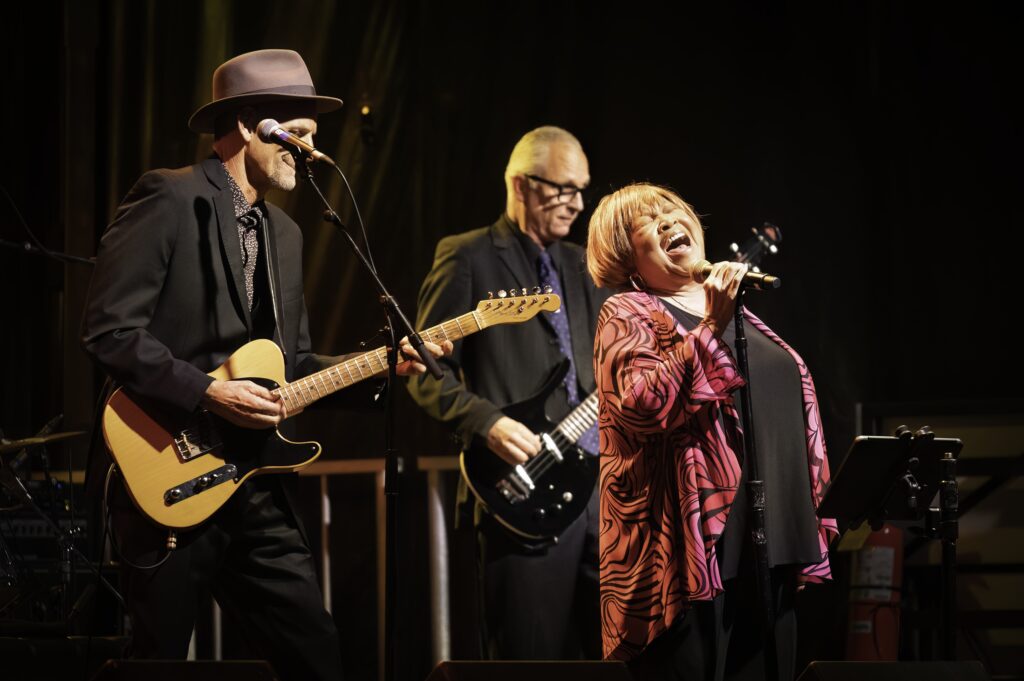
(Photo by Tucker Joenz)
The Society launched a reconstruction project in 2012 and by November 2023 had raised the estimated $3 million needed to rebuild the 1738 fort through grants and donations. The project, which is a collaborative effort by the Fort Mose Historical Society, Florida State Parks Foundation and the Florida Park Service, broke ground in January 2024.
Since then, land has been cleared, the outline of the fort has been drawn and the structure has begun to take shape. When completed this year, the reconstructed fort will stand 39 feet high, offering a tangible glimpse into the lives and bravery of the Fort Mose slaves who became settlers.
Since its introduction in 2022, the Fort Mose Jazz & Blues Series has been an important fundraiser for the project generating awareness and more than $129,000.
“Our win is if we can raise funds for the Fort Mose Historical Society and tell the story of Fort Mose,” Pellicer said. “That’s how we measure success.”
The outdoor, multi-day event coincides with Black History Month. The 2025 lineup includes Snarky Puppy, KEM, Tower of Power, Dinner Party, Macy Gray, The Dirty Dozen Brass Band and more from Feb. 6-16 at the Fort Mose Historic State Park.
“Tower of Power is so excited to be playing the Fort Mose Jazz & Blues Series,” said Emilio Castillo, TOP bandleader. “Not only is Florida one of the most popular states for us to play, but we are honored to perform at such a historical landmark that brings awareness to grounds that stand for freedom and liberation.”
Education and engagement are cornerstones of the series. Reenactors in period costumes greet fans and share the Fort Mose story and artists are given private tours of the museum and grounds.
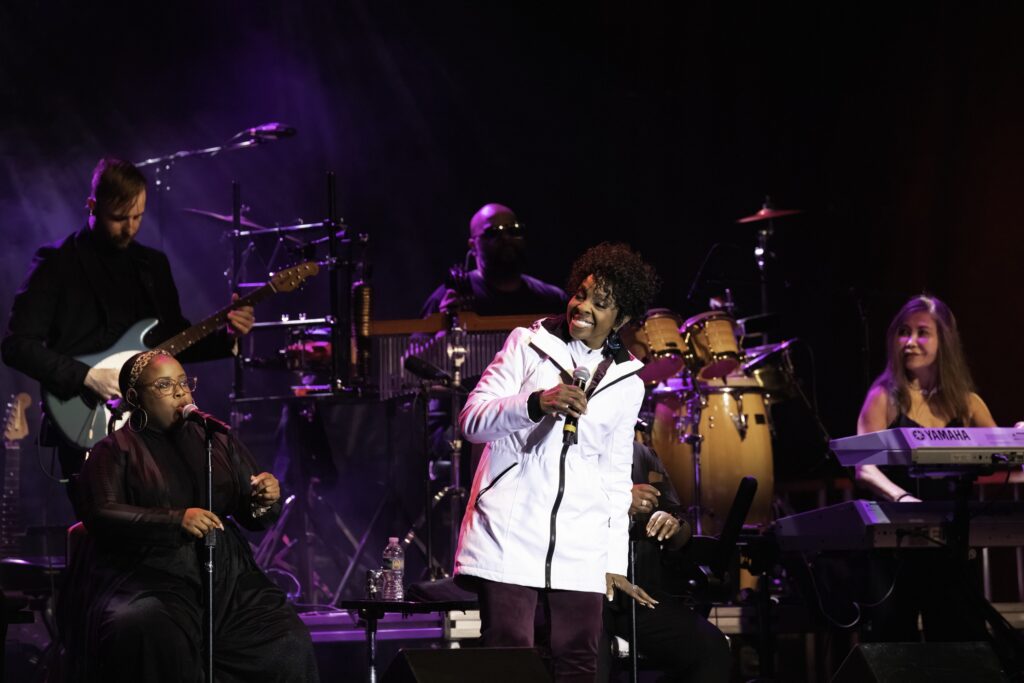
(Photo by Melissa Marcarelli)
“Attendees will get to enjoy a classic TOP set in an intimate setting and learn more about the restoration efforts around Fort Mose,” said Castillo. “Come check out the show and get a soul vaccination.”
Previous performers include Christone “Kingfish” Ingram, Jazz at Lincoln Center with Wynton Marsalis, Keb’ Mo, the Count Basie Orchestra, Gladys Night, Rhiannon Giddens and Mavis Staples. Attendance has doubled since the inaugural series drawing a record 6,200 attendees in 2024 from 41 states.
People come for the music and leave with a deeper understanding of the history.
“I would guess that a significant number of the people who have come to the concerts didn’t know a thing about Fort Mose,” Storey said. “But when they arrived, you had representatives from Fort Mose greeting them, often in period dress. They had the opportunity to go into the museum and learn about the history of Fort Mose. So, the concerts brought in an audience that was not sophisticated about Fort Mose, and in the process raised their awareness.”
The park setting three miles northwest of St. Augustine contributes to the experience. The natural amphitheater is surrounded by live oaks dripping lacy beards of Spanish moss. The audience is capped at 1,100 to keep it intimate and preserve the park setting.
“It really feels as though you are in a magical place,” added Storey. “I can’t overstate how extraordinary that amphitheater experience is. It really is beautiful. It just feels like you are in a special world, hearing music and seeing a Florida evening outdoors at its beautiful best.”
The series could easily grow into a larger space. SJC Cultural Events, a community-focused nonprofit based in St. Augustine, also manages and operates other venues and cultural series including the St. Augustine Amphitheatre, Ponte Vedra Concert Hall and Sing Out Loud Festival. But Pellicer is reluctant to leave the historic location.
“I can see us doing that at some point, but there is something special about the live oak trees, the Spanish Moss and knowing that you’re on the actual historic site where all of this happened,” he said. “It just gives you this feeling.”
Pellicer and Cari Baker handle booking in house and hosting shows over six days provides flexibility. Ticket prices vary by date and artist and start at $49 to $124 with proceeds benefiting the restoration.
“We’re going to do this year in and year out because we are so far behind telling this story,” offered Pellicer. “It’s just one of those events that gives you a lot of fulfillment. The whole team wants to keep this thing going.”
FREE
 Daily Pulse
Subscribe
Daily Pulse
Subscribe
 Daily Pulse
Subscribe
Daily Pulse
Subscribe