
The Biz: Sponsor Tries DOGE Gambit With TICKET Act; Warner & Spotify Ink Deal; Market Watch & More
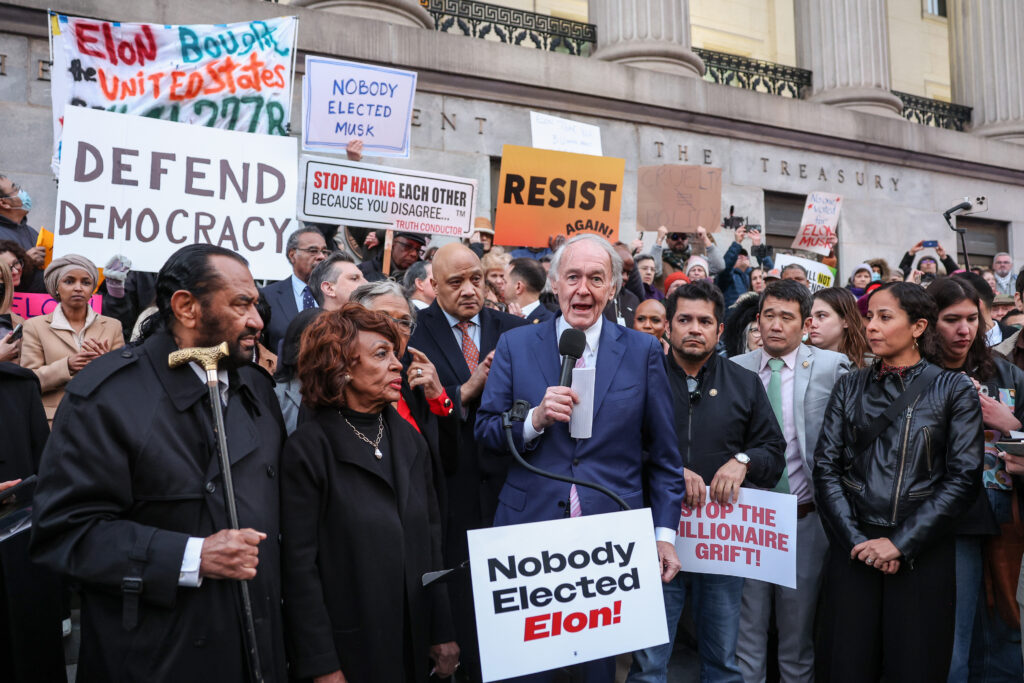
Senator Looks To TICKET Act To Stop DOGE
There’s been much consternation among Congressional Democrats — and others — about the level of access and power Elon Musk and his Department of Government Efficiency have to the federal government’s payment system. There are reports that DOGE apparatchiks were given largely unfettered access to personal information about millions of Americans and that the Muskers are making largely unilateral decisions about what is and is not government waste.
What better way to push back than … a breathtakingly popular and bipartisan piece of ticketing reform legislation, right?
The latest version of the TICKET Act was filed in the Senate at the end of January and made it to the critical mark-up phase Feb. 5, wherein the Senate’s Commerce Committee was set to consider amendments and report the bill to the full Senate. One amendment — filed by the committee ranking member Sen. Maria Cantwell (D-WA) — made it through with no opposition or debate; it simply shored up language prohibiting the use of “deceptive” URLs by secondary ticketers.
Sen. Ed Markey (D-MA), one of the bill’s sponsors (along with Republican Eric Schmitt of Missouri), had bigger fish to fry than dodgy web addresses. He offered an amendment to add a section prohibiting access to the Department of Treasury’s system by “private citizens” or CEOs or directors of companies that hold government contracts and others. The language was broad enough that it didn’t merely say “Stop Elon Musk,” but it was clearly aimed at the Tesla chief, a point Markey wasn’t shy about making both in committee and on (Musk-owned) X.
Whether such a amendment was germane to the matter at hand is a question for the angels (or at least Texas Republican Sen. Ted Cruz, who chairs the committee) with Markey arguing that since the TICKET Act amends the Federal Trade Commission Act, which (among other things) addresses privacy issues, it was fair game. Cruz and his fellow Republicans were unpersuaded. The amendment fell on party lines and the TICKET Act (with Cantwell’s amendment) was reported favorably and unanimously.
This version of the bill-that-will-neither-die-nor-actually-become-law-apparently would mandate all-in pricing, though upfront disclosure of fees has been enshrined as a regulation after the Federal Trade Commission mandated it by rule last year. The new version would also ban speculative ticketing, crack down on misleading websites, require more rapid refunds for canceled events and mandate an FTC study on the usage of bots in ticketing purchases.
The speculative ticketing ban is a bit of a sticky wicket, because the bill still explicitly allows the selling of.a service that will buy tickets not yet on sale, which sounds an awful lot like speculative ticket selling. Under the bill, such a service would have to be advertised as a service with disclosure that the tickets themselves are not being sold. A distinction without a difference? Maybe, as Sen. Brian Schatz (D-HI) noted, but he conceded the bill as filed is a “compromise” and perhaps a toothier spec ban could come later.
Warner Inks Licensing Deal With Spotify
Following UMG’s deal with the streamer, Warner Music Group has signed a new multi-year licensing agreement with Spotify.
Like UMG’s agreement, Warner’s deal ends the controversial “bundling” discount that cut mechanical royalties.
From a press release:
The new deal will help deliver new fan experiences, a deeper music and video catalog, further paid subscription tiers, and differentiated content bundles.
The agreement also builds on the companies’ existing alignment around ‘artist centric’ royalty models that reward and protect the power of artists to attract and engage audiences.
Importantly, the new publishing agreement introduces a direct licensing model with Warner Chappell Music in several additional countries including the U.S., reinforcing songwriters’ benefit in this evolving landscape.
Market Watch
Shares of Live Nation grew steadily this week, up nearly $6 and nearing $150 per share by midday Thursday. Like other blue chips (and lesser lights, for that matter), LYV took a dive as it appeared apparent President Donald Trump would deliver on his 25% tariff promise against Canada and Mexico Feb. 4. And like most stocks, once Trump backed off, the price rebounded. … Sphere Entertainment was more volatile, but eased into a steady position, trading up about $1.50, close to $47 per share. … Wall Street backed off from Endeavor this week, following a big spike last week on news that shareholders would ask for a higher take-private price. Shares of the WME parent are back in the $31 range (still higher than the $27 per share offered by Silver Lake) after climbing past $32 at the end of last week.
FREE
 Daily Pulse
Subscribe
Daily Pulse
Subscribe
 Daily Pulse
Subscribe
Daily Pulse
Subscribe