
‘SNL 50’ & The Musical Legacy Of Being Live From New York
Paul Simon and Sabrina Carpenter’s duet on “Homeward Bound” opened “SNL50” on Sunday night, but it also served as an encapsulation of the oeuvre that dominated the “Homecoming Concert” that began “Saturday Night Live”‘s golden anniversary weekend two nights before at Radio City Music Hall.
The venerable singer-songwriter joining with the very-much-of-the-moment pop chanteuse on a timeless song that no longer belongs to any era was a great demonstration of why “SNL” persists. After five decades, it’s entrenched in a way that few other pieces of contemporary culture are. It can bring together Paul Simon and Sabrina Carpenter and make it make sense, because SNL doesn’t belong just to Boomers or Xers or Millennials — though, of course, all will say their era of “SNL” was the best, an argument that’s been cliche for decades. It belongs to all of them.
On the Friday concert, after a crowd-pleasing rendition of “I Want It That Way,” the boy-band-turned-middle-aged Backstreet Boys gamely introduced Devo (with Fred Armisen on drums), MTV’s “TRL” era giving over the stage to one of the pioneers of the channel, which like “SNL” is maligned by every generation for changes it makes in service of the next.
“SNL”‘s anniversary year has been exceedingly self-referential (a cynic might say self-indulgent), even for a show that thrives on self-reference, but anniversaries are always going to be nostalgic. See Eddie Vedder following his expert cover of Tom Petty’s “The Waiting” (and subsequent serpentine meandering monologue about … people who have died? It was hard to follow, even by Vedder’s standards) with the opening bars of Elvis Costello’s “Less Than Zero” and recreation of Costello’s famous 1978 interruption. Vedder didn’t launch into “Radio Radio” as Costello did (he played Pearl Jam’s “Corduroy”) and “SNL” creator/producer Lorne Michaels didn’t flick off Vedder as he did to Costello (the only televised digitus impudicus was Meryl Streep’s aimed at Will Ferrell as he performed alongside Ana Gasteyer as Marty and Bobbi Culp, the clueless music teachers at Altadena Middle School).
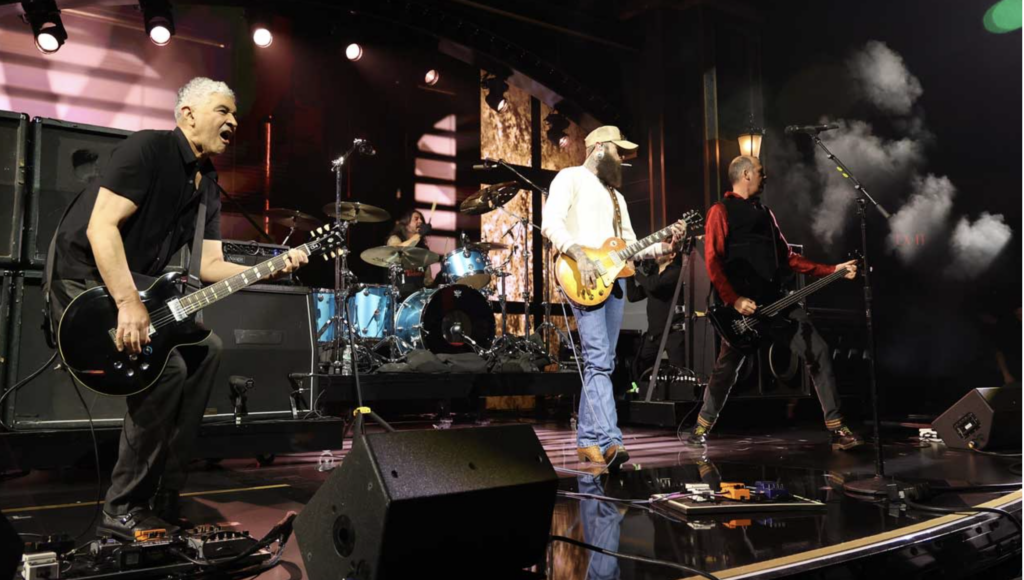
The effort at generation-gap-bridging was evident all night. Host Jimmy Fallon feted the Blues Brothers with “Soul Man” which gave way to Miley Cyrus covering Queen’s “This Thing Called Love” backed by Brittany Howard’s riveting guitar and truly mystifying collection of effects pedals. Post Malone became the latest surrogate frontman with an increasingly-common semi-reunited Nirvana, with a walloping version of “Smells Like Teen Spirit.” No, the proximity of Posty with Dave Grohl did not spontaneously create a festival.
The absence of Freddie Mercury and Kurt Cobain made fill-ins necessary. Father Time remains undefeated and after 50 years, iconic “SNL” musical performances had to be recreated with surrogates. David Byrne, St. Vincent and Arcade Fire, along with the Preservation Hall Jazz Band, covered David Bowie’s “Heroes,” for example (Byrne later sang a couple Talking Heads joints with Robyn). Jelly Roll ran through a smattering of Johnny Cash tunes (his outfit honored The Man In Black rather than Elton John, sadly; Cash and Captain Fantastic famously swapped clothes in a 1982 “SNL” episode).
That was the only real nod to country all night (Jerry Douglas did come out to play dobro with Mumford & Sons on “The Boxer” and Brandi Carlile, who played “The Joke,” is at least country-adjacent, if not Nashville-approved). Jelly also joined Snoop Dogg in what was one of only two hip-hop performances. The other came from Ms. Lauryn Hill – bedazzling like a Golden Age of Hollywood star in a full-length fur — and Wyclef Jean who can still kill us very softly and expertly indeed. Even Bad Bunny — who, like Hill, kicked it old-school fashion-wise — was more salsa than trap on Friday.
“SNL” for all its broader cultural relevance very much remains very New York and its musical tastes — which like everything on the show is no doubt a reflection of Michaels’ tastes — remain very rock-centered. That doesn’t mean the show is beholden to radio (or music video). Breakout performances on the show have become the stuff of legend — though rarer now as musical discovery is in the literal palms of our hands these days — and Michaels is always willing to give the week’s two songs to bubbling-up acts or those whose acclaim is more critical than commercial. Bonnie Raitt has been both at various times in her career and has appeared on “SNL” four times. On Friday, she performed the still-painfully-sad-after-all-these-years “I Can’t Make You Love Me” with Chris Martin handling the piano in a cameo surprisingly subtle for the frontman of one of the world’s most famous bands.
Not subtle: Cher. But when has she ever been? She did indeed turn back time, donning that famous black lace bodysuit and strutting with all her Cherness in a fiery rendition of “If I Could Turn Back Time.”
Though that performance took us back to 1989, the decade that was on the heels of that year was really the centerpiece Friday night. Not terribly surprising since the concert was produced by Mark Ronson (born in 1975) and perhaps (again, cynically) a concession to the fact that those kids who were in their teens and 20s in that decade are now in a position to spend lavishly and shepherd their own kids into a lifelong appreciation of “SNL” (he, born in 1981, says with some level of self-awareness).
There were some notable absences on the Friday show. Surely one would have expected Simon to be there as he was Sunday (he’s been the musical guest 13 times). Justin Timberlake, too, was nowhere to be seen and his parts of the bawdy duets with Andy Samberg were sung instead by Lady Gaga (no complaints there, really; Gaga also sang both voices in “Shallow” after Samberg comically failed to hit Bradley Cooper’s notes). The SNL house band wasn’t on duty either, that role instead played by Questlove & The Roots, who deserve endless praise for their note-perfect support across a variety of styles
The show closed with Jack White — after some delay that required Fallon to engage in rather awkward riffing; hey, it’s live TV! — who ended it all with “Seven Nation Army.” And that was perfect, too. The song is 22-years-old but so ubiquitous now (and for good reason: it rocks) that you could feasibly convince someone its two years old or 40 years old.
Like “SNL” it’s always going to be around.
FREE
 Daily Pulse
Subscribe
Daily Pulse
Subscribe
 Daily Pulse
Subscribe
Daily Pulse
Subscribe