
Understanding What A Building Needs – How HOK Reimagined Sweden’s Avicii Arena

ALL NEW WITHIN THE OLD: Rendering of Avicii Arena showing the new elements, like the retractable roof panels, the spreader frame that pulls up the scoreboard, as well as the gondolas in the top tier. Courtesy HOK

Stockholm’s Avicii Arena reopened for business in February, after a year-long renovation period that made an iconic, yet old building fit for the future. Nothing’s changed on the outside – the globe remains one of the most prominent features of the Stockholm skyline – but its insides got significantly overhauled.
The renovation of Avicii Arena in Sweden, Stockholm, is a truly fascinating project for several reasons. For one, it’s a heritage-listed building, meaning HOK, the architects tasked with the job, couldn’t just apply brute force. Necessary changes and reinforcements had to be done with surgical precision, as to not affect the integrity of the building.
Secondly, it’s a story about using analog technology in a digital age to future-proof an entertainment venue: real innovation was achieved by using of mostly off-the-shelf products, which can be easily maintained and replaced, ensuring longevity.
Thirdly, the renovation of Avicii Arena is an inspiring example of how existing assets can be repurposed. Anybody owning or operating an old building that’s just not fit for modern purposes anymore: you don’t have to tear the whole thing down or start from scratch, which is both cheaper and more sustainable than erecting a brand-new superstructure.
Avicii Arena is operated by ASM Global’s Stockholm Live, and owned by the city of Stockholm, which commissioned HOK via Stockholm Globe Arena Fastigheter (SGAF), the city’s real estate department responsible for the developments on the site known as Globen City. “The client wanted works to be transformative, but also respectful to the building’s legacy, while keeping a limited budget and timeframe in mind,” Nuno Guerreiro, the project designer at HOK, said.
A few elements had to be kept as they were during the refurbishment, including the prominent blue cores inside the building, and, of course, it’s iconic spherical shape. The exterior couldn’t be touched at all.
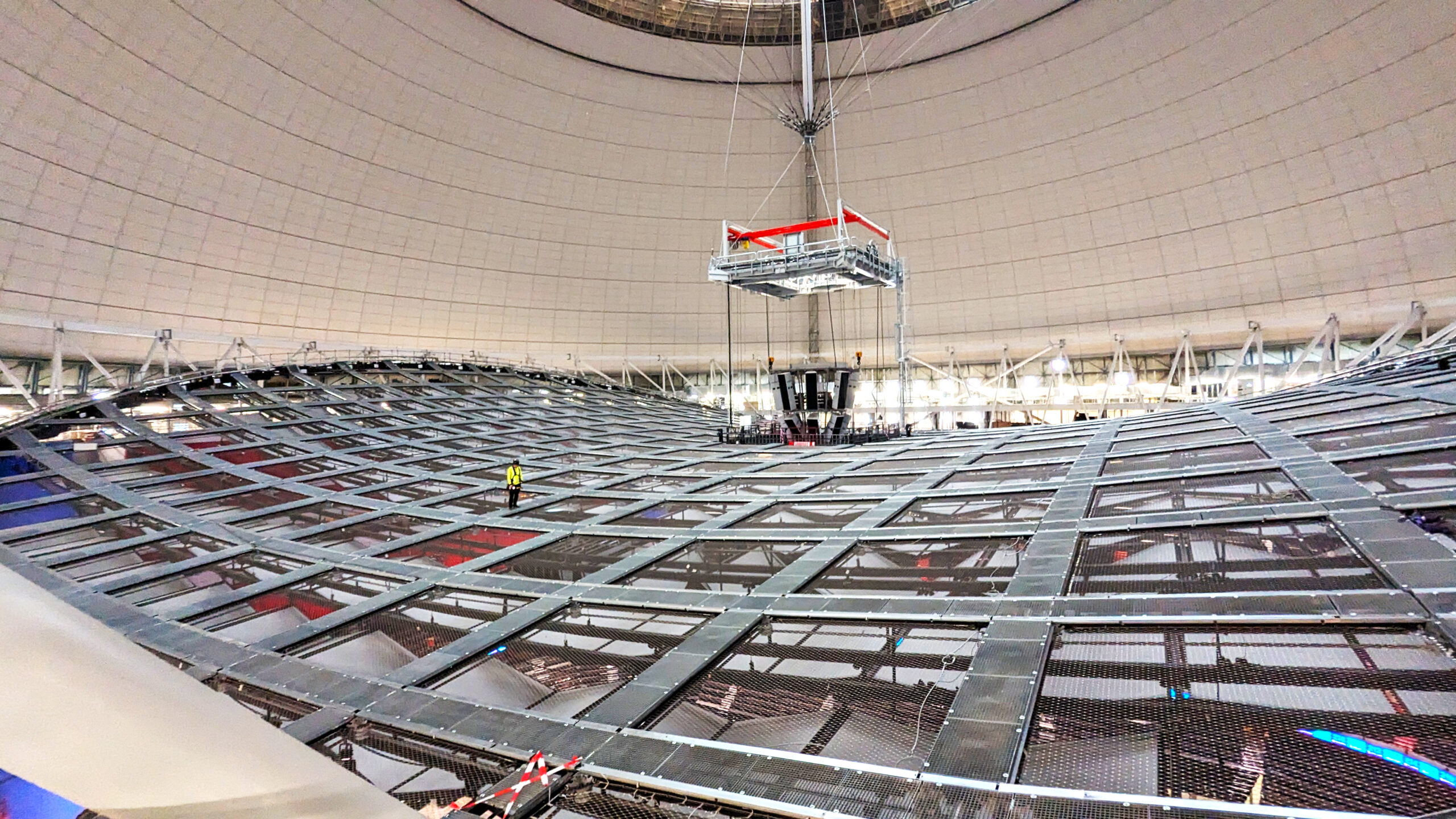
Inside, guests would look up into a gigantic spherical void, which is quite an awesome sight, but massively affected the atmosphere and acoustics during events. It was the client’s wish to maintain the visual experience of this unusual vertical space, so HOK came up with a retractable ceiling, made up of panels that fold away to one side in about 10 minutes, bringing the vast dome above back into visibility.
When it’s closed, it not only provides that compact, indoor-feel you want during events, but also changes the sound as the panels double up as acoustic absorbers and reflectors made from recycled plastic. The building can now also host theater shows, which simply wasn’t an option pre-refurbishment.
The panels move along a new rigging grid, which may be the most fascinating aspect of this renovation: the old rigging system hung directly from the space frame that structured the whole globe. Heavy rigs, like the one used for the 2016 Eurovision Song Contest at the Globe, would create deflections in the roof. The new structure can handle the weight of modern productions. There are hatches all over the walkways, where the crews can hang all of their bridle equipment from. And because the walkways are connected by a special stretch mesh, the entire ceiling is safely accessible without the need for handrails.
In the old Globe, the boxes and suites weren’t being used, as they were too far away from the event floor. The venue lacked an adequate amount of hospitality spaces. The bright-red seats proved problematic during TV broadcasts. All of this was adressed by HOK’s design.
The entire seating tier C was demolished and replaced with gondolas – similar to what was implemented inside Detroit’s Little Caesars Arena – which brings people closer to the action even at that height. The suits have been transformed into major lounge spaces connected to the gondolas, which creates hospitality and VIP
opportunities the arena previously couldn’t tap into.
The ground floor tier that surrounds the ice hockey rink got renewed as well, and the entire arena received new seats, manufactured by a regional business. In general, HOK leveraged local procurement wherever possible.
A spreader frame hanging from the middle of the dome carries the scoreboard, which retracts into the void whenever its not needed. And that’s not even touching on the ventilation of the building, which is an engineering masterpiece in its own right: a MEP ring that reaches around the entire structure, hidden away under the top tier, all connected to the exterior, regenerating the air inside the arena every 10 minutes, and eliminating the need for any pipes across the ceiling.
“To do a deep intervention like this one is as demanding as doing a new build,” said Guerreiro. HOK design principal John Rhodes likened it to building a very large ship in a bottle.
Avicii Arena reopened in February, and has already been hosting a few events. The first major concert highlight will be two nights of Billie Eilish, April 23-24. The building’s capacity was maintained at just under 14,000 seated, and up to about 16,000 including a standing floor.
And now that Avicii Arena can host ice hockey, the 9,000-capacity Hovet next door can be demolished, liberating land for a new mixed-use development. 3Arena, formerly known as Tele2 Arena, is also close-by, as is Stockholm’s former meat-packing district, which is also scheduled for refurbishment in the coming years. The long-term plan is to transform the entire Globen City into a fully-fledged entertainment district, an attractive destination for locals and tourists alike.
To stay within budget, most of the components used had to be off the shelf. “Essentially,” Guerreiro summed it up, “it was all about creating a complex system out of relatively simple parts that can be easily replaced and maintained.” The interior intervention alone cost around €60 million ($64 million). Material replacements, and upgrades to existing facilities within the building – on the concourses or inside the toilets, for instance – brought up the overall cost to about €100 million ($107 million). It’s a remarkable price tag, especially when compared to what one would usually budget for a brand-new building.
“It’s tremendously good value,” Rhodes concluded, and one that required some “bravery from the client, to see the vision, and to carry it through. We’ve been working within a very tight timeframe as well. We’re all very proud of it. It’s been quite a journey, and, hopefully, people start to look at their slightly tired, or old venues, and feel inspired by this.”
FREE
 Daily Pulse
Subscribe
Daily Pulse
Subscribe
 Daily Pulse
Subscribe
Daily Pulse
Subscribe