
Earth Day: How Green Products Can Help The Planet & The Bottom Line
As venues amplify sustainability practices, enterprising companies are introducing a variety of products designed to help operators reach their green goals. Pollstar has assembled a sample of some of the products currently on the market that are having a positive impact on the environment and the bottom line in housekeeping and concessions.
PLEASE, WASH YOUR HANDS
Soap2o created a small soap pod that eliminates plastic waste while saving space and time for custodial crews.
“Dispensers in a commercial use environment have single-use plastic soap cartridges,” said Jeffrey Lerma, President & CEO North America for Soap2o. “Essentially … when that is out, or even when it’s down to 10 or 20 percent of soap left, the janitors take it out and put a new one in – and that ends up in the landfill.”
Soap2o, which was founded in the U.K. and launched at O2 before coming to the U.S. a year ago, uses a refillable dispenser and a concentrated soap pod (similar to one used for laundry detergent), that is mixed with water in less than a minute and used to top off the container.
“The issue arenas and stadiums have is before a game if the soap dispenser has 30 percent of soap left, they know it’s not going to make it through a whole game. So, they will take that plastic cartridge and discard it,” said Lerma. “With our system, you can just top off the dispenser. You start every event with a full dispenser. It’s one less thing for janitors to worry about during a game.”
Lerma said switching can save a venue 30 to 50 percent. Mercedes Benz Stadium in Atlanta saw a 43 percent savings. Soap2o is currently in Footprint Center in Phoenix, Crypto.com Arena in Los Angeles, Allegiant Stadium in Las Vegas and Arrowhead Stadium in Kansas City. The savings are tied to reduced shipping costs.
“We show people a sustainable solution and we can also say it’s going to positively impact your bottom line – which can some- times be the biggest obstacle for people to overcome,” Lerma said. ng, commercial kitchens and concessions.
TURN OFF THE WATER!
Boss Defrost founder/CEO Mac Marsh was an engineer at a hotel and every time he walked through the kitchen, he noticed food being defrosted under a constant stream of running water, one hour of water for every pound, hours on end, day after day. Food can be thawed in a refrigerator over days, which is the preferred method, or the running water method, which is often quicker.
“I saw this water being wasted running over food and it just drove me crazy,” said Marsh.
He applied his engineering skills to several 3-D models before coming up with Boss Defrost, a system that mimics the running water method by recirculating water to safely thaw frozen food.
“The whole reason behind it was to save our freshwater resources, because we live in Colorado, and we’ve been in a drought for almost a decade now, and it’s just such a wasteful industry practice,” Marsh said.
The electricity usage is 12 watts and a typical unit costs $399.
Footprint Center used the system and saw a 98.5 percent reduction in water used for safely thawing frozen food. The portable water circulation system saved 242 gallons of water an hour. Footprint Center expects to see an annual water savings of 72,000 gallons – equal to 1.15 million glasses of water.
“A cool part is that it’s portable, so you can thaw outside the sink,” explained Marsh. “So, for sports venues it’s a great tool because sink space is precious real estate in a venue kitchen.”
GREEN IS SWEET
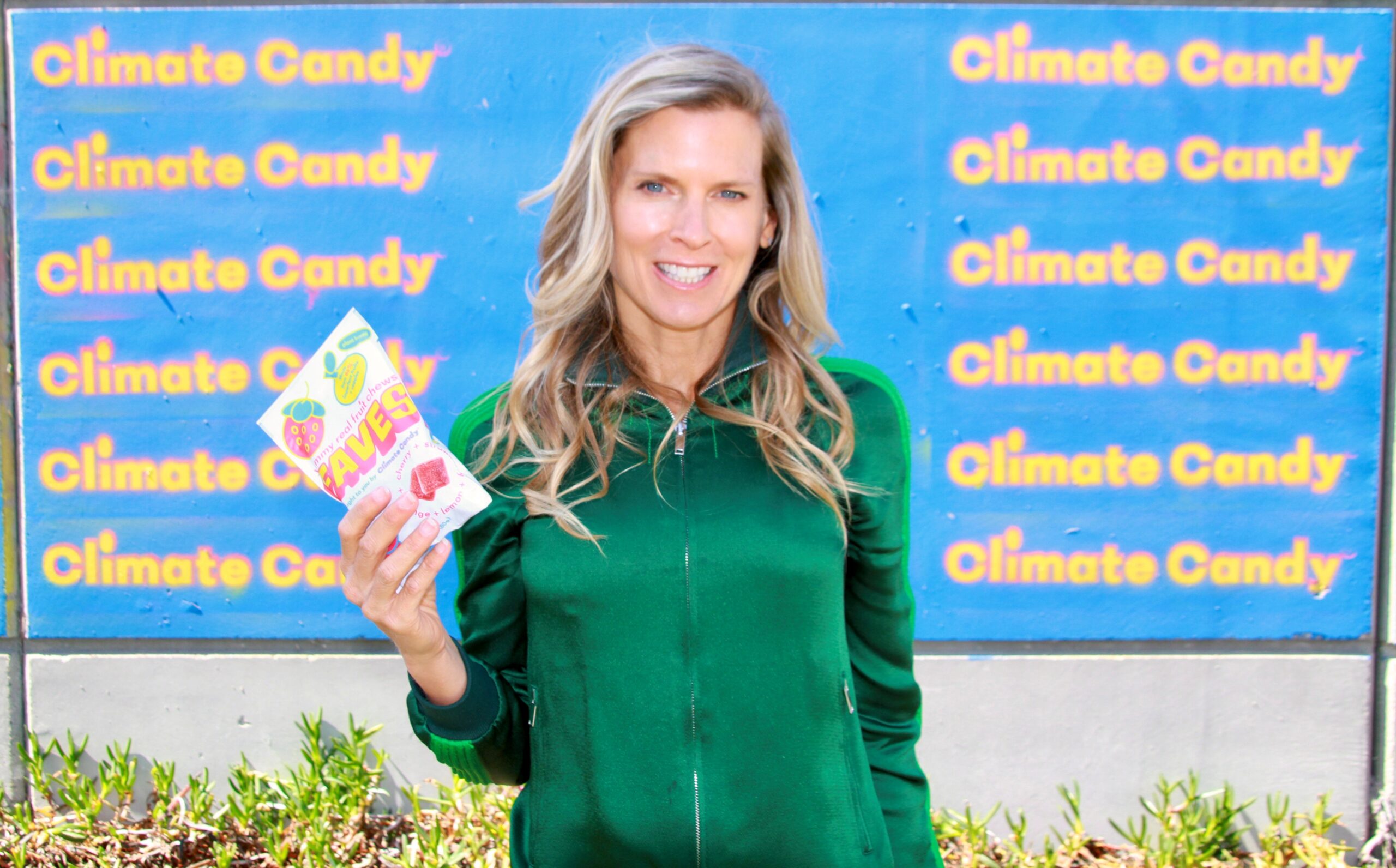
The great, great-granddaughter of the founder of Spangler Candy Co., the inventor of the Dum- Dums lollipop, had a smart idea for a contemporary candy company. Amy Keller launched Climate Candy with a plant-based product and sustainable packaging that satisfies sweet tooth consumers and protects the environment.
“The solution to heal ourselves as a planet is really what we choose to eat, which includes all of us,” said Keller. “Literally, while I was in the Arctic Circle, I wrote the business plan for making something out of imperfect fruits and vegetables to help the people on the planet, and came up with Climate Candy.”
Faves is a candy chew made sweet from only imperfect fruit and veggies with no sugars or fillers. Available in a variety of flavors, they are non-GMO, gluten and allergen-free and have an 18-month shelf life. The candy comes in bulk or PCR , compostable, or paper packaging and was the winner
of the Google Single-Use-Plastic Challenge. The kraft paper packs divert more than 92K pounds of waste from landfills each year.
“Did you ever think that you could buy something like candy, and it can be something that helps us?” Keller asked. “We’re wasting so much food, and running out
of land, water and healthy soil. With climate change escalating and people going hungry, it just doesn’t make any sense to lose this food.”
The brand launched in late 2023 and has been introduced at summer music festivals including Lollapalooza, NBA and NFL training camp athlete boxes and the Amex store at the U.S. Open. They are also available in corporate offices, airports and hotels and expanding to airlines in 2025.
“A lot of procurement partners realize, ‘Wow, because I chose this over other brands, I have an effect on the amount of cropland saved, the gallons of water saved, the amount of packaging I’m saving,’” Keller said. “And then rescuing this number of fruits and vegetables helps the farmers, because they’re imperfect.”
FREE
 Daily Pulse
Subscribe
Daily Pulse
Subscribe
 Daily Pulse
Subscribe
Daily Pulse
Subscribe