
North Carolina In My Mind: Rhiannon Giddens Talks New Album & Curating Biscuits & Banjos Festival

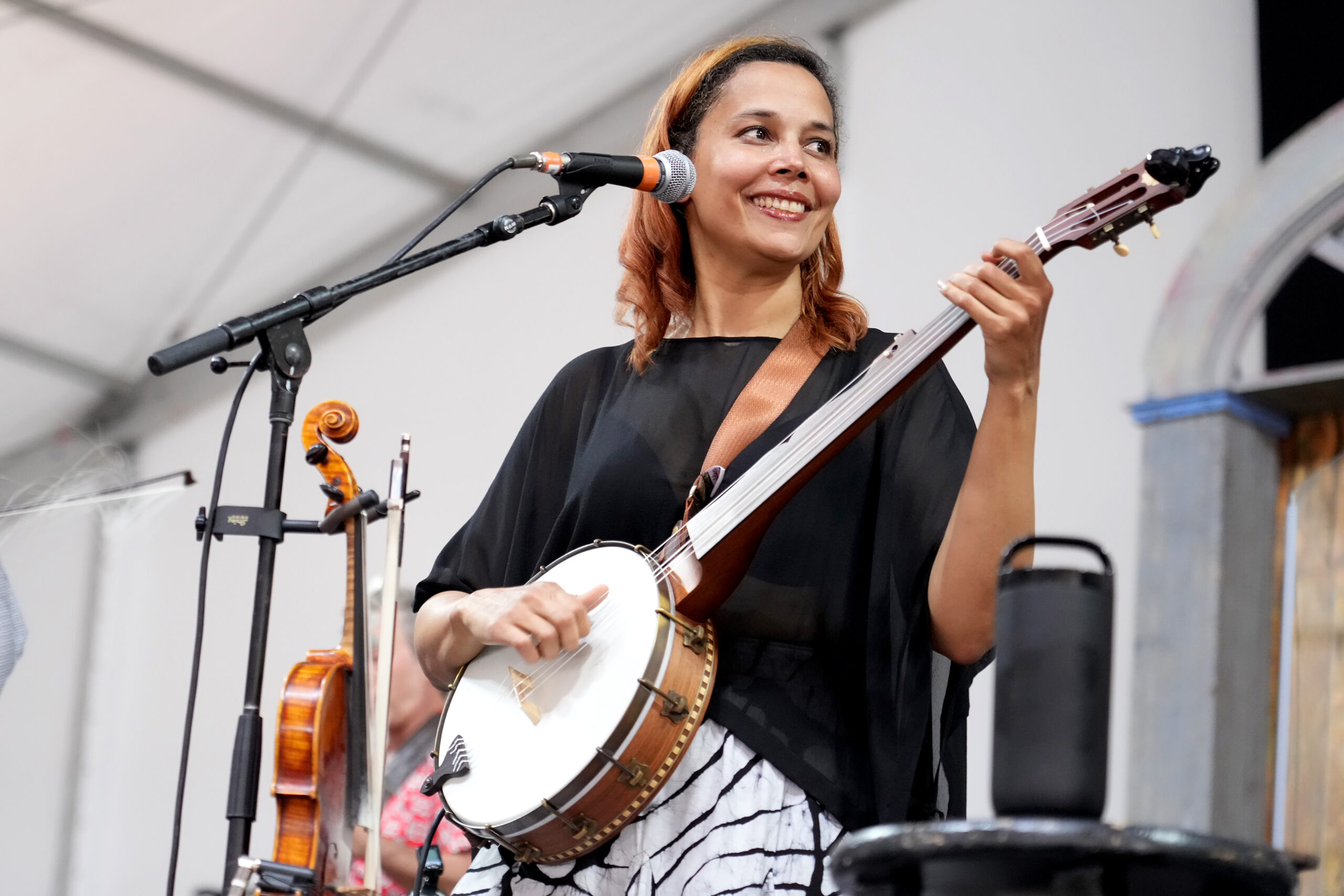
North Carolina’s state motto, “Esse quam videri,” which means “To be, rather than to seem,” is personified by the authenticity and integrity of polymath extraordinaire Rhiannon Giddens. From composing music for the Nashville Ballet to bringing the banjo to the masses with a feature on Beyoncé’s “Texas Hold ’Em” to winning the Pulitzer Prize for co-writing the opera “Omar,” Giddens is somehow ever expanding yet always true to herself. The Grammy Award-winning multi-instrumentalist and recipient of the MacArthur “genius grant” has two new projects centered around the love of her home state: an album released earlier this month and the debut of her Biscuits & Banjos festival.
Giddens teamed up with Justin Robinson for the collaborative album What Did the Blackbird Say to the Crow, which was released April 18 via Nonesuch Records. With Giddens on banjo and Robinson on fiddle, the 18-track album highlights the Black string band tradition of North Carolina and includes many tunes the duo first learned from old-time fiddle player Joe Thompson.
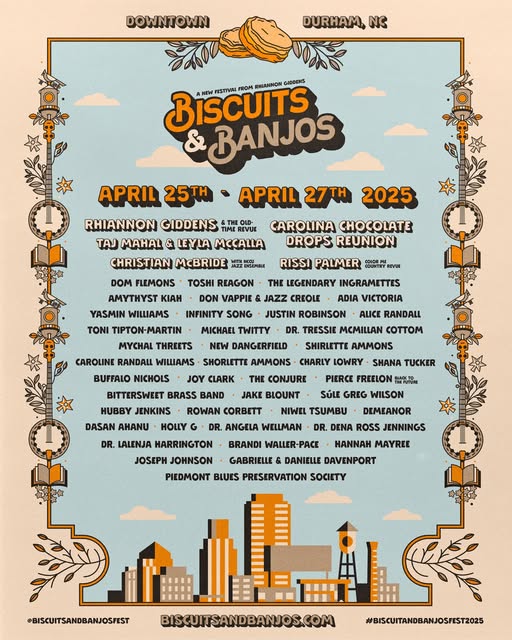
The inaugural Biscuits & Banjos is described as “a tribute to North Carolina’s Black cultural legacy and the role of Black string band music in shaping American roots traditions.” The nonprofit, community-responsive event takes place April 25-27, 2025, in multiple venues in downtown Durham, North Carolina. Though the ticketed portion of the festival is sold out, free programming will include musical performances, artist panels and film screenings.
In addition to curating the festival, Giddens will take the stage, joined by her new band, The Old-Time Revue, as well as reuniting with the Carolina Chocolate Drops for the group’s first performance (with all original and key members) in more than a decade. She’ll also speak on the panel “Black Voices In Country Music,” along with Rissi Palmer and Alice Randall, and help judge which biscuit will be crowned the winner of the Biscuit Trail Competition during the “Art of the Biscuit” panel, celebrating Southern food culture and traditions.
The lineup for the festival includes Taj Mahal, Adia Victoria, Leyla McCalla, Infinity Song, Don Vappie & Jazz Creole, and Toshi Reagon.
Funding for the event was made possible in part by the North Carolina Department of Natural and Cultural Resources, the National Endowment for the Arts, North Carolina Humanities, the City of Durham, Durham County and North Carolina Arts Council, along with a number of individual donors and community partners.
Following the festival, the “Rhiannon Giddens & The Old-Time Revue Tour” has shows booked from late April through the end of July. The routing includes stops in Atlanta, Nashville, Toronto, Seattle, Denver and a June 18 performance at Los Angeles’ Hollywood Bowl with special guests Our Native Daughters, as well as Steve Martin, Ed Helms and more.
Giddens, who was featured on the cover of Pollstar in early 2024, is booked by outer/most in North America and managed by Red Light Management‘s Megan Frestedt and Alex Kadvan. She released her third solo album, You’re the One, in 2023. She’s described the 12-track album as “American music: Blues, jazz, Cajun, country, gospel, and rock—it’s all there.”
Pollstar: Congratulations on the festival and the new album! Let’s start with the festival. Biscuits and Banjos launches later this month in your home state, and I was wondering if you could talk about your personal connection to Durham and what the city’s musical heritage and culture are like.
Rhiannon Giddens: I have a couple of different connections to Durham. Other than just being a North Carolinian, I went to school at the School of Science and Mathematics, which is down the street from Duke University. It’s a residential school that you go to for 11th and 12th grade. And then when the Chocolate Drops were just forming, when we were just in the beginning, me, Dom [Flemons] and Justin [Robinson] were just little baby musicians (laughs). I lived in Durham, and Dom came over from Flagstaff, and then Justin was living in Chapel Hill, or maybe he was living in Durham. We were all living in the area. So, Durham was a big part of just how we got started as a band—Durham, Chapel Hill, Carrboro. So, just the whole Triangle Area, and then also just learning more about it as a historically Black city – it still is, but obviously demographics are changing and all of the things that are happening all over the country. But there was a very well-known and important Black middle class there.
How did you approach curating the festival?
It’s a cultural festival, really. Music is very important, and also food. And for me, I just wanted to pay respect and homage to the people who are kind of doing cultural excavations within their work, whether they’re musicians or [work in] foodway. … I [thought], wouldn’t it be cool to have a festival and just put all these awesome people who were doing kind of similar work to me, and have a big party together. I was thinking who are also going to be enriched by the other people who are going to be [there] so that if you’re an artist and you’re coming to Biscuits & Banjos as a performer, you’re also going to see a lot of your friends or you’re going to want to hang out. It’s not really you just come and do your gig and leave. It’s like come, hang out, stay for an extra day, and then also thinking about making it a real cultural, a real community festival, really working with people from Durham.
We were very clear from the beginning: we do not want this to be an extractive mercantilist, capitalist festival. We had to deal with money within the system, but we wanted it to be something that people from Durham would feel good about. My team is working on it, but everybody else, from the producer down to graphics, to so many of the things that are involved, are all North Carolina-based. It wasn’t a matter of us coming in, setting up shop and then taking it all away again. We want to build these friendships and relationships for the future.
It was really neat how the event was described as a nonprofit, community-responsive festival, and that some of the programming is free to the public. It seems like making sure the community is included is a big part of the event.
Definitely. Otherwise, what’s the point? We need that more than ever right now. It’s just the idea that we can come together and do what humans do really well. We do lots of things, but part of those things are violent and terrible (laughs), but we also do joyful things really well, which is why we have the culture that we have. Let’s celebrate that.
How did you decide on the name for the festival?
I love biscuits, and I love bananjos. I used to work in marketing, and it was just like “Biscuits & Banjos” — that’s it right there. It was a concept before it was the festival. When I thought about making a festival, I was like, “It’s got to be Biscuits & Banjos, and we got to talk about food ways” because what I noticed is that a lot of people are doing very similar work to what I’m doing and other people are doing in the music arena they’re doing with food and looking at our food ways and how they’re made up of all the people who are around. It’s really important to untangle some of the threads that go into our food to understand how our societies have come about.
Biscuits and Banjos will feature a Carolina Chocolate Drops reunion, marking their first public performance in more than a decade. I’m assuming you’re rehearsing. What’s it been like getting the band back together for this?
It’ll be the first time that the original trio has been together since Justin left in 2012. The band kept on going, and a lot of those members are going to come back, which is awesome, but the original trio definitely dates back 20 years. We met at the Black Banjo Gathering, which happened in Boone 20 years ago and became the Carolina Chocolate Drops the fall of that year. I haven’t seen Dom since he left the band a few years after that.
It’ll be really cool to get back and play these tunes, which we haven’t played in forever, but they’re going to be there. We played so much when we were together, and Justin and I have been playing together, so it should be like getting back on a bike. It’s going to be great, and Dom’s been doing such great work. We’ve all been doing related work in our own corners. It’s not like one of us went off and did techno (laughs).
Along with the music, the festival features some insightful panels, including one you’re speaking on, “Black Voices In Country Music.” Anything you wanted to mention about that conversation or any other panels?
The panels are going to be great. There are so many people. I’m just going to hang out because I like those folks. I like all the folks. I’m just excited for people to come and enjoy some really smart folks who have been doing a lot of thinking on these things. The original Black Banjo Gathering, which was 20 years ago, had panels in addition to performances. So this is kind of in a way of paying respect to that. It’s not Black Banjo Gathering 2025. Man, that was such a big thing for us that it’s like a thank you to that original event.
You answered my next question then because I was going to ask if there were any events that you took inspiration from.
Yeah, definitely [Black Banjo Gathering]. That was spearheaded by Tony Thomas and Cece Conway. I helped organize that back in the day, but those two and many other people had a vision … and without that, we wouldn’t be here.
Your new album, What Did the Blackbird Say to the Crow, was released April 18. Anything you can share about working with Justin on the LP and the recording process?
Speaking of getting back up on a bicycle. To play these tunes, we kind of realize that we have a special thing together because we learned at the feet of Joe Thompson [and] learned how to play old-time music with him. It’s not like the two of us have been playing old-time music since we were 5 and we just learned some of his tunes. How we came about as instrumental musicians is hugely influenced by playing with Joe. There’s a feel to the way we play together that is special and unique for us both. I really wanted to showcase fiddle and banjo music, and let the banjo be without a guitar and bass to let it inhabit a world that it used to inhabit a lot.
I also wanted to showcase Justin’s fiddling. Somebody was asking me why I don’t sing. I was like, “Justin knows all the songs, so I don’t need to sing these.” I sing all the time. I sang all on the last record. I’ll sing on the next record; I don’t need to sing on this. His fiddling is so special, it’s a real old style, and he’s cultivated that. He’s not really been interested in reaching outside of that. He’s like, “This is the music I play.” And that’s kind of an old-fashioned attitude. It’s also my attitude about old-time music. I don’t learn a bunch of new tunes. I’m not learning stuff from Missouri and this and that. I’m like, “This is what I play, This is the way I play. These are the tunes I play. I don’t need to learn 40 million more tunes to prove anything”. If you want this kind of music, hire us. If you don’t, then hire somebody else.
The idea that place and time and all of that really affect, and used to affect a lot more, the kind of music you played where you were, who you learned from — we’ve just doubled down on that. … We’re just kind of holding down the fort. You just get together and get on a porch and play the tune through for a few minutes, and then play the next one. That’s it. That’s what it would be like if we were sitting down next to you. We wouldn’t be like, “How do we arrange this?” We’re just going to play the tune.
I love what you said about the importance of time and place because that’s showcased so beautifully in the songs you chose, and also these music videos that you’ve released so far, just giving a sense of place. The song “Going to Raleigh” was recorded at a historic former plantation, and knowing the significance of the location makes it even more touching. How did you decide upon this location, and what was the experience like for you recording there?
It was a little intense. We had three days total. We had one day in each location, and we picked the tunes we’re going to do in each location, and the first two were easy because it was Etta Baker’s house and Joe Thompson’s house. We were [there] with the blessing of their relatives – Etta Baker’s son Edgar and Joe Thompson’s nephew.
Then we went to Mill Prong, and that was a very different vibe, and those folks who run that are very nice. It’s nothing to do with them; it’s just that the energy of the place was intense. We started by the river, and that’s where “Going to Raleigh” was recorded. We set up there, and there was something about thinking about the generations of people who were there before us, who worked on that plantation coming down to the river just for a moment. And to hear the same water that they heard, the same kind of birds that they heard, and to have the freedom to get in our car and drive down there and pull out a fiddle and a banjo, make a recording, where those folks were working for their lives all day in and out — this is a privilege. And feeling that responsibility and being grateful, but also just feeling it was a lot.
With the videos in mind, Alexi did a really great job. Orally, I wanted it to be [like] we just sat down next to you and played a tune, but also visually it’s not like a bunch of cuts and swooping in and drones or whatever. It’s just like two of us playing.
Yeah, that was neat.
Because the thing is there’s just not a lot of that at the moment. It feels like with AI coming in, there’s a lot of anonymity and rootlessness to a lot of the music now. It’s like globalism is great in some ways because I can sit here and listen to something from Armenia, or I can get down with a band from Australia. That’s the good side. The dark side is that you have no connection. The music doesn’t have a connection for you. If you didn’t make it, you listen to it, but what does it mean?
For millennia, music has always accompanied a person, a personality and a connection to some sort of history. It’s only in the last hundred years that we have separated music from its maker and put it into technology. It’s a massive shift, and we haven’t really thought about what that means. It’s kind of weird because I’m talking about making a record, but how do we use this technology to try to think back a little bit more? It’s recorded beautifully, but it still is one mic on the banjo, one mic on the voice, one mic on the fiddle, and a couple of mics for the locusts. How do we use it in a way to reinforce time and place?
It’s definitely a challenge, but I felt very strongly about it because AI … is destroying a lot of artistic disciplines right now. And people won’t know until they’re gone what happened. This is part of my futile walking against the tide, I guess — trying to scoop out the water with a spoon that’s coming into the boat just to make a record.
I think that’s so cool again that you’ve incorporated nature into the videos, and how they also feel very human and real. I think that’s why the music and the videos are touching people’s hearts.
And there’s no makeup. There was no coordination of outfits. I mean, there are times I’m looking at my hair and I’m like, “Oh my god, what was I thinking?” But we were just there to play, and we were recording those moments, but it wasn’t for the camera, and there’s a difference. To be able to put all this out on a major label is kind of amazing.
Yeah, that’s wonderful. And so you mentioned that one of the tracks, “Hook and Line,” was filmed at your late mentor Joe Thompson’s house. What was it like being mentored by him?
We were really lucky to catch him toward the end of his life. He was 86; he died when he was 93. We would go down and play with him for hours and learn his tunes, play the same tunes over and over again, hear the same stories, and it was such an honor. It’s one of those things that the older you get, the more you realize how priceless that was. I had come back from Oberlin to the triangle triad, and Justin happened to hear about the Black Banjo Gathering in his car. He turned around and drove like a bat out of hell to meet Joe Thompson. I was working a corporate job, Justin was a paralegal, Dom was working at a restaurant, and it was an old-fashioned apprenticeship. We’re just playing, and he’s just telling us stories, and if we know when we get it.
The album includes, as you mentioned, a cover of Etta Baker’s “Marching Bird,” which was filmed at her home. It’s such a beautiful song. What drew you to this tune?
Justin had been playing it on the banjo, and I was like, “Oh my god, that’s gorgeous. We have to play that.” And we had planned to go to her house, and the whole experience was surreal because she basically walked out and never came back. It literally looks like it did when she was living there. For both of us it was like, “Oh my God, this could be grandma’s house.” Then her son was there telling us stories, and it was a special moment. Most of the other things we recorded at that location were done in her garden with the birds, but we did [“Marching Bird”] in her living room, and it was a special kind of vibe because that’s where she recorded so many things. So much happened in that living room. There was a recording of Etta, I think it was on “Music Maker,” where she was playing a tune and you can hear the birds. It was recorded outside, and both of us had that in our minds, thinking about this recording as an inspiration.
How did you approach production and the band’s lineup on your upcoming tour?
This was a really exciting prospect to put together my dream old-time band because I got started doing this kind of music. I was a singer first, and I’ve done lots of different things, but it was an opportunity to come back to my foundational basics and also bring some of the folks that I’ve made musical relationships with over the years. Dirk Pal, a legend within the old-time and Cajun communities, an incredible multi-instrumentalist and also co-producer of our Native Daughters as well as Freedom Highway, and his daughter, who’s a granddaughter of Dewey Balfa, a huge force in Cajun music — the two of them have been playing together, and then bringing my nephew [Justin], who is the only banjo-playing rapper in the world. The two of them represent the next generation of people who are connected to these traditional styles. [My nephew] Justin was 5 years old at the Black Banjo Gathering and got his first pair of bones when he was 5. He’s playing bones on the record that I made with Justin Robinson, so this is full circle stuff and family because that’s also important. And then, of course, me and Justin Robinson and Jason Cipher. Jason has been along for the ride for the longest of anybody. It’s a really special lineup.
And so I feel really proud that this band represents a really important piece of where American culture comes from. And it’s just going to be kickass (laughs). No drums, no electronics. I mean, we obviously won’t just be playing old-time music, but we’re gonna be really rocking it.
Looking at the routing of your tour, a big show is your June 18th stop at the Hollywood Bowl in Los Angeles, joined by special guest Native Daughters. That’s your first performance with the group since 2022. And then there’s also going to be Steve Martin, Ed Helms, and more.
I’m excited about that show just because it’ll be the first time I’ve really been on the same stage with Steve. I mean, we’ve crossed paths multiple times, and I won his award, and he’s bringing Allison Brown. It’s just going to be a kickass night, and Ed has been such a champion of bluegrass for so long. It just kind of felt like it would be really neat to put these folks together, and then, of course, Native Daughters, our first reunion since our sold-out show at Carnegie Hall. Each one of them has been doing incredible work in the last five years, and it’ll be a chance for each of them to shine.
And then, we’re going to be at the Anthem in D.C. That’s my first time there. It’s a big rock club, so it’s going to be interesting. [We] figured out a way to be in a space where all of my fan base is going to feel welcome and to have that go on. And then, it’s always exciting to go back to the Ryman. There’s a lot of good stuff.
READ MORE:
From Banjos To Ballet: The Nerdy Genius Of Rhiannon Giddens
FREE
 Daily Pulse
Subscribe
Daily Pulse
Subscribe
 Daily Pulse
Subscribe
Daily Pulse
Subscribe