
No Fallow Season Across The Pond: Europe’s Extended Touring Season Keeps Industry Trucking
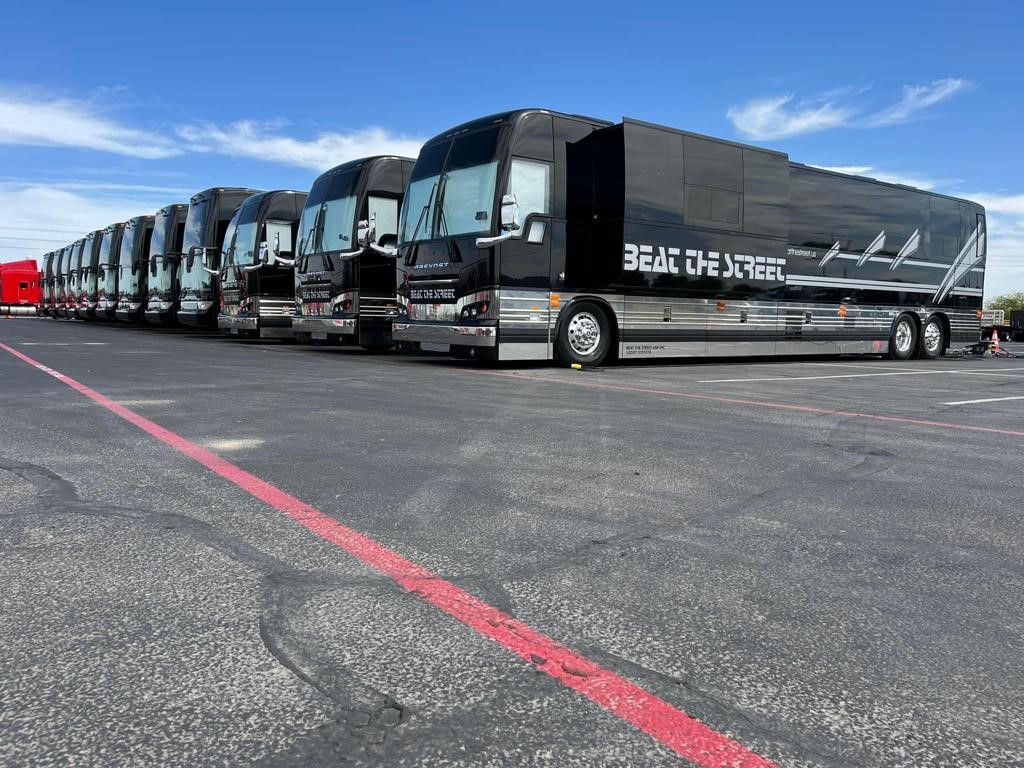
For the touring transportation business, the notion of a quiet or fallow period is increasingly a relic of the past. Demand is not just booming; it is stretching out across the entire year.
“Specifically on the music touring side, it’s incredibly buoyant,” says Julie Black, manager of executive aviation at UK-based Hunt & Palmer (owners of Premier Aviation), about current aeronautic bookings. “We’re having yet another whopping year already.”
Jörg Philipp, owner and MD of Beat The Street, says road transport is equally in demand at the moment. “We’ve been really busy from January onwards, when normally January is a bit quiet,” he notes of business in the UK, Europe and the U.S., across all sizes of tours, from those using one bus all the way up to multi-vehicle mega-tours.
“What is new is that we are really busy going into September, October and November already,” he says. “Normally, you’d have had a natural break in September for maybe two weeks before regular touring started again.” Such peaks and troughs in demand are becoming rarer.
With fuel costs rising, there is some concern about transport hungrily eating into touring profits. Black says, counter to this, “There are areas in which aircraft charter does deliver greater value” for touring parties. She adds that air travel can eradicate many of the issues UK acts, in the years since Brexit, normally face with ground transportation in the EU, especially when having to cross multiple borders.
Even so, Black says, “In terms of operating airplanes around Europe and within the UK, Brexit has given us a complete headache. If you’re a French airliner, you can’t fly domestically within the UK; and if you’re a British airliner, you can’t fly domestically within the EU. When the UK was part of the EU, that wasn’t an issue. Now, everything is subject to permits and permissions. And that all takes time.”
Philipp damningly calls Brexit “that bullshit idea” that “makes your life much harder,” pointing to the mountains of paperwork and carnets caused by its implementation. “It’s a massive, massive increase in costs just because of Brexit.”
He also says the “90 days in 180 days” rule – meaning British crew members can only work in EU territories for a maximum of 90 days within any 180-day period – causes considerable logistical problems for non-EU staff to tour the EU. Many acts are looking to make their touring as green as possible and are putting measures in place to achieve this. Leading the way are Coldplay, who announced in 2024 that they had reduced their touring carbon footprint by 59% compared with their previous world tour.
Black says that the aviation industry is “very visual” in terms of its carbon footprint, but that doesn’t mean flying is more environmentally damaging than “putting 30 trucks and 30 buses on the road” for a big tour. She adds, “Sustainable aviation fuel, which is basically a biofuel blend, is now available in many airports around the world.”
For Philipp, there is a desire for buses to be greener (by converting fleets to be fully electric), but the wider infrastructure to support it is not yet advanced enough to charge and service a full fleet of buses in a timely manner.
Black says the biggest challenges affecting aviation at the moment are airport access and no-fly zones. “As governments, local authorities and residents seek to improve things in local communities, often one of the first things to do is to make airport opening hours more restrictive. Lots of airports now have curfews when they never used to have them.”
Black, however, notes tours they work on in Asia and South America include many more stops than before. “We just did a tour of 12 countries around South America, including a couple we hadn’t chartered into before,” she said.
The ongoing conflicts in both Ukraine and Gaza are also having huge repercussions, particularly for air travel. “It does seem to be fairly well managed, but, obviously, any kind of conflict in the world is going to cause a great deal of uncertainty for people,” Black says.
As touring gets longer, it becomes exponentially more complicated and, in geopolitical terms, more uncertain. This is why, Black insists, working with well-established experts in the area has never been more critical.
“You need to know you’ve got an experienced operating partner,” she says. “You need to know that somebody’s got your back, and that’s where companies like ours come into their own. I’ve never had an artist miss a show yet.”
FREE
 Daily Pulse
Subscribe
Daily Pulse
Subscribe
 Daily Pulse
Subscribe
Daily Pulse
Subscribe