
Fighting The Good Fight: NITO Celebrates 5 Years Representing Indie Agents & Managers Battles On
A lot has happened in the more than five years since High Road Touring’s Frank Riley and a cadre of independent music agents founded the National Independent Talent Organization. The industry association and advocacy group for music agents and managers most impactfully helped talent reps obtain a whopping $900 million cut of the federal Shuttered Venue Operators Grants program that proved indispensable both for talent reps and the live industry’s post-pandemic return.
“If the Shuttered Venues act had come out without artist representatives being included in that bill, the industry would not have come back as quickly as it did,” says Nathaniel Marro, NITO’s executive director. “There would have been a lot more chaos, a lot more confusion. It would have been a very slow rebuild because if you look at our side of the business, those offices were going to close.”
Since then, NITO’s membership has grown ten-fold with 144 members companies split between managers and agents and more than 1,000 employees, and its mission has continued to evolve. The group is now focused on myriad issues critical to artists and their reps including ticketing reform, insurance affordability, clear contract negotiations, fairness with Performance Rights Organizations and artist visas, among other issues.
From the outset, NITO worked closely with the National Independent Venue Association, which spearheaded the federal government’s $16.25 billion SVOG program. “When I started the whole thing,” Riley recalls, “I went to Dayna (Frank, of First Avenue and the first NIVA board president) and asked her, ‘Should we join NIVA collectively or have our own organization?’ And she said, ‘Frank, talk to Casey (Higgins of Akin Gump), our lobbyist, and ask her that question.’ Casey said, ‘You should have your own voice. If you have your own voice, you can work with NIVA in a coordinated way and can also speak for your own organization.’ That’s why NITO formed.”
The team of 16 independent agents Riley initially brought in to form NITO represented an industry cross-section with each founder putting up $4,000 to build the organization. This included Entourage Talent’s Wayne Forte, Ground Control Touring’s Eric Dimenstein, Leave Home Booking’s Stormy Shepherd, Madison House’s Nadia Prescher, Mongrel Music’s Brad Madison, New Frontier Touring’s Paul Lohr, Partisan Arts’ Tom Chauncey and Hank Sacks, Pinnacle Entertainment’s Scott Sokol, Skyline Artists Agency’s Mark Lourie and Bruce Houghton, Sound Talent Group’s Dave Shapiro (who passed away last month), The Kurland Agency’s Ted Kurland and Jack Randall and TKO’s Steve Schenck
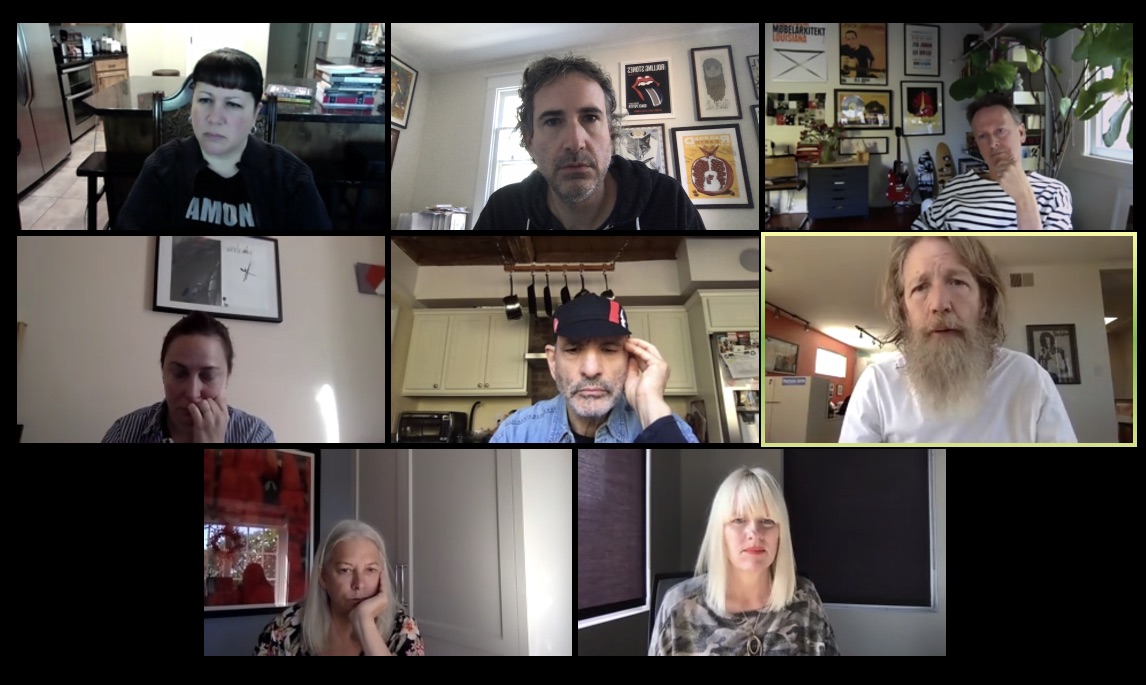
“I was sitting in my kitchen on a conference call when we decided to form an organization,” says Forte, who is also NITO board president and one of the organization’s driving forces. “So aside from needing the money for lobbyists, we needed an attorney. We needed to form a nonprofit. We needed an accountant. We had to file with the IRS. There were a lot of steps we had to take and we needed money to do that. It was a scary time, but honestly it was like we could be out of business any day and didn’t know what was going to happen.”
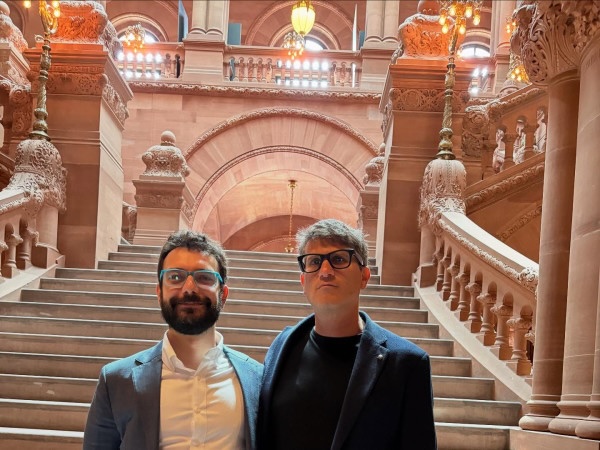
IN THE HALLS OF POWER: NITO Executive Director Nathaniel
Marro and Randy Nichols, head of NITO’s Ticketing Task Force
in Albany where they met with New York state representatives
to discuss a proposed
While agents and managers’ interests often align around touring, it was ultimately the tax code that led to the two uniting under the NITO banner.
“Managers in the beginning were not involved because we were not operating under this NAISC (North American Industry Classification System) code which talent representatives fall under,” says Marro, who when we speak is on a text chain with a New York state senator discussing ticketing. “Our lobbyists we’re like, ‘Well, you have to fall within something in order to have an organization.’ That’s why we started following NAISC code and realized managers were part of the same code.” NITO then opened its doors to managers.
“I first met Hank Sacks (of Partisan Arts and a NITO board member) as SVOG was getting worked out,” says Fielding Logan, a manager at Q Prime South who oversees touring for acts including Eric Church, Brothers Osborne and others and is on NITO’s board. “There was a time where no one really understood exactly what it was, who could apply and who would benefit. There were some board members in NITO who helped our company understand the lay of the land. The work that they did alongside other stakeholders was huge.”
Today, with SVOG in the rearview (mostly) and the live industry transitioning from the bottom falling out to a “Golden Age of Live” to an uneven economic landscape, NITO’s mission has evolved and the group is now working on several critical issues facing artists and their reps.
“Ticketing is one of our major issues,” says Forte, “because it affects everybody. It affects the fans. It affects the artists. We spent a lot of time researching the numbers and putting out these reports and getting them to stakeholders.”
NITO’s ticketing report showed that on the secondary market resale tickets on average are two times more than face value. “There’s more money being made by the secondary market sellers than the artists are making,” Forte says. “That’s the bottom line. And those secondary and speculative ticket companies for the most part are backed by private equity. That’s one of the things we found out when we started digging in.”
“We were invited to a closed-door discussion with the Justice Department to talk about unfair practices in the live event marketplace, including ticketing,” Forte continues. “Nathaniel and Randy (Nichols, NITO’s ticketing guru) went up to Albany. They met with politicians. Members gave oral testimony in California, Maryland, New York regarding ticketing legislation. We helped ban speculative tickets and deceptive practices in Maryland and Minnesota. Unfortunately, it’s got to go state by state here. We can’t just do it all nationally.”
In addition to ticketing, NITO’s worked on affordable solutions for touring insurance, which increasingly more venues and festivals require. “People were asking for proof of insurance before you went on the road,” Marro says. “For a lot of bands of a certain size it was too expensive or something no one had ever asked for. But it’s become more and more of an issue. We reached out to Epic Brokers and came up with a very affordable option, an annual policy that’s around $1,700-$1,800 and it covers the entire year and works for anyone averaging 2,500 tickets and below.”
NITO is also helping members with standard contracting terms. “We had Live Nation and AEG sending us back contracts that were completely crossed out,” Marro says. “What the majors do is have these pre-negotiated terms and conditions. So we did the same for our members and negotiated terms and conditions that they accept and anyone in NITO can use, which is a huge benefit to folks who are dealing with the overhead of contract administration.”
The advocacy group is also working to make performance rights organizations’ live performance fees more equitable. “We talked to all four of the major PROs about what’s happening with live rates,” Marro says. “You see the breakdown of SESAC, ASCAP, BMI and GMR which adds up collectively to about 2%. There are two issues with that: One, these are collective license agreements, which cover all the recorded music you can think of. So if you play a last-minute cover, you’re fine. But if you’re only playing ASCAP music then why is BMI, CSAC and GMR getting any money that night? We have an issue with that.
“The other side of it is the money you’re supposed to get back from at least your own rights organization—never comes back. Part of the reason that’s happening with live is it’s all manually uploaded, everyone has to report their own set list and upload it into every one of the systems themselves. And that either is or isn’t happening.”
The increasing challenge of obtaining artist visas is another issue NITO’s studying. “We’ve been working on an artist visa group for a while,” Marro says. “We’re looking at a study to see exactly the amount of money that is being generated even within our independent universe from bringing foreign artists here.”
For all of NITO’s work with agents and managers and artists, ultimately NITO’s larger purpose may be its most important accomplishment.
“Fundamentally, the most interesting thing about NITO is we’re shifting the paradigm of collaboratively and collectively working together,” Marro says. “We have all these small companies that before were ‘competitors.’ And there are competitive elements within our industry, for sure, but then we realized that everyone is facing a lot of the same issues. They were all getting contracts back that were completely redlined. They’re all dealing with ticket fees and a secondary market that’s boggling their clients. The fact that we actually have an entity now that can take care of some of these things on their behalf is a huge shift, a huge change. I’ve heard enough people within NITO say, ‘I wish this existed 30 or 40 years ago when I started.’”
FREE
 Daily Pulse
Subscribe
Daily Pulse
Subscribe
 Daily Pulse
Subscribe
Daily Pulse
Subscribe