
The Who Wrap Prolific, Six-Decade Live Career With Farewell Tour
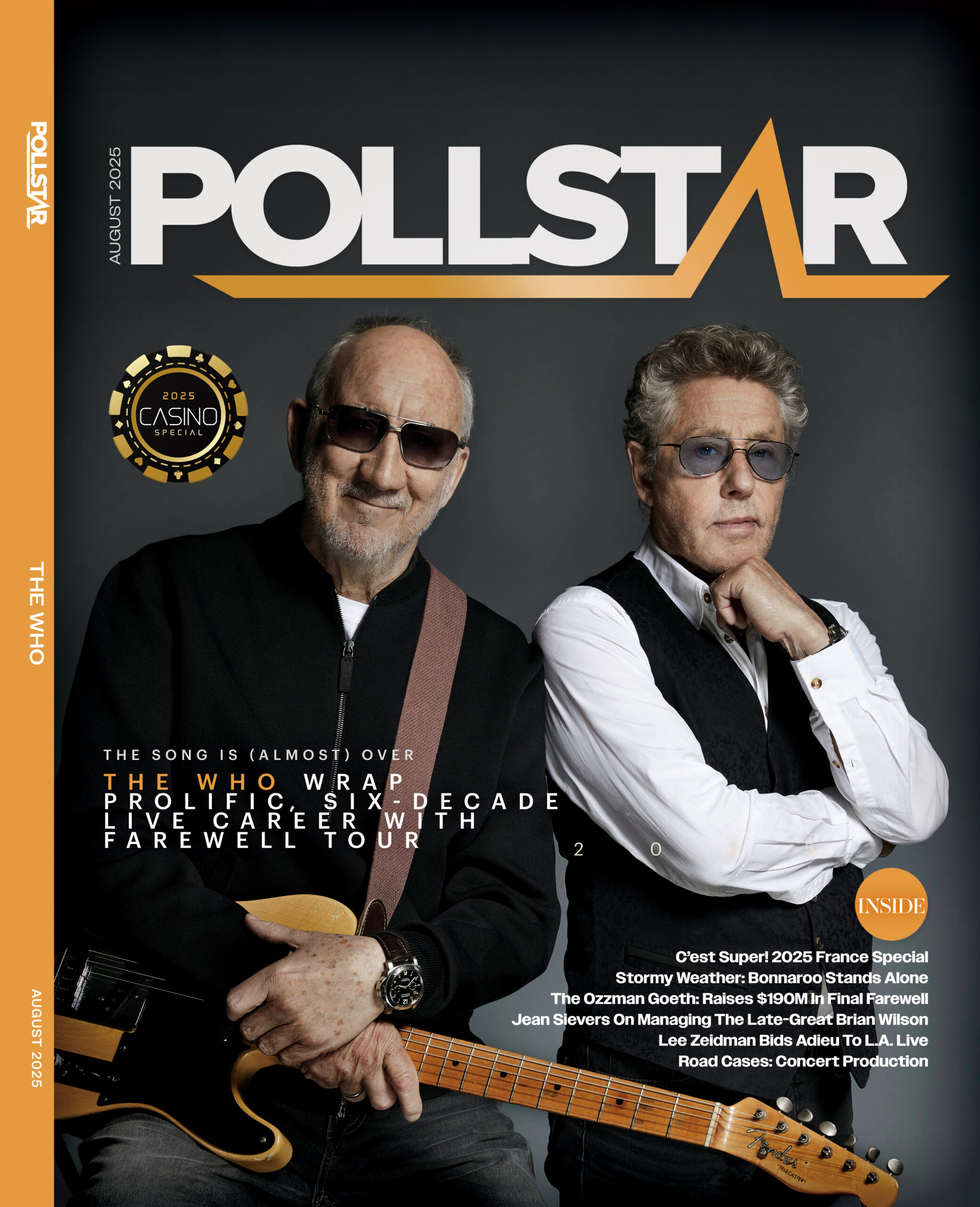
One of the most impactful touring concerns in the history of live music will make its last run with The Who’s final tour of North America, set to begin Aug. 16 at Amerant Bank Arena in Sunrise, Fla.
Billed as “The Song is Over—North American Farewell Tour,” the trek currently stands at nearly 20 shows in 14 cities, including doubles in Toronto, Chicago and Los Angeles so far. Immediate plans call for the tour to wrap North America on Sept. 28 in Las Vegas, though longtime Who manager Bill Curbishley and tour promoter Steve Herman with Live Nation both tell Pollstar further international shows could be in the cards.
Read More: The Who’s Roger Daltrey: ‘‘I F***ing Hate Set Lists’ (The Pollstar Interview)
But for Who fans in America, you better, you better, you bet: this is it. “This definitely will be the last tour of the U.S., that’s for sure,” The Who’s founding front man Roger Daltrey, 81, who with guitarist Pete Townshend, 80, will be the only survivors of the original band standing on stage, stated definitively. “We will not be back touring.”
Without question, the tour will close the routebooks on one of the most influential bands to ever invade American shores. The Who are one of the few bands still working that have been around since Pollstar began documenting ticket sales, reporting more than 400 shows that sold 6.3 million tickets and grossed $360 million worldwide. Live Nation has produced the last decade of The Who’s shows, to the tune of $50 million gross and 434,496 tickets sold to 46 shows reported. That includes an earlier “farewell tour” 43 years ago, a long goodbye that obviously didn’t take.
“Seven years later, Pete came back and said he wanted to work again, so back we went onto the road,” Curbishley recalls with amusement. “I look at this adventure now as being, yeah, it may be an end to actual touring, but they’ll certainly do individual shows. I can’t see them ever stop doing that, especially charitable shows. I can see them picking up and doing odd shows here and there until they decompose.”
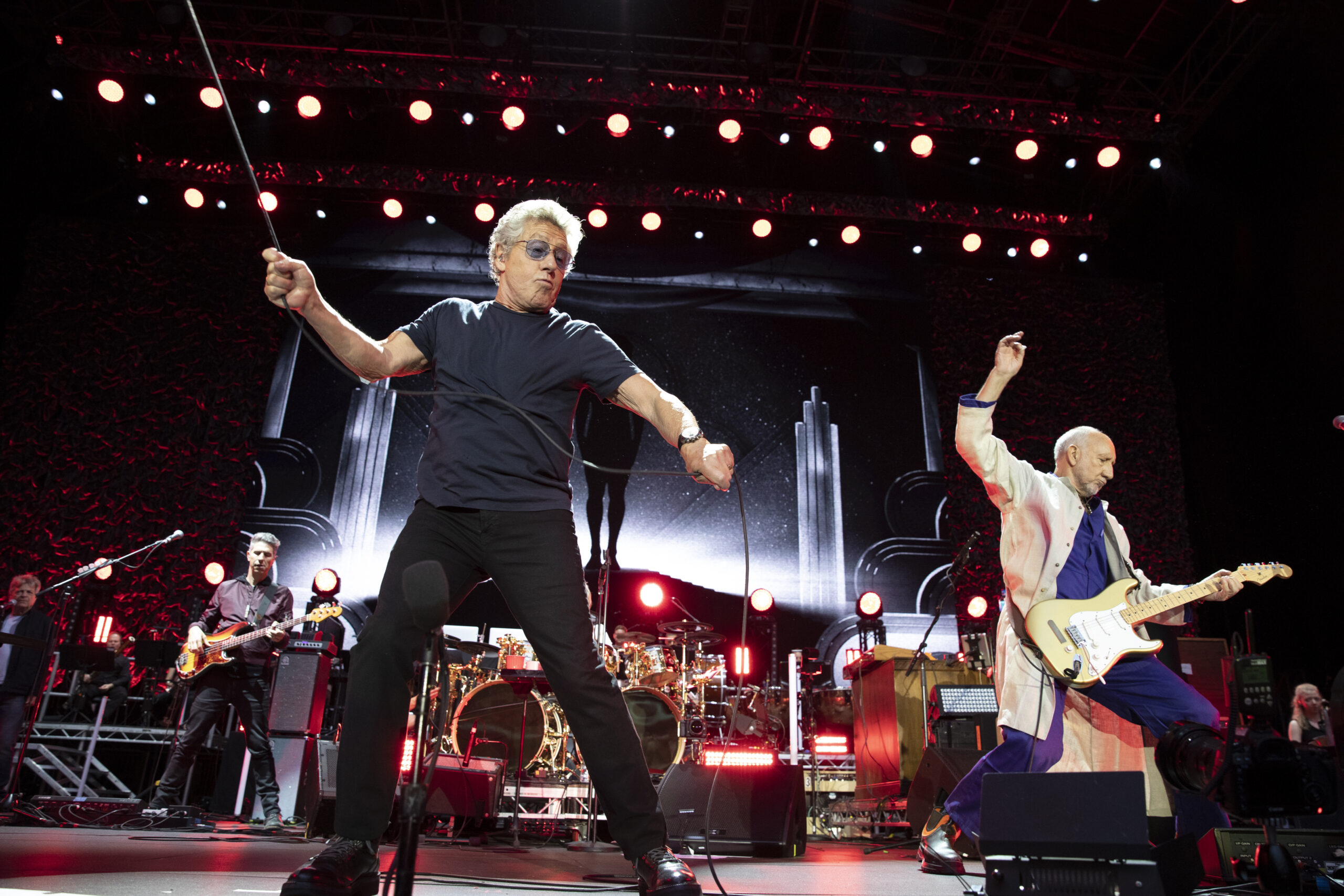
Daltrey said as much in his interview and Curbishley points out that “live” and The Who go hand in hand. “Live is such an important thing to them, it’s part of their DNA,” he says. “They’re an exciting live band; I can’t see them just stopping performing live. It wouldn’t gel. It wouldn’t be right.”
Herman’s own amazing journey with The Who began in 1978 when he hitchhiked from Toronto to Buffalo to see the band in concert, an experience he says “changed his life.” Herman also remembers seeing the band on its first “farewell tour” at Maple Leaf Gardens as a college student. “Now, I have the honor of supporting their farewell tour with Bill. What a full circle moment. One of the greatest rock and roll bands of all time, and I can’t believe that I’m actually promoting their last tour here in North America. It’s just such an opportunity.”
The tour was very thoughtfully routed, maximizing the amount of time the band allotted to spend on the continent with much discussion about “how and where they feel they should play,” Curbishley says. “They’ve got a really good following in most cities,” he points out. “Unfortunately, you can’t play everywhere, but we try and play what we consider not only the very important ones, but ones that are reachable with a short drive from other cities. So strategically that makes sense.”
Ten Of The Who’s All-Time Greatest Live Performances
Initially, Herman says the tour was set at around 10 shows and has steadily added dates. “We’re taking our time, because you have to think about the right places for them, where they are in their careers, or other circumstances,” he explains. “We originally started with four cities, then the idea was to do two shows [in each]. But it grew, because after discussions with Pete and Roger, Bill came back to me and said, ‘Pete would like to do a few more places.’ At the same time, we tried to pick destination places.”
The tour is a mix of arenas like Madison Square Garden (Aug. 30), United Center in Chicago (Sept. 7, 9), and Climate Pledge Arena in Seattle (Sept. 25), and outdoor venues, including Fenway Park in Boston (Aug. 26), Jones Beach Theater in Wantagh, NY (Aug. 28), Budweiser Stage in Toronto (Sept. 2,4), the the Hollywood Bowl (Sept. 17,19), and Shoreline Amphitheatre in Mountain View, Calif. (Sept. 21). Support is a mixed bag, including Billy Bob Thornton & the Boxmasters, Billy Idol, Booker T. Jones, Candlebox, Feist, Joe Bonamassa, the Joe Perry Project, Tom Cochrane and ZZ Ward.
Another consideration in routing is allocating space between shows to allow for the musicians’ consistent vitality, particularly Daltrey’s voice (with Curbishley saying Daltrey is singing “incredibly well” since undergoing vocal cord treatment in 2009.) “They’re not getting any younger, and the way they perform for two hours-plus, you have to have certain days off,” says Curbishley. “Where they used to be able to do two or three in a run, that can’t be done now. They could do a back-to-back here and there, but you have to put days off in between.”
While the last three tours Live Nation has promoted with The Who have been with an orchestra, Herman says these upcoming shows will be straight-ahead rock. “This time they wanted to be a rock tour like it was in the early days,” Herman points out. “There’s no orchestra. It’s stripped down and they’re going to rock. I think this is going to be a more epic ending for this band.”
Curbishley, who has the perspective of decades observing The Who’s audience, says he noticed in the ’80s that the fans were trending younger. “I always go out front to check the sound, check the presentation, check the lights, and I started noticing how many young people were there,” Curbishley recalls. “They’re probably being brought by parents or friends saying, ‘You must see this band.’ Because The Who have always been breaking up from the day they started, I suppose they viewed it as, ‘We’ve got to see this band while we can.’ But they were influencing young people, and their children, to come and see this band while they could. I realized then that we were picking up a younger audience and that’s the way it’s been since.”
Touring America has always been “different,” Curbishley explains, “in as much as there are great venues and far more opportunities. It’s a much bigger country than the UK or any of the countries in Europe, and it offers so much. The USA is really 60% of the world in terms of music sales, and in terms of most things.”
But there’s more to it for a British band breaking in America than size and money, Curbishley continues. “Once you get accepted into America, I think that permeates all the way through to Japan and other countries. It says, ‘This is a band that’s been accepted and branded as a great band.’ You have to be accepted in America or otherwise, that’s it, you’re not complete. I find it great touring America because every area, as I just said, you’ve got great venues, but the audiences are just absolutely great. Fantastic. I’ve got great memories and it’s been wonderful.”
Being close with the band through the formative years of contemporary touring has brought Curbishley, a legend in his own right, into contact with many legends of the live business, including their original North American agent, Frank Barsalona. “I worked for many years with Frank; he was a great, great agent,” Curbishley says. “There’s a lot of promoters around who owe their careers to Frank. He was really creative, forceful, dynamic. We had a great relationship.”
Curbishley also fondly recalls the great promoters of yore, including Bill Graham, Ron Delsener, and others. “I used to bash heads a lot with Bill; we were friends, but I used to bash heads a lot with him, because there was never a moment when he wouldn’t try and take advantage,” Curbishley remembers with amusement. “I’ve got fond memories of Bill and Delsener, yeah, we go back many years. Some of those great promoters, Jack Boyle, Don Law, all great promoters.”
The difference between promoters back in the day and the corporate promotion world is, “You have to admire the fact that they were using their own money,” Curbishley points out. “It wasn’t Live Nation or AEG in those days, it was their money, and they got behind that and they promoted it, and they really worked hard. But in that way, they broke a lot of great bands, as well.”
And, of all the bands that were broken by the legendary promoters that formed the business, The Who remain one of the greatest, both in terms of onstage power and box office clout. Herman says, a month after onsales, the camp is happy with ticket sales in general for “The Song Is Over.”
“We’re ahead of what I thought we’d be at, so I feel pretty good, and we got a lot of stuff to come,” Herman says. “In today’s world, it’s tougher to get the attention, you have to do a lot of different things. I’m bullish that we’ll sell out all the shows.”
While Herman didn’t say as much, fan skepticism about “farewell tours” in general, especially considering The Who have already done one, albeit over 40 years ago, could potentially keep some fans on the fence. “As we get closer to that moment,” Herman says, “I think there’s going to be a pretty big demand for tickets.”
He adds that he’d love to do more shows with The Who. “I’ve been asking, believe me. ‘Hey, why don’t we do a show in Mexico City? Maybe we should do a couple of shows in Europe.’ They are playing a couple of shows in Italy branded in the same way (July 20, 22), but that’s the only thing besides these that are happening right now, and we’re involved in those. I don’t expect them to do too many more shows, but I think there’s a possibility outside of North America that there would be a few stops, if they decide that they like it and it makes sense. I think we take this bite and then we see how we’re doing, if they’re enjoying themselves, that’s the main thing. I think they’re doing this because that’s what they do. I don’t think they’re doing this for any other reason.”
Curbishley says he is “not totally discounting” adding more shows. “If any really important shows came up that appealed to them, I’m sure they would pick up their gear and they’d want to do it,” he says.
Then there’s the matter of saying goodbye to America and then pulling an “Irish exit” for the rest of the world.
“I said to them, ‘Look, you can’t say farewell to North America without saying farewell to the rest of the world.’ You start and end in the UK, but we haven’t structured anything yet. Pete was talking about going to Latin America, maybe Japan, Australia. I really would like them to say farewell to the planet, then get Elon Musk to put them in a rocket and send them somewhere.”
FREE
 Daily Pulse
Subscribe
Daily Pulse
Subscribe
 Daily Pulse
Subscribe
Daily Pulse
Subscribe