
Music City Morphs To Meet Demand (Nashville Market Focus)
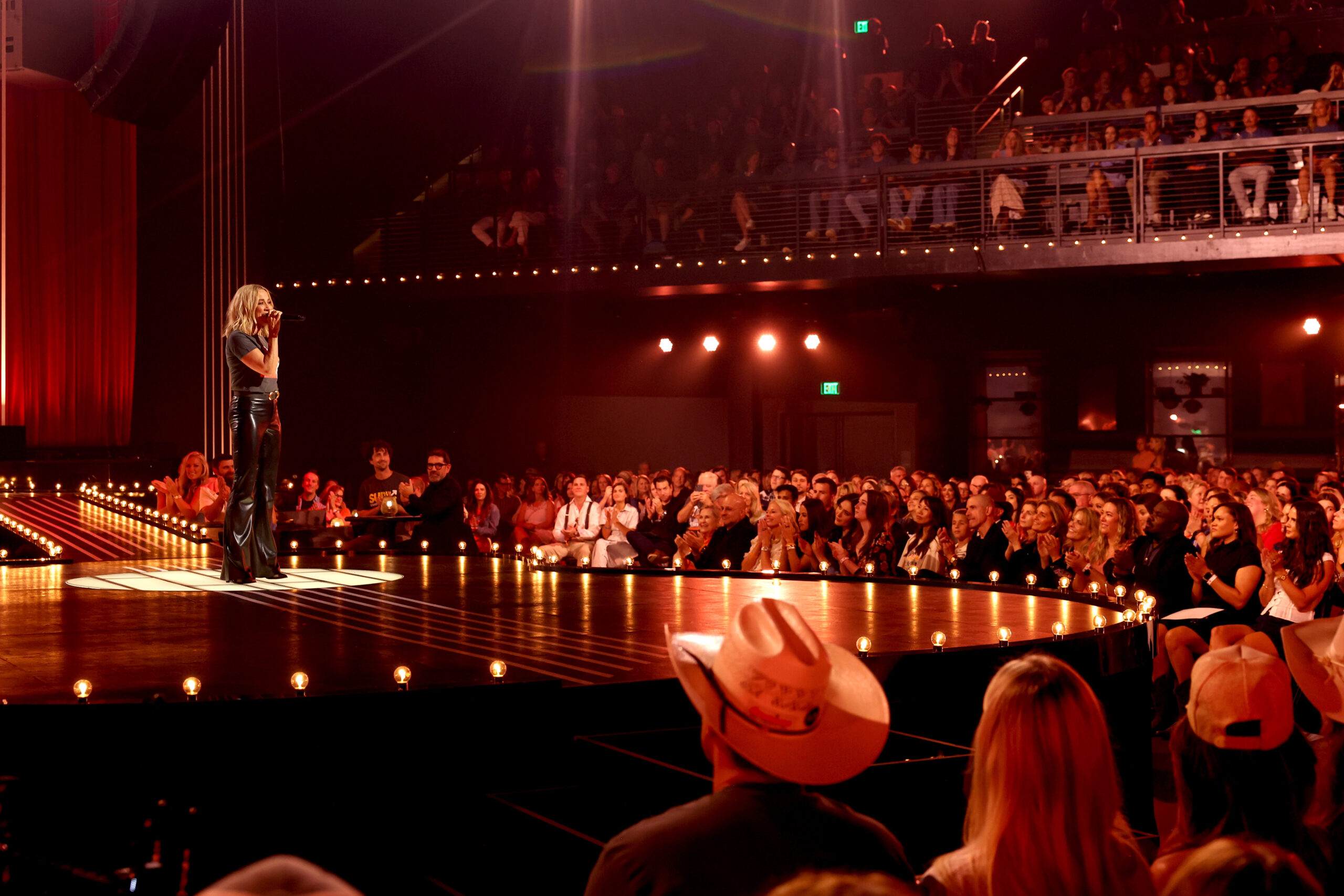
From cinderblock roots bastions like Station Inn to pyrotechnic pop-culture spectacles at Nissan Stadium, venues give Music City room to play. And Nashville plays to its strengths.
At 250-plus, Nashville has more venues per person than other major music hubs – six times the “venue density” of Tokyo or New York, according to the Nashville Independent Venues Study, which was released in summer 2024 by Metro Nashville government in partnership with organizations including the Nashville Area Chamber of Commerce and Nashville Convention and Visitors Corp (NCVC).
(This article is part of Pollstar’s monthly Market Focus feature, which includes additional charts, stories and other content.)
“We have so many [venues] it’s easy to forget, but what we don’t want is for people to take it for granted,” says Deana Ivey, NCVC president and CEO. “We go to other cities and it seems so quiet and we’ll say, ‘Oh, no wonder people love Nashville.’ It’s music all day, every day across the city.”
For its size, Nashville is a peak performer. According to Nielsen market data, Nashville has 191,970 homes and is the No. 17 concert market in the country according to Pollstar figures. In 2024, live revenue was $167,360,280 with 2,052,013 tickets sold.
The Music City moniker has a long history, but it took decades for the live venue business to catch up to its global reputation.
“When we first started, we really had to establish ourselves as Music City and deliver on that promise,” says Ivey. “And at the time, we knew where the music was, but our visitors didn’t necessarily know how to find it.”
At the turn of the 21st century, Nashville was experiencing a rebirth. After 20 years of dormancy the historic Ryman Auditorium had been resurrected with a major $8.5 million renovation. The Country Music Hall of Fame and Museum moved from Music Row to its current downtown campus at a cost of $37 million in 2001 – the same year CMA Fest, formerly Fan Fair, moved from the quaint but dilapidated Tennessee State Fairgrounds to the urban center.
Populated by day drinkers, songwriters and aspiring artists, the city had a notorious collection of industry haunts, which weren’t exactly on the mainstream radar.
“I think about the ’90s when I was 20-something years old and doing what I’m doing now,” recalls Music City native Joey Lee, co-head and partner WME’s Nashville outpost. “Douglas Corner, 12th & Porter, 328 Performance Hall, the Exit/In, and The Settler, the Cannery and the Broken Spoke out on Trinity Lane – that’s no longer there. …It wasn’t a place for the public.”
To help spread the word the NCVC started erecting guitar pick-shaped markers at designated music venues throughout Nashville – a program that continues today for venues offering at least three nights of live music per week.
The tourism division created a website and app for people to find music, any day, any time. They launched the Music City Walk of Fame, similar to the Hollywood Walk of Fame, with inductees including Dolly Parton, Johnny Cash, Tim McGraw, The Kings of Leon, Jack White, Loretta Lynn and Sam Moore. They wrapped traffic light boxes, with pictures of popular artists and played music for the crosswalk crowd – classical music at the Schermerhorn Symphony Center and country at the Hall of Fame.
“Music is our calling card and we use music to leverage tourism,” says Ivey. “Music is woven into everything that we do.”
In 2025 the NCVC launched 615 Indie Live to help independent venues and local artists gain traction by organizing a full day of live music at 17 music rooms. More than 2,000 fans paid $15 for a wristband that gave them access to all the clubs throughout the day.
“It was so well received they were packed starting first thing,” offers Ivey, adding the program will return on Feb. 7, 2026. “The venues loved it. Locals loved it. And it gave us another reason for visitors to come at a slower time of year.”
With tight margins and increased competition from a slew of venues offering free music, Nashville’s independent venues need all the help they can get, according to Chris Cobb, the National Independent Venue Association (NIVA) state representative and former owner of Nashville’s Exit/In.
“I can sum it up in one word, and that would be corporatization,” says Cobb, who moved to Nashville in 1998 and started booking shows in 2000. “If you’re looking for an oversimplified summation of what I’ve seen occur here in the past 25 years, that would be the word.”
An influx of large venues and capital has strained resources for small independent operators, many of whom are grappling with skyrocketing rents in a booming real estate market, shrinking liquor revenue, tour packages that bypass local acts, rising insurance premiums and increased competition for artists, staff and customers.
“It’s incredibly challenging. I think more so challenging now than I have seen in my 25 years here,” adds Cobb, who is the talent booker at 3rd & Lindsley, Overton Park Shell in Memphis and the Hamilton County Fair in Chattanooga, Tennessee. “But we can’t discount the fact that the market is so much more active than it used to be. It wasn’t that long ago that nobody wanted to play Nashville.”
Those days are long gone.
Fans are coming from outside the market, too. The NCVC tracked zip codes from Coldplay’s July 22-23 shows at Nissan and 90 percent of tickets sold were purchased by people living at least 50 miles away.
“People want to come to Nashville to see their favorite artist,” says Ivey. “And it’s a great destination.”
Music drives the economy and influences business decisions. Nashville’s sports facilities including Bridgestone Arena (1996), Nissan Stadium (1999) and the 30K-cap home of the Nashville Soccer Club Geodis Park (2022), were all built with sports and entertainment in mind (see page 171).
“The business leaders in this community know how important music is to Nashville and they make sure that they build for live music – whether it’s the acoustics or layout,” explains Ivey. “Geodis is a great example. It’s a soccer stadium and everyone says it’s a fantastic concert experience. It’s what makes Nashville special.”
A prime example of multi-purpose facility construction is the all new Nissan Stadium, which is scheduled to open in 2027. Having a domed stadium provides the opportunity to chase NCAA Final Four tournaments, college football playoffs, the Super Bowl and mega concerts in the winter months when the city needs the business.
Another new venue on the horizon is AJ (Adventurous Journeys) Capital’s mixed-use development Wedgewood Village in Wedgewood-Houston that includes a 4,500-seat live music venue.
The venue follows on the heels of the opening of The Pinnacle, a 4,500-cap music venue which opened on Feb. 27, through a partnership between AEG and Southwest Value Partners – owner and developer of the 19-acre Nashville Yards project.
The capacity filled a void at twice the size of the historic Ryman Auditorium and 2,300 below Ascend Amphitheater (6,800).
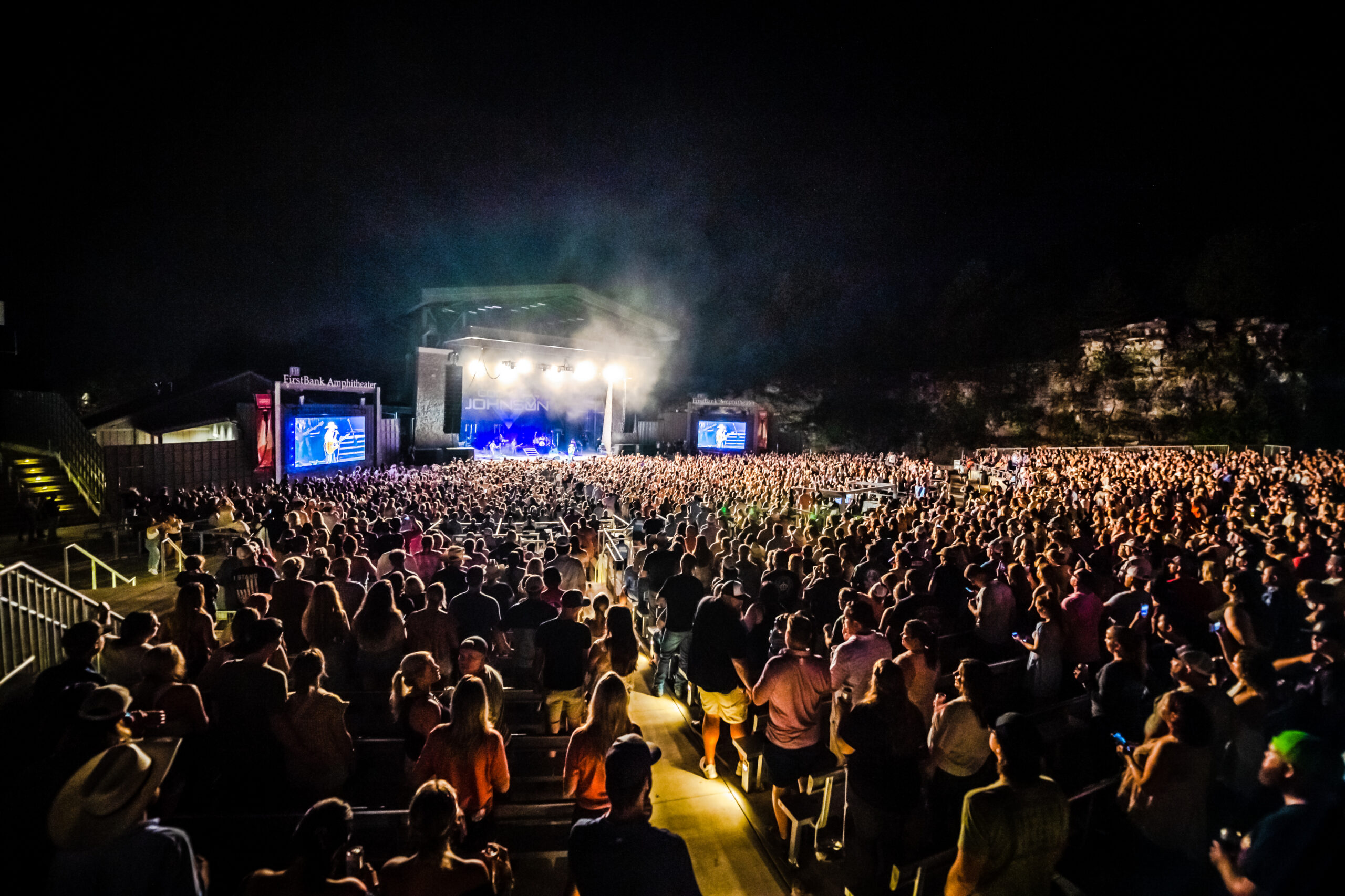
After nearly a decade without a large outdoor venue, Ascend Amphitheater opened in 2015 downtown on the riverfront. In 2021, the 7,500-cap FirstBank Amphitheater followed, opening in a former rock quarry 50 miles to the south in Franklin, Tennessee.
“It seems to be an advantage,” says owner Nancy McEachern. “A group that has played Nashville the past few years, they’re like, ‘Oh, we played Ascend the last three years, why don’t we play a little south and pick FirstBank?’ it’s a nice change of scene for people who play here often.”
FirstBank Amphitheater, which provides fishing poles and trail bikes to visiting artists, hosted the largest outdoor show this year with Riley Green, with a gross of $808,392 and 15,038 tickets sold over two shows on June 19 according to Pollstar data.
“This is our fifth season and we do consider ourselves part of the Nashville music scene,” adds owner Rick McEachern. “In fact, one of our trademarks is ‘Music City in the Country.’ We are in the whole Music City vibe but we deliver something completely different from what you get from a downtown experience.”
Downtown Nashville could be described as a neon collision of honky-tonk authenticity and pop-culture country with stalwarts like Robert’s Western World and Tootsie’s Orchid Lounge – where Willie Nelson and Patsy Cline would hang out in the ’60s between sets at the Ryman – in the vicinity of bars bearing the names of contemporary superstars like Luke Combs, Miranda Lambert, Lainey Wilson, Garth Brooks, Post Malone, Blake Shelton and Eric Church.
“Most of these places are free,” offers Lee. “You walk up and down Broadway, or Midtown, or wherever, and it’s just free music. It’s everywhere.”
Music can be found throughout the city including The Gulch, Midtown and East Nashville. But of all the performance venues in the region, the Ryman Auditorium stands apart as both a treasured historic landmark and a dynamic concert hall. The Ryman Auditorium opened in 1892 as a religious tabernacle and became a spiritual beacon for music enthusiasts around the globe with Coldplay calling it “the greatest theater in the world.”
“From the very beginning it was built for a singular purpose as the Union Gospel Tabernacle,” explains Chrissy Hall, Director of Concerts at the Ryman. “But very soon after that, they realized that it was a gathering place for the whole community. And we’ve just really striven to maintain that treasured place within the community.”
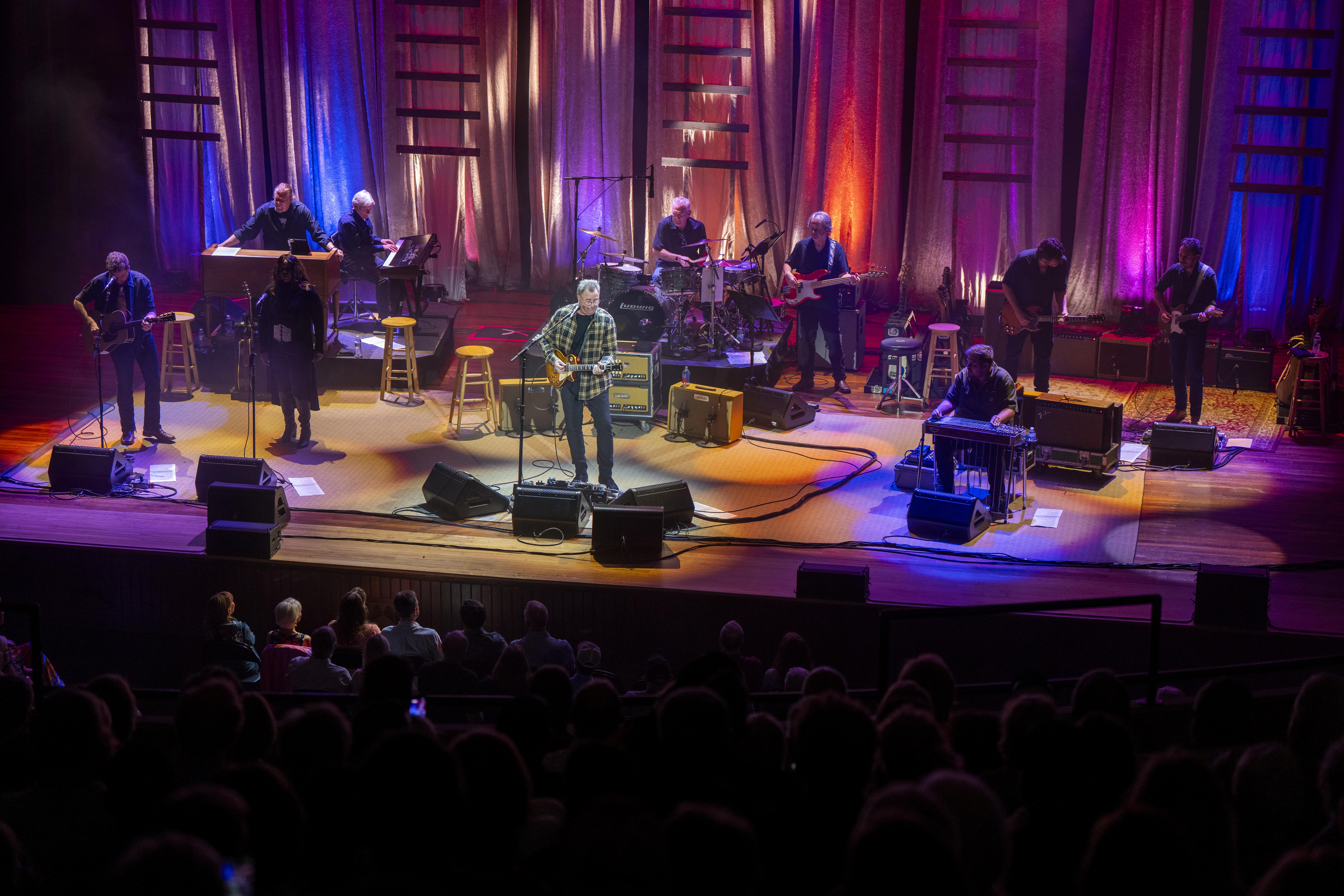
Operated by Opry Entertainment Group, a subsidiary of Ryman Hospitality Properties, Inc., the 2,362-pew/seat venue has received numerous accolades over the years including 15 Pollstar Venue of the Year awards. Opry Entertainment Group, which includes the 4,400-cap. Grand Ole Opry, was recently selected to operate the Ascend Amphitheater for the next decade.
“This is a natural extension of our overall growth strategy and increases our ability to provide different offerings for fans and artists in the market,” says Opry Entertainment Group CEO Patrick Moore. “You might have some of the same artists play the Ryman that will also play Ascend, but it’s going to be a different type of performance and a different sort of theatrical experience for fans.”
As the city’s entertainment landscape continues to expand, Moore believes there is enough consumer interest and industry support to sustain continued growth.
“This city is unique because of the number of venues and the artist community, which is almost like Silicon Valley for music,” says Moore. “You’ve got the managers, the artists, the labels, the promoters, the venues, but the heartbeat of the city, to me – and of course, I’m biased – is really the Ryman Auditorium and the Grand Ole Opry. Those two things provide a brand halo for the city and the musical experience in this region.”
FREE
 Daily Pulse
Subscribe
Daily Pulse
Subscribe
 Daily Pulse
Subscribe
Daily Pulse
Subscribe