
2025 Q3: Beyonce Has Top Tour; Record-Setting Top 100; Smaller Venues Face Challenges

What a difference three months make. 2025’s Q3 boxoffice tally for the Top 100 tours is proof positive of the impact a robust summer touring season can have on the cumulative touring data for the first three quarters of the year, which after a mixed mid-year, are now seeing record-setting highs by every available metric. Indeed, Q3’s total gross, total tickets, average gross, average tickets and average ticket price all hit new highs, which is a markedly different scenario than the data revealed in our mid-year survey.
In early June, when we compiled the Top 100 worldwide tours from the first half of the year, the box-office figures were decidedly mixed. There were declines in overall gross and ticket sales compared to the previous year, though we did see increases in average gross and tickets sales. For this Q3, however, it’s a different story.
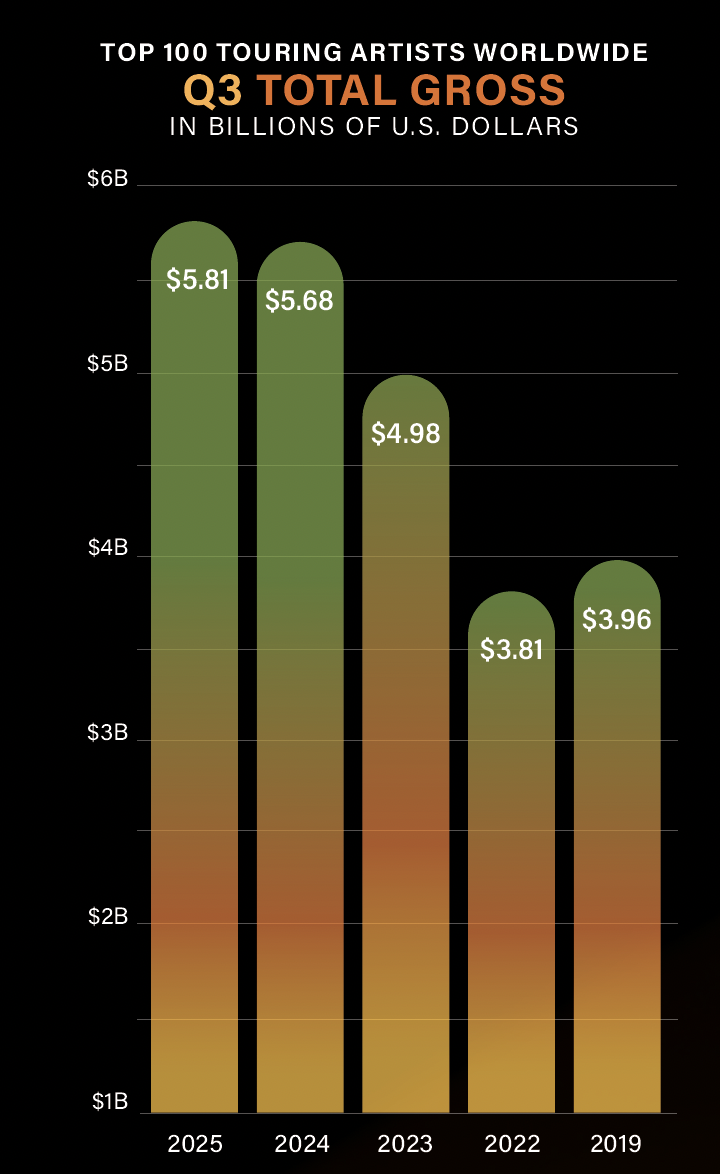
From shows reported during the Q3 eligibility timeframe (Nov. 14, 2024 through Aug. 13, 2025), the total worldwide gross for the top 100 touring artists hit a record high of $5,812,065,495. That’s a 2.3 percent increase over 2024’s overall Q3 gross of $5.68 billion. That upward growth, while certainly smaller than last year’s 14.1 percent jump compared to 2023, nonetheless indicates the top of the market is holding its value while setting a new all-time high.
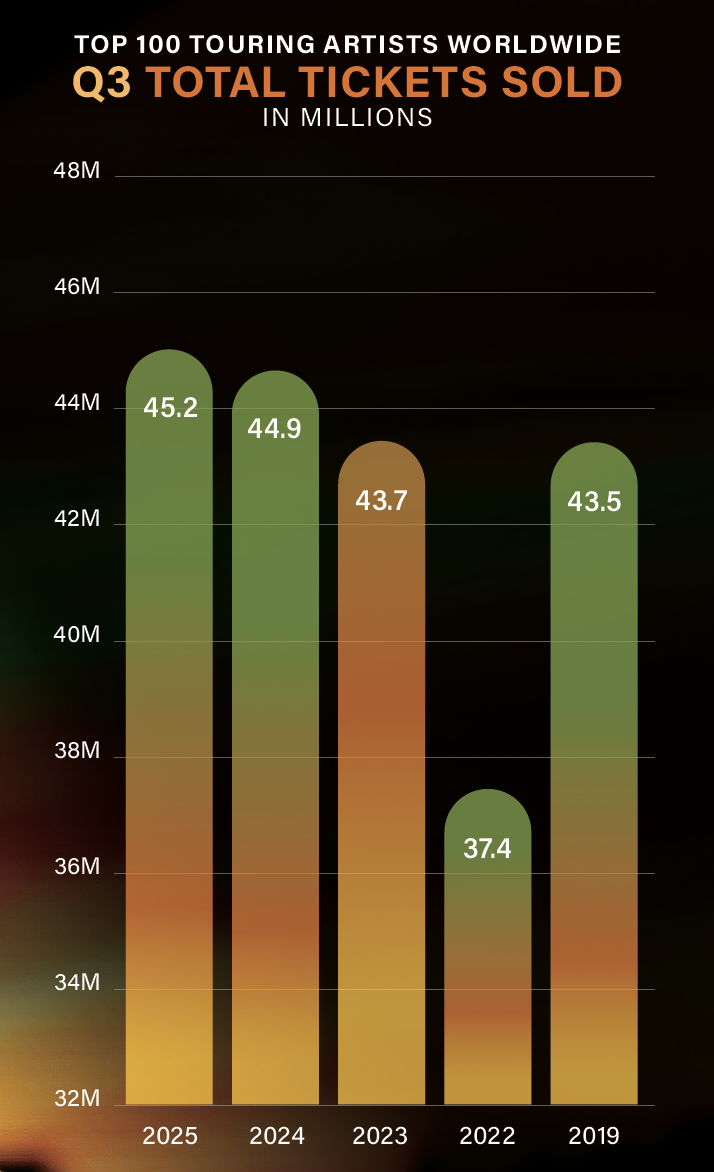
Likewise, the number of tickets sold thus far in 2025 is 45,244,907, represents a nominal 0.8 percent bump over 2024’s Q3 figures. Yes, it is less than 1 percent, but again, these are all-time highs for the live business. And again, it’s retaining 2024’s 2.7 increase over 2023’s attendance.
Per-show averages this year showed substantially more growth than the overall numbers. In 2025, the average gross per show hit $2,422,703 for the top 100 touring artists, a whopping 29.4 percent higher than the $1.87 million average a year ago. And the sold-ticket average is in the same ballpark: 27.7 percent higher than in 2024. Ticket sales averaged 18,860 per show by the top 100 artists, while the 2024 average was 14,766. This data clearly points to top touring artists moving into larger venues, including stadiums.
The average ticket price jumped by a far less substantial 1.5 percent this year to $128.46, a minimal increase over 2024’s $126.55, but it continues the upward movement reflected by the average price in each of the past five years. Last year’s ticket price topped 2023’s $113.85 by a heartier 11.2 percent, almost identical to that year’s percentage increase over 2022’s $102.21. Stretching back to 2019, the Q3 ticket price was $96.17 in the last full year before the pandemic era when neither 2020 nor 2021 included a full year of live entertainment activity.
Obviously, affecting every category highlighted in the quarterly recaps in any given year are the artists in the touring cycle, venue capacities, markets, consumer demand and ticket pricing. This year, though, the impact of the artists has never been more evident.
Q3’s top grossing tour, Beyoncé’s “Cowboy Carter Tour,” played stadiums and grossed $407.6 million, surpassing the $390.2 million at Q3 when she last toured with her “Renaissance World Tour” in 2023. This year’s chart-topping numbers should finally put to rest all erroneous reports suggesting her tour faced flagging sales. In fact, Bey’s ticket sales this year landed just under 1.6 million from 32 performances – almost 50,000 per show.
By the Q3 deadline, No. 2-ranked Coldplay added $254.3 million to their “Music of the Spheres” tour’s overall box-office haul with 2.08 million tickets sold so far in 2025. That’s a higher gross than last year when they had the No. 1 tour at Q3 with $237.4 million. Shakira lands at No. 3 with a gross of $217.8 million from 1.6 million tickets sold on her “Las Mujeres Ya No Lloran World Tour” that played stadiums in the Americas.
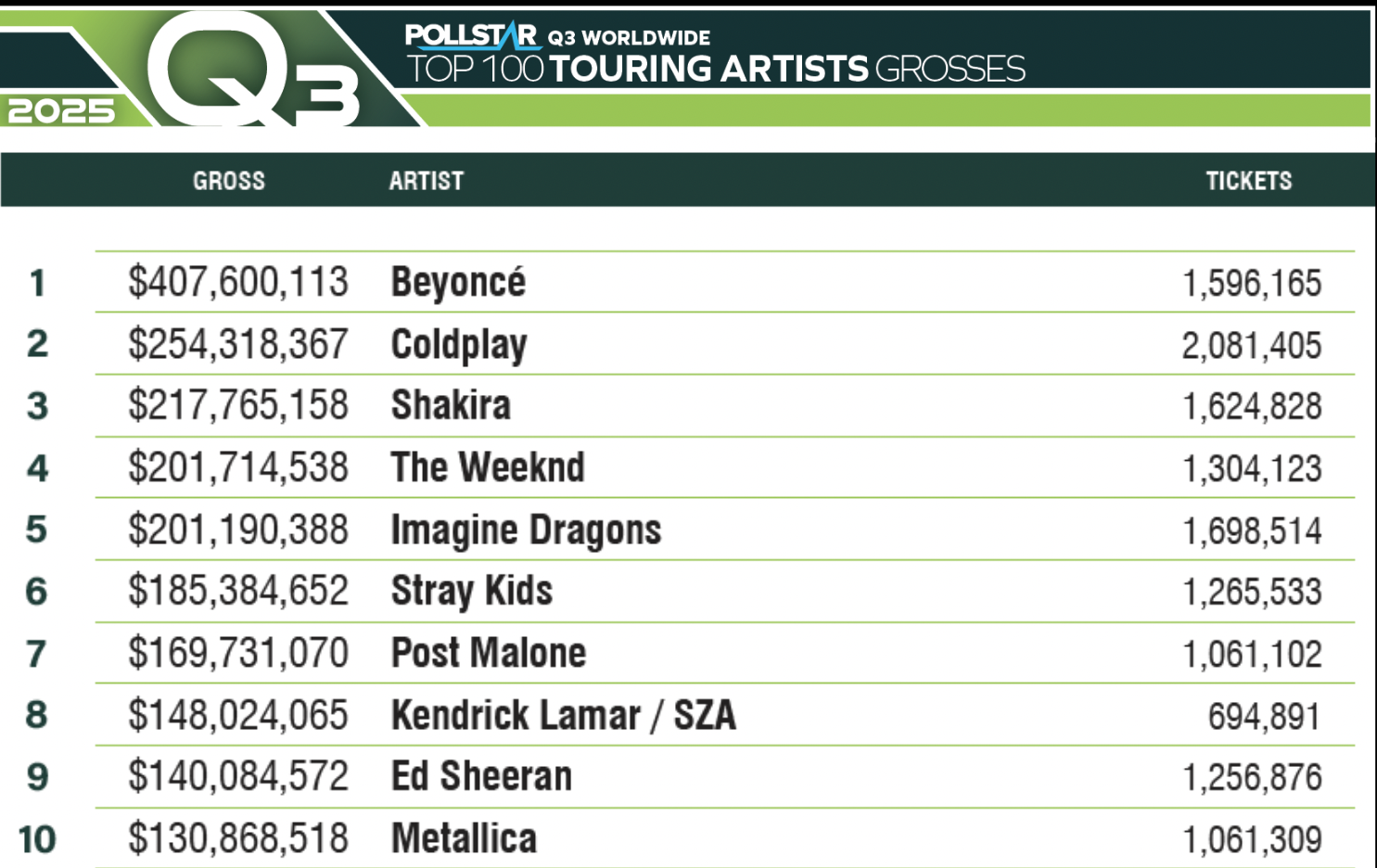
The Weeknd follows at No. 4 based on $201.7 million from 1.3 million fans at 27 North American shows on his “After Hours Til Dawn Stadium Tour.” And rounding out the top five, Imagine Dragons quietly grossed an astronomical $201.2 million at 38 shows, primarily at European stadiums, with ticket sales totaling just under 1.7 million.
South Korean band Stray Kids had their best showing ever on a Pollstar quarterly chart, bowing at No. 6 with $185.4 million from their aptly-named “Dominate World Tour.” Post Malone’s “Big Ass Stadium Tour,” with the ascendant Jelly Roll, takes the seventh ranking with $169.7 million at the box office, while No. 8 is the “Grand National Tour” starring co-headliners Kendrick Lamar and SZA whose inspired hip-hop-R&B/pop pairing broadened their fanbase, yielding an impressive $148 million gross.
Ed Sheeran is No. 9 with $140.1 million on his long running “Mathematics Tour,” and Metallica takes No. 10 with $130.9 million from over 1 million tickets sold on the “M72 World Tour.”
Among Q3’s top touring artists, the top 10 grossed $2.06 billion, up 15.2 percent from the $1.79 billion earned by last year’s top 10, while selling 13.6 million tickets. That’s an increase of 24.4 percent over 2024’s top 10 with almost 11 million sold at Q3.
Percentage differences are much lower among the top 50 artists. Together, they grossed $4.55 billion at Q3, just 1.9 percent more than $4.46 billion from the top 50 in 2024. Ticket sales are even tighter, as this year’s 32.1 million tickets sold at Q3 is only half of one percent more than 2024’s 31.9 million.
SOME SMALLER VENUES FACING ECONOMIC HARDSHIP
This month’s Deep Data Cuts (see here) looks at venue results for Q3 based on Pollstar Boxoffice reports. Stadiums and large venues with capacities over 30,000 are the one venue category that saw substantial increases in grosses, ticket sales and ticket prices compared to the previous two years, which is keeping with Q3’s Top 100 Worldwide Touring Artists chart.
In the smaller venue categories, however, the market contracted, though mostly by single digits. That contraction is in line with what Pollstar has heard repeatedly from club promoters and talent buyers along with such industry organizations as the National Independent Venue Association, National Independent Talent Organization and the International Entertainment Buyers Association who say many in the club sector continue to face increased economic hardship. This includes greater difficulty selling tickets along with lower bar sales, rising expenses, shaky consumer confidence and a volatile economy, all of which can leave margins razor thin at best.
Venues with capacities of 750 or lower sold an average of 278 tickets per show in Q3, 3.5 percent less than last year’s 288 and 7 percent lower than 299 in 2023. The average ticket price was $34.74, up 11.1 percent over last year. Grosses increased 7.2 percent over 2024 to $10,075. Still, lower ticket sales means lower per caps for clubs who depend on ancillary sales.
For larger clubs with a capacity of 751-1,500, the ticket average dropped to 769 in 2025, a 3.9 percent drop from 2024’s 800 average and a more substantial 9.4 percent from 2023’s 849 average tickets sold. Average grosses YoY dropped 3.8 percent from $35,049 per show last year to $33,714 this year and saw a 6.1 percent drop from 2023’s $35,900 per show.
For 1,501-2,500 capacities, 2025’s average ticket count of 1,457 is less than one percent lower than last year’s 1,460, but it is 7.23 percent less than 2023’s 1,571 average. Likewise, the gross average of $81,800 is only 0.6 percent lower than 2024’s $82,300 but a 2.7 percent drop from 2023’s from $84,100.
For venues in the 2,501-5,000 category, the change in average tickets sold between 2025 (2,629) and 2024 (2,661) is negligible, a 1.2 percent drop; the decrease since 2023 (2,894) represents a more substantial 9.2 percent difference. The same holds true for the average gross which remained on par between 2025 and 2024, but this year’s $169,980 average dropped 8.1 percent from 2023’s $184,947.
These decreases in tickets and grosses for smaller clubs with smaller profit margins are concerning and ultimately could be detrimental to the larger live ecosystem, which depends on smaller venues for developing talent. These venues also provide a social benefit as a gathering space for many communities. Their losses can go far beyond any monetary value.
FREE
 Daily Pulse
Subscribe
Daily Pulse
Subscribe
 Daily Pulse
Subscribe
Daily Pulse
Subscribe