
The Stars Of 2025’s Montreal Int’l Jazz Fest: A Million Fans, Fantastic Programming, Montreal

When Pollstar reached Maurin Auxéméry, the head programmer at the Montreal International Jazz Festival, the largest jazz fest in the world, he most significantly had just come from a memorial service for Serge Fiori, frontman of Harmonium. As one of Quebec’s most popular bands, Fiori’s passing elicited flags at half-mast across the French-speaking Canadian province. While most Americans would have a hard time at best placing Fiori, it is part of Auxéméry’s mission as head of programming the jazz festival to expose artists many have never heard of to larger audiences.
“We had huge crowds from different communities,” says Auxéméry when asked what he found most gratifying about this year’s 45th annual edition of the festival. “Montreal was built by immigration and there are many many different communities in the city. It’s extremely cosmopolitan. There are communities here from West Africa, South America, Europe, India, Middle East and China. It’s not always easy to create a festival where all those people, who are Montrealers, feel at home going to the festival. This year, more than any other year, though, we were able to achieve that and it was extremely satisfying to see all the different communities.”
Auxéméry, who himself immigrated to Montreal 18 years ago from France (born in Marciac and raised in Toulouse), has worked at Montreal Jazz Fest for 12 years, including as its director of programming for the last three. He says another highpoint from this year’s confab was booking artists not necessarily on others’ radars.
“When we talked about the headliners, the media and people around us were like, ‘Who is Mon Laferte (from Chile)? Who is Natalia Lafourcade (Mexico)? Who is Monsieur Periné (Bogota)? Who is Kes (Trinidad)? Who are all these people?’ It’s incredible because Natalia Lafourcade sold 6,000 tickets. That’s huge for Montreal. And it’s huge when Mon Laferte, her first time playing in Montreal, sold out 3,000 tickets. And nobody around us knew Mon Laferte. When Kes played with had to close the street because there were too many people on the site and that hadn’t happened in a while… It’s great how important these artists can be to certain communities.”
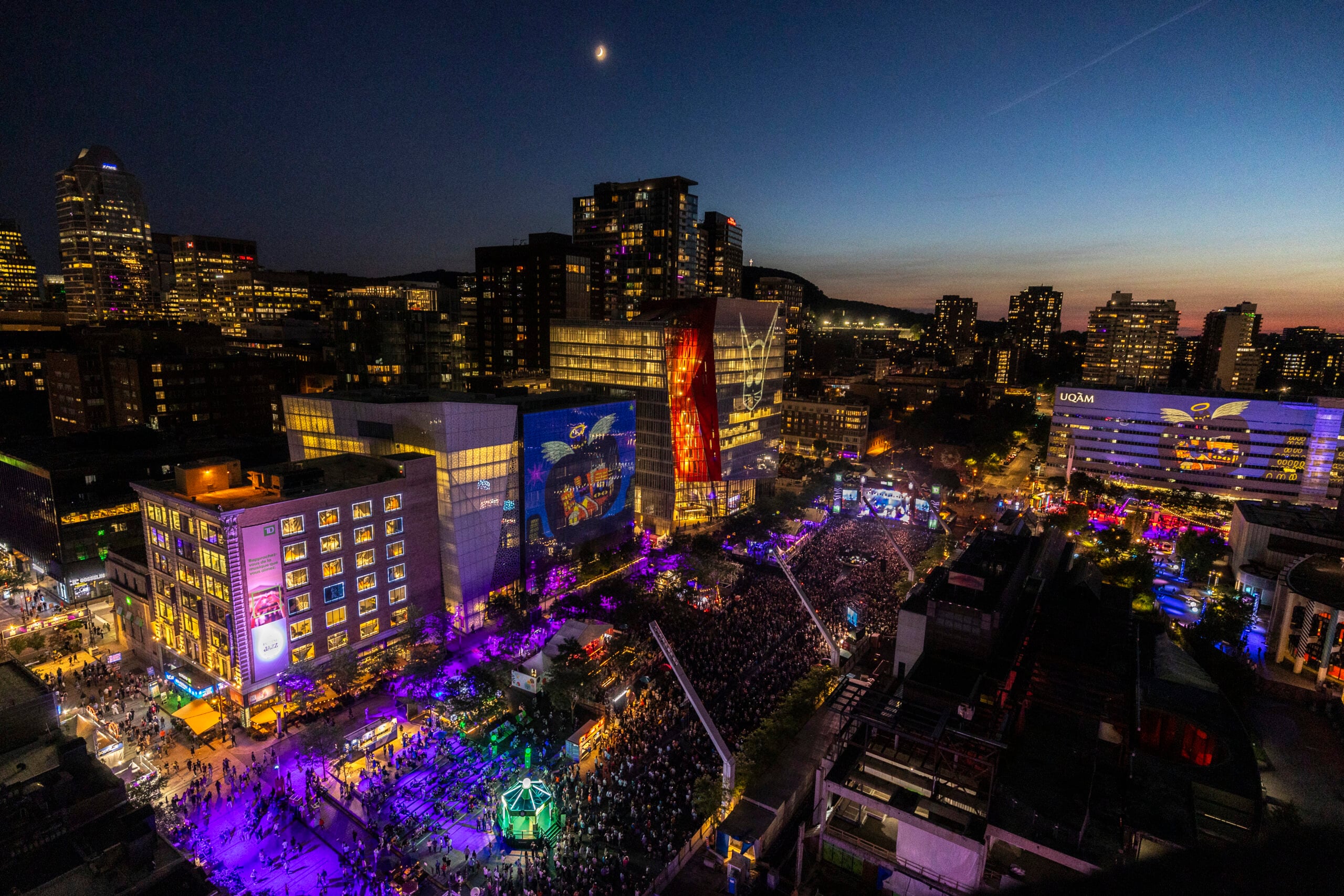
While no music festival can be all things to all people, Montreal Jazz may get closer than most. The fest runs for ten days with 300 shows (245 artists total and 99 Canadian) with two-thirds of the shows absolutely free and the rest ticketed. This year’s attendance, which has yet to be tallied, is expected to be close to last year’s, which had 600,000 festival-goers and a total of 1.27 million admissions with music for a wide swath of music palates.
Montreal Jazz is a smorgasbord of non-denominational audio delights and this year’s included everyone from Nas (with orchestra), Bill Frisell, Mavis Staples and Esperanza Spalding to Kid Koala, Samara Joy, the Sun Ra Arkestra, Arooj Aftab and Branford Marsalis to Alison Russell, the Violent Femmes, Bonobo and Geroge Thorogood to Rhiannon Giddins, Vijay Iyer & Wadada Leo Smith, Gary Bartz and Thundercat to Fantastic Negrito, Trombone Shorty, Marc Ribot and the Freedom Riders – and that’s just a small sampling.
In addition to the evening shows, there’s artist interviews (we saw a highly entertaining Jeff Goldblum interview), symposia and even art installations. This year also celebrated the centennial anniversary of legendary jazz pianist Oscar Peterson, a Montrealer and past Montreal Jazz. performer This included an outdoor photo exhibition at Place des Arts, a performance by the The Oscar Peterson Centennial Quartet and vinyl pressings of Peterson’s Montreal Jazz performances in 1989 and 2004.
Though Auxéméry didn’t give the financials of this year’s Montreal Jazz Fest, a non-profit, he did explain that it is nested under parent company, Group CH, which is run by the Molson family and also owns the Montreal Canadiens hockey team, the Bell Centre, Evenko and L’Equipe Spectra, which manages Montreal Jazz. He also explained that the festival has roughly three equal revenue sources: sponsorships, government support and sales of ticketed shows, F&B and merch, that’s allowed Montreal Jazz to flourish for the last 45 years.
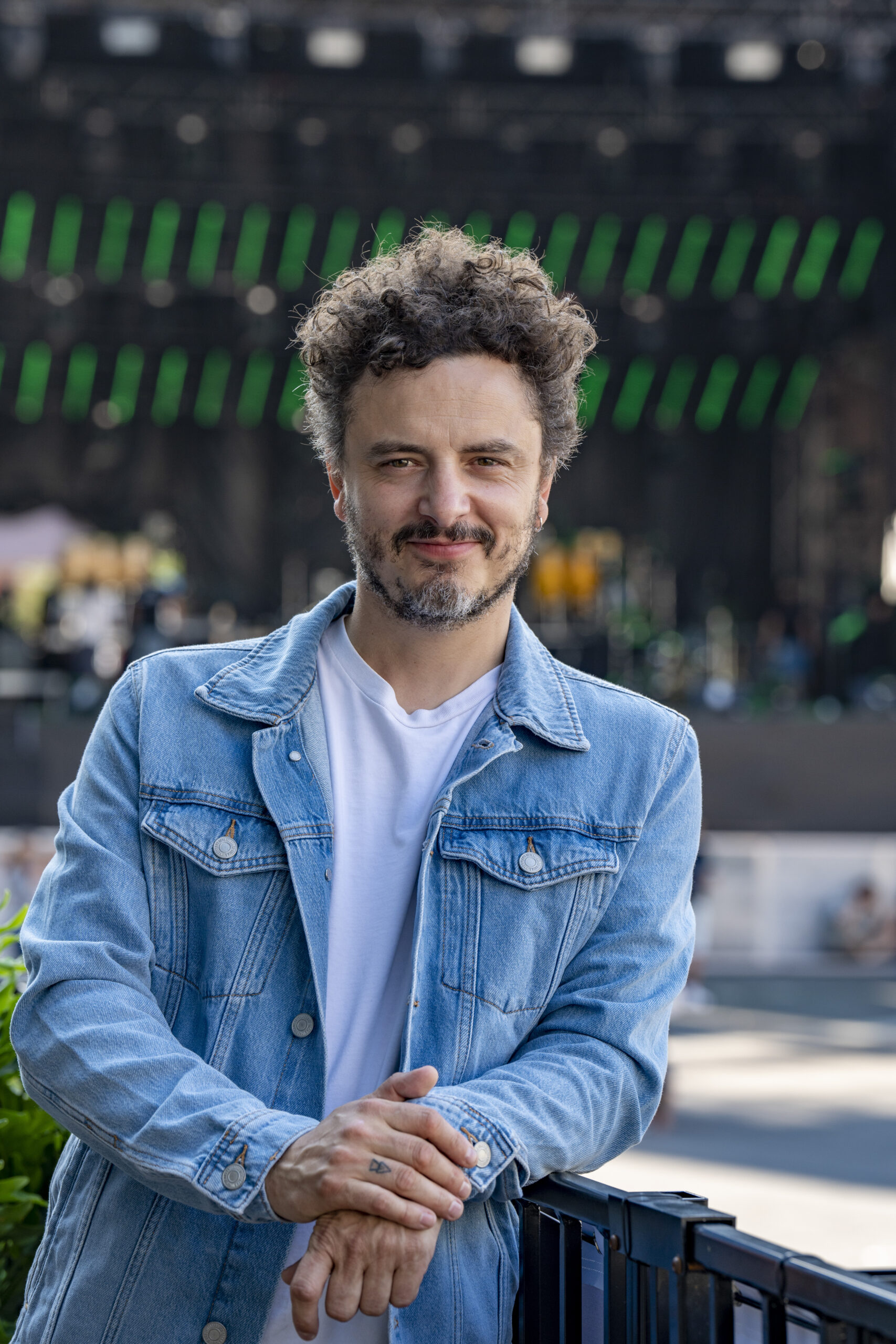
“Public money comes from the city, from the Quebec province and federal money,” Auxéméry explains. “Then we also receive private money from sponsors and partners, including TD Bank, Rio Tinto, Rogers Communications and others and the revenue streams are close to one third each.”
Because of the success of this year’s ticketed shows, which include Frissell, Marsalis, Thundercat, Nas, Natalia Lafourcade, Arooj Aftab, Gary Bartz the fest’s program director believes this year’s revenues will surpass last year. “We improved ticket sales. 85% of tickets sold to the indoor shows and I don’t think that ever happened in the past. Usually it’s between 75 and 80 and it’s usually very good but this year was better by far.”
Auxéméry says this year’s merch sales were massive in part because of the return of “Ste-Cat,” a halo-topped feline cartoon mascot with wings, originally designed by Yves Archambault that hadn’t been part of the fest since 2013. Thanks to local artist Chien Champion, the cat was resurrected and featured prominently on posters, shirts and projected onto buildings surrounding the TD Stage (see photo abov).
While past numbers put out by Tourism Montreal have put the economic stimulous to Montreal at $100 million, Auxéméry says it’s still too early to quantify that data.
A challenge Auxéméry and his booking team faced this year was the difficulty in obtaining U.S. visas for international artists which impacts a Canadian market inextricably connected to the American market.
“Whenever a band is excluding the US from their touring strategy, it makes Canada more complicated because it’s a smaller market,” he says. “Canada is (a geographically massive) market and it is more complicated to drive from one big city to another. When you’re in the U.S. you go from Boston to New York to Washington, that’s doable. In Canada, it’s more complicated; you can do Montreal to Toronto, then you have to fly to Edmonton or Vancouver, otherwise it can be 3-4 day drive. The visa situation is complicated and that’s the feeling among artists here, Europe, Africa, South America and Asia. The impact is huge and artists have to take that into account in their touring strategies.”
Another word to the wise: Before arriving to Montreal Jazz make sure you get your ticketed shows lined-up in advance of your arrival. Many of the ticketed shows were sold-out at show time. The two shows we saw at Place Des Arts were well worth the price as the performing arts center is a gem with exquisite sound and sight lines and something of a relief from the massive shows at the larger outdoor stages, including the TD Bank stage at Place des Festivals and the adjacent Rio Tinto and Scene Rogers stages.
While music is most fest attendees’ guiding star, the real not-so-secret star of the festival for out-of-towners is Montreal itself. With no festival gates to speak of and most shows not starting until evening, festgoers are afforded the opportunity to spend their days exploring Montreal’s vast cultural, commercial and natural riches. This includes incredible cuisine (Leméac and Cadet were delectable), famed Montreal bagels and smoked meat (Mile End), climbing Mount Royal, shopping (Eva B. is a great thrift shop) bike riding (the city’s bike share program is user friendly if you download the app), the old town (you will think you’re in Europe), the St. Lawrence river (with zip lining and a spa on a boat), a bustling Chinatown and far more.
On two different nights walking down St. Catherine Street, the fest’s main thoroughfare and pedestrian-only street lined with food trucks (try the pistachio “beaver tail”), vendors, brand activations and the Place des Arts performing arts center, we stumbled upon a spontaneous outpouring of music and dancing, one with middle-eastern sounds and the next evening hip-hop.
While Montreal has a city population of 1.7 million (and a metropolitan population of 4.2 million), it’s small enough to run into musicians and knowledgeable fans. For example, we shared a van from Montréal–Trudeau International Airport to our hotel with Kiefer, a pianist, producer and composer with a soul-jazz bent who performed at Gesù, a small theatre with pristine sound located in the basement of a church built in 1865.
On another day, we ran into an Australian cello player named Linda May Han Oh in our hotel lobby. Later that evening, her trio played one of the most impressive sets of our festival experience at Pub Molson, a smaller outdoor stage randomly stumbled upon.
Auxéméry says the fest’s sponsors were happy with this year’s festival. “TD just singed for signed on again,” he says. “I spoke with the person in charge here in Quebec and he loves the festival. He loves the way we’re doing it and the fact we are so Inclusive and democratized”
When asked what he means by democratized Auxéméry contines. “That’s the objective of the festival, having music accessible to all the people of Montreal and outside Montreal and to have a lot of people on site and bring in the biggest number of people we can and make sure anybody can come. We have more than a million people coming to the festival so it’s a lot of eyes that our partners get and they’re happy with us.”
And so are the many music fans, artists and Montrèal tourist officials.
FREE
 Daily Pulse
Subscribe
Daily Pulse
Subscribe
 Daily Pulse
Subscribe
Daily Pulse
Subscribe