
Green Is Good For Venue Business
Turns out the business strategy behind impact in sustainability is not that different from other aspects of the live venue business.
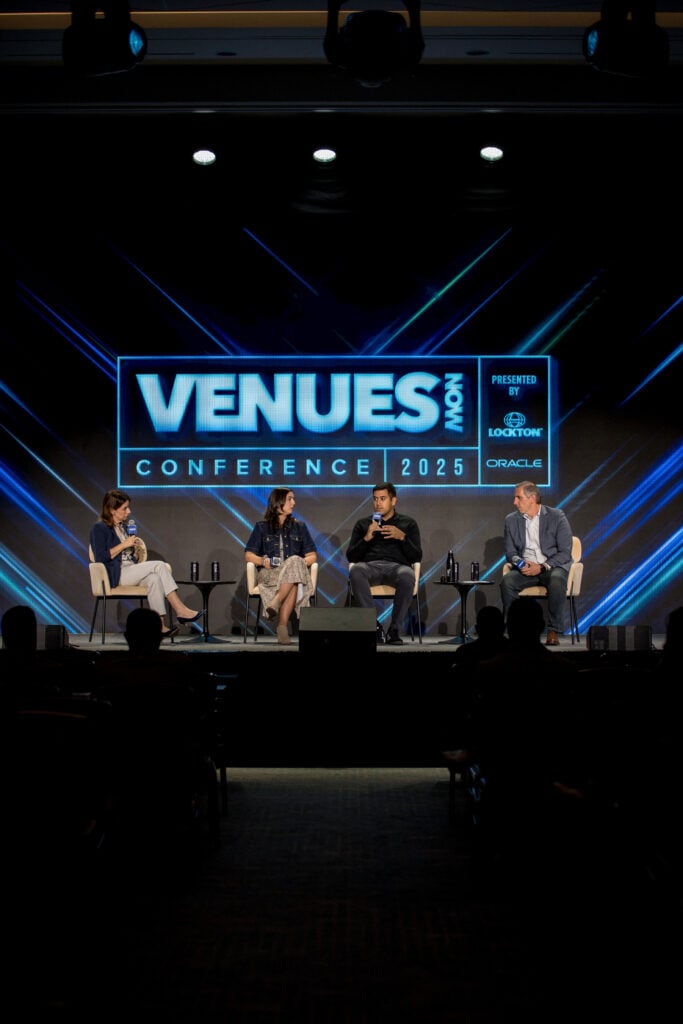
During a panel on the topic today at the VenuesNow Conference at Resorts World in Las Vegas, industry leaders discussed creating actionable plans that reflect the values and needs of industry stakeholders as central to launching successful green campaigns.
Moderated by Shannon Trujillo, SVP Business Development for Oak View Group (Pollstar‘s parent company), panelists included Rishi Jain, Director of Impact for Premiere League champions Liverpool Football Club, who leads the Club’s approach to sustainability through the lens of equality, diversity, inclusion and environmental sustainability; Maria Sapienza, Director Analysis and Planning for the Chicago Cubs, who oversees key deliverables including capital planning, operational budgeting, analysis/reporting and strategic plan development; and Michael Sciortino, General Manger of UBS Arena, home ice for the NHL’s New York Islanders.
Sapienza highlighted the Cubs’ journey toward a sustainable future including a 50% emissions reduction goal by 2030 and zero waste initiatives. Jain emphasized the organization’s holistic Red Way program, achieving ISO 2021 certification and significant emissions reductions. Sciortino detailed their “Sustainable Brilliance, Community Resilience” platform, prioritizing emissions reduction and local staffing goals. They all agreed that sustainability is not only good for business but essential for long-term success, emphasizing the importance of clear strategies, stakeholder engagement and measurable goals.
Putting their “best foot forward” was the first step at UBS Arena, where Islanders management and OVG worked with the Metropolitan Transportation Authority to build a train station at the 17,250-cap venue to reduce carbon emissions at the LEED-certified arena. Sustainability is part of the organization’s DNA from the investment in the train station for the Long Island Railroad to working with their partners to incentivize train ridership; achieving zero waste; creating sellable assets for the partnership team; and investing in being carbon neutral for Scope 1 and 2 emissions.
“It’s across the board,” Sciortino told the audience. “It’s part of what we do. It’s been part of what we do since we started.”
The Chicago Cubs, who play at Wrigley Field, which was built in 1914 and can seat 41,000, recently entered the green space.
“We at the Cubs try to be the best in class in everything we do, and I would say in sustainability – on what the before looked like – was ‘no in class,’” Sapienza said with a laugh.
Privately owned by the Ricketts family, the ballpark and surrounding neighborhood underwent a massive $575 million five-year renovation that culminated in 2021. During construction, sustainability often stayed on the bench. When the family purchased the team, they had three goals, according to Sapienza: win the World Series, save Wrigley Field and be a good neighbor.
“Seeing where the league is, where other teams are, what our stakeholders wanted in the city, we just were not in line with their values,” explained Sapienza. “So, we got a group together, did material assessment and figured out where we wanted to be in the sustainability space. It’s definitely a forever journey, but we’ve been taking the initial steps over the last couple years to create a strategy and then start executing.”
For Liverpool FC, their commitment to sustainable practices was an evolution that began with being the first UK football team to participate in a Pride parade and other social-leaning stances like being the first to take a knee.
“That’s a really powerful message for us,” Jain said. “What we were not so great at is the environmental work. It didn’t have an identity. And that’s what the Red Way did. It brought it together as a holistic program. It allowed us to go after some standards of benchmarks.”
Having a unified message was equally important at UBS Arena.
“We needed a platform, and we needed to put one unified message together,” said Sciortino. “So, we got all the stakeholders literally in a room, physically in the room, not on Zoom, and we sat there for a few hours and talked through all the different things that we do, all the different things that we want to do, what we think we can do.”
The discussion coalesced under the umbrella concept of “Sustainable Brilliance, Community Resilience,” which transcended being a catch phrase to being a standard to measure future and ongoing projects including hiring locally, hosting climate forums and an ambitious goal of reducing Scope 3 emissions by 25%.
“For a venue that parks 3,200 to 3,600 cars for our big events, that’s going to be a real challenge,” he said. “But we have a great railroad system and there’s a lot more work we can do there, and a lot of room to grow.”
For Jain, the Club’s community outreach strategy has been rooted in transparency.
“It was very different for us – and probably very different for UK sport – is that we told people what we wanted to achieve,” he explained. “So, we put out our 2030, 50% emissions reduction goal, the 2040, for net zero, we said where we want to get to. …There was a lot of nervousness around that – my nervousness was included within that – because that’s not really the done thing.”
Being upfront about the ups and downs of spearheading DEI and sustainability initiatives has endeared the team to their fans and stakeholders, including 25 to 30 various partners.
“Actually, that authenticity in our approach has led to a lot of success and allowed us to have really meaningful conversations,” Jain explained.
For Sapienza, a lot of the discussions around sustainability happens internally.
“How do you prioritize this among everyone else’s priorities?” she asked. “And I think over the past couple years, what we learned – speaking of the ups and downs – is that we were probably a little bit ambitious and probably put goals out that we can’t reach because there are so many priorities. And it’s not a bad thing. It’s great to be an ambitious organization that has a lot of priorities, and this is going to be one of them.
“So, while we may move slower, let’s make sure we have an underlying strategy where everyone’s involved, everyone knows what we’re doing, what their role is and let’s be honest with each other.”
Ultimately, the panel agreed that having clear, achievable green goals and practices that are clearly communicated to all stakeholders is good for business. There are the cost benefits such as converting to solar power as energy prices escalate, but Sciortino sees the people profit.
“I know this question is rooted in dollars and cents, but I think that the good vibes – doing something good, doing the right thing – is a really positive thing for our staff, our team and our partners,” surmised Sciortino. “I think the feeling that everyone gets from working on these projects – and working for an organization that cares and tries and investments – is real.”
FREE
 Daily Pulse
Subscribe
Daily Pulse
Subscribe
 Daily Pulse
Subscribe
Daily Pulse
Subscribe