
Venues Of Vegas: An Update On The Las Vegas Athletics (VenuesNow Conference Recap)
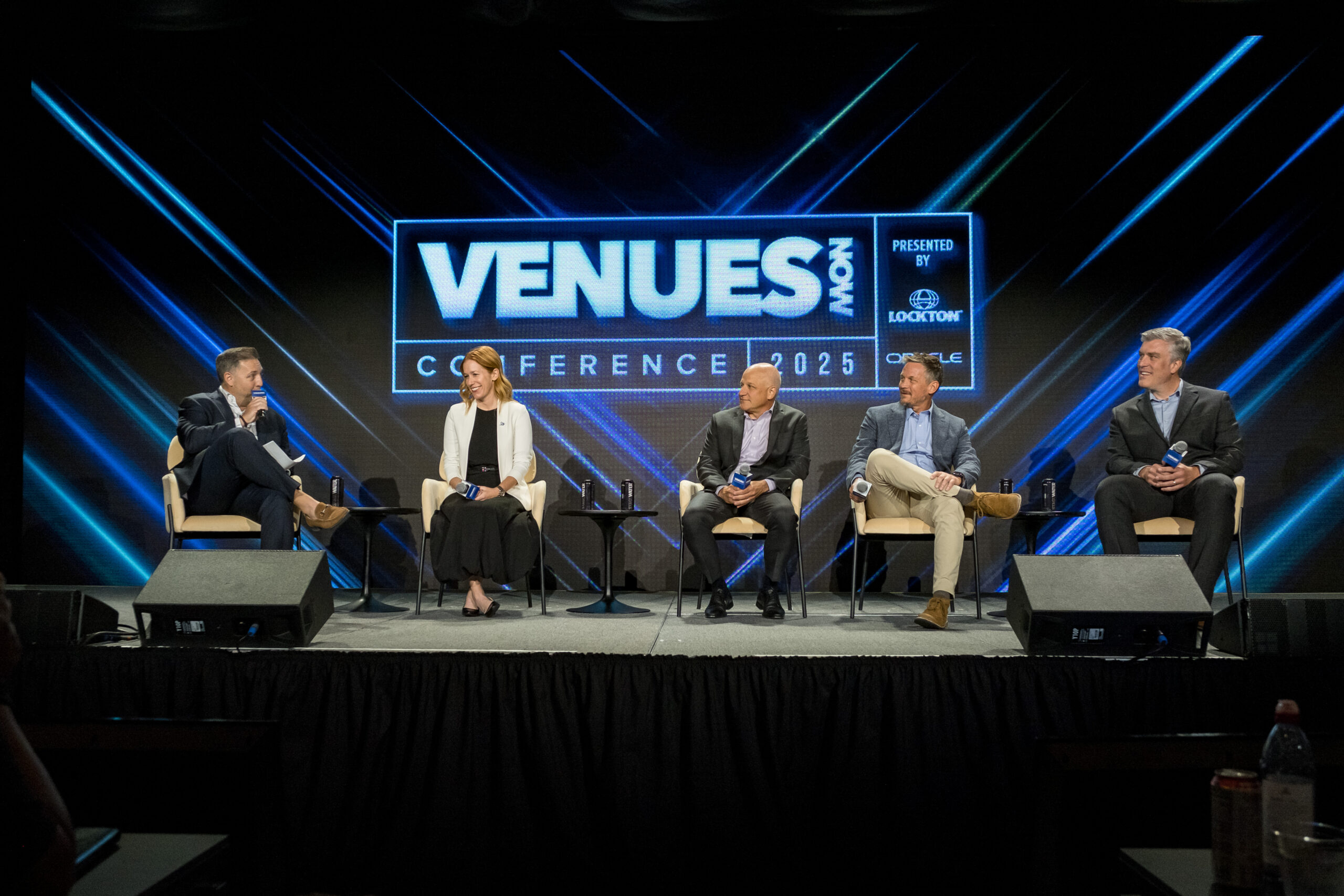
The Athletics officially broke ground on a new Las Vegas stadium in June, and the team behind the proposed venue on the Strip stopped by the VenuesNow Conference to provide an update and some insight on the storied baseball team’s latest venture.
Las Vegas didn’t have a professional sports team until the NHL’s Golden Knights arrived in 2017, and by 2028, the city will have four, with the A’s scheduled to debut in their new home in the spring of that year.
The 33,000-capacity stadium, designed by Bjarke Ingels Group and HNTB, will cover nine acres of a 36-acre lot that will also feature a hotel and entertainment complex. It will mitigate the Vegas heat with a fully enclosed roof that will reduce sunlight glare and boast some of the best sightlines in all of baseball.
Such an ambitious project can be challenging, but it’s not keeping A’s executives and developers up at night. As a matter of fact, A’s President Marc Badain said they’re sleeping just fine.
“This is the best team of people to build a building,” said Badain, who also helped with the development of Allegiant Stadium, home of the NFL’s Raiders since it opened in 2020. “They just did it here in Vegas, so it’s basically getting the band back together. You obviously have concerns. It’s like throwing a wedding. Something’s going to go wrong, but you build in provisions for that. You’re building contingencies.”
Developers are also in the process of building the “skeleton” of the stadium, and many of the design elements they’re excited about will be visible by next year.
Logan Gerken, vice president and general manager of development company Mortenson, said he looks forward to seeing the enclosure, which was inspired by the one at the Walt Disney Concert Hall designed by architect Frank Gehry. He said that despite the challenge, it’s an opportunity to “build globally significant architecture on one of the busiest intersections on the Strip.”
“That’s where a lot of our focus is right now and getting some of the iconic elements that are going to make that fan experience fantastic and also make it fun from a construction perspective,” Gerken added.
Developers see the venue more as a super arena because it’s less than 1 million square feet, promising to deliver an intimate, premium experience wherever you sit. The stadium is a private public partnership, meaning it will be owned by the state, and what inspired government officials to partner with the A’s is the return on investment the Raiders and Golden Knights have seen.
“There are examples of successful public-private partnerships, and there are unsuccessful ones,” Badain said. “In this market, the numbers around Allegiant, I believe for every dollar put in by the public, they’ve seen a return of over $2. That’s not made up. It’s real return on investment, and that exceeded expectation.”
The organization isn’t just focused on building a stadium. Moderator John Saccenti, executive director of ESPN Events, asked the panel about the challenges of building a fanbase in a market that has dozens of millions of tourists, most of them from other U.S. states, Canada and Mexico.
Catherine Aker, the A’s vice president of marketing and communications, considers herself fortunate to have different blueprints from the Golden Knights, who focused on attracting locals, and the Raiders, who approached it expecting many visitors with a large global fanbase.
“Seeing those two models, understanding what works gives us a chance to look at things differently,” Aker said. “We are going to have to have both to be successful.”
Aker noted that it was MLB that asked the A’s to explore Las Vegas, so even the league sees the city’s potential and how it can innovate the sport.
“We are going to be a testing ground for what the next phase of baseball is going to be, not just stadiums like Camden Yards many years ago, but the actual in-game experience, making sure that we are engaging the next generation of baseball fans,” Aker said. “We are at a critical time with our sport, and I think baseball acknowledged and recognized this. We are the perfect team because we’re not afraid to take risks, to try new things, and that has been in our nature even before ‘Moneyball.’
“I like to say that we are a 125-year-old expansion team, so we’re taking the history with us of four cities now and what we’ve built. Our international brand is unique compared to all the other baseball teams, and taking it into a new market to make it worthy for Vegas entertainment.”
FREE
 Daily Pulse
Subscribe
Daily Pulse
Subscribe
 Daily Pulse
Subscribe
Daily Pulse
Subscribe