
Major $450M Renovation Planned For OU’s Palace On The Prairie
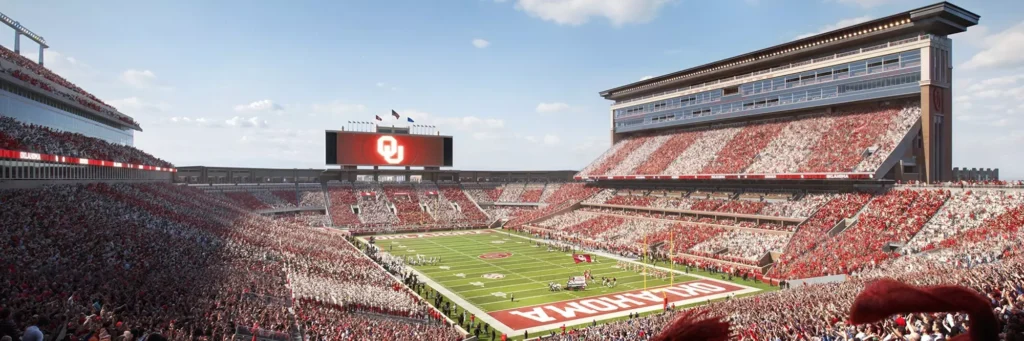
Rendering courtesy of University of Oklahoma Athletics
The University of Oklahoma is putting the boom in Boomer Sooner with a $450 million renovation of the Gaylord Family – Oklahoma Memorial Stadium’s west side.
The OU Board of Regents approved the design development phase plans and authorized preparation of construction documents for the project, which has been dubbed “The Palace Project.” The next phase of the stadium master plan is designed to benefit fans and spur significant will benefit all Sooners who step inside the stadium and generate revenue that will bolster the future of OU Athletics.
“The Palace Project is transformational in every sense for everyone – not just in how it will elevate our facility, but in how it will enhance the experience for our student-athletes, coaches and fans,” states Joe Castiglione, Vice President and Director of Athletics. “This project – the largest in OU Athletics history – reflects our ongoing commitment to providing championship-level resources for our program to compete at the highest level, while honoring the deep tradition and pride that define Oklahoma. We’re experiencing tremendous momentum, and this investment ensures we continue building on that foundation for years to come.”
OU recently released project renderings offering a glimpse of the future stadium, which includes expanded concourses, upgraded amenities and new gathering spaces. Additionally, the renovation will strengthen one of the nation’s most formidable home-field advantages, creating an energized environment that helps OU Football compete at the highest level.
“It’s difficult to adequately express how excited our football program is for the Gaylord Family – Oklahoma Memorial Stadium west side project, and I’m sure Sooner Nation is equally ecstatic,” adds head football coach Brent Venables. “We are already blessed with one of the greatest venues in the sport, but this game-changing transformation will give new meaning to ‘The Palace on the Prairie.’ The renderings are stunning and once completed, this project will positively impact everyone who steps foot in the stadium.”
Given the current financial pressures of college athletics, it’s become necessary for universities and athletics departments to innovate and pursue additional opportunities to sustain costly programs. Several campus stadiums are currently undergoing renovations including Beaver Stadium at Penn State, Doak Campbell Stadium at Florida State University and Williams-Brice Stadium at the University of South Carolina.
The Palace Project will drive new resources to OU Football at a time when those resources are needed more than ever, positioning the program to compete for and win championships.
Currently the Oklahoma Sooners football team is ranked No. 8 across the U.S. LBM Coaches Poll, AP Poll and College Football Playoff (CFP) rankings. On Nov. 29, the Sooners will play the Louisiana State University Tigers at home in Norman, Oklahoma – the last regular season game at the stadium.
With the renovations, OU is striving to ensure the future success of the program while preserving the legacy and traditions that define OU Athletics. It’s being called “the most critical construction initiative in the history of OU Football.”
The first football game was played on the site in 1923. Seating consisted of a 500-seat bleacher area on the east side until 1925, when 16,000 seats were built on the west side of the site, which corresponds to the lower level of the current facility’s west grandstands.
Surpassing a recent centennial, the west side carries a proud legacy but understandably requires a sizable investment to meet modern standards.
The renovation will introduce new gates on the west side of the stadium to improve fan entry and will lead to ground-level and second-level concourses that connect to the north and south end zones. The west concourse and upper deck will also be designed with new elevators, improved access points, expanded restrooms and new marketplace concession stands; all chairback and bench seating will be replaced, additional ADA seating options will be added and a new fan area will provide patrons on the west upper deck with a unique common space.
A new press box spanning the length of the west side and sitting atop the upper deck will feature a camera deck and a level for working press, game operations, emergency management, television and radio broadcast and coaching booths.
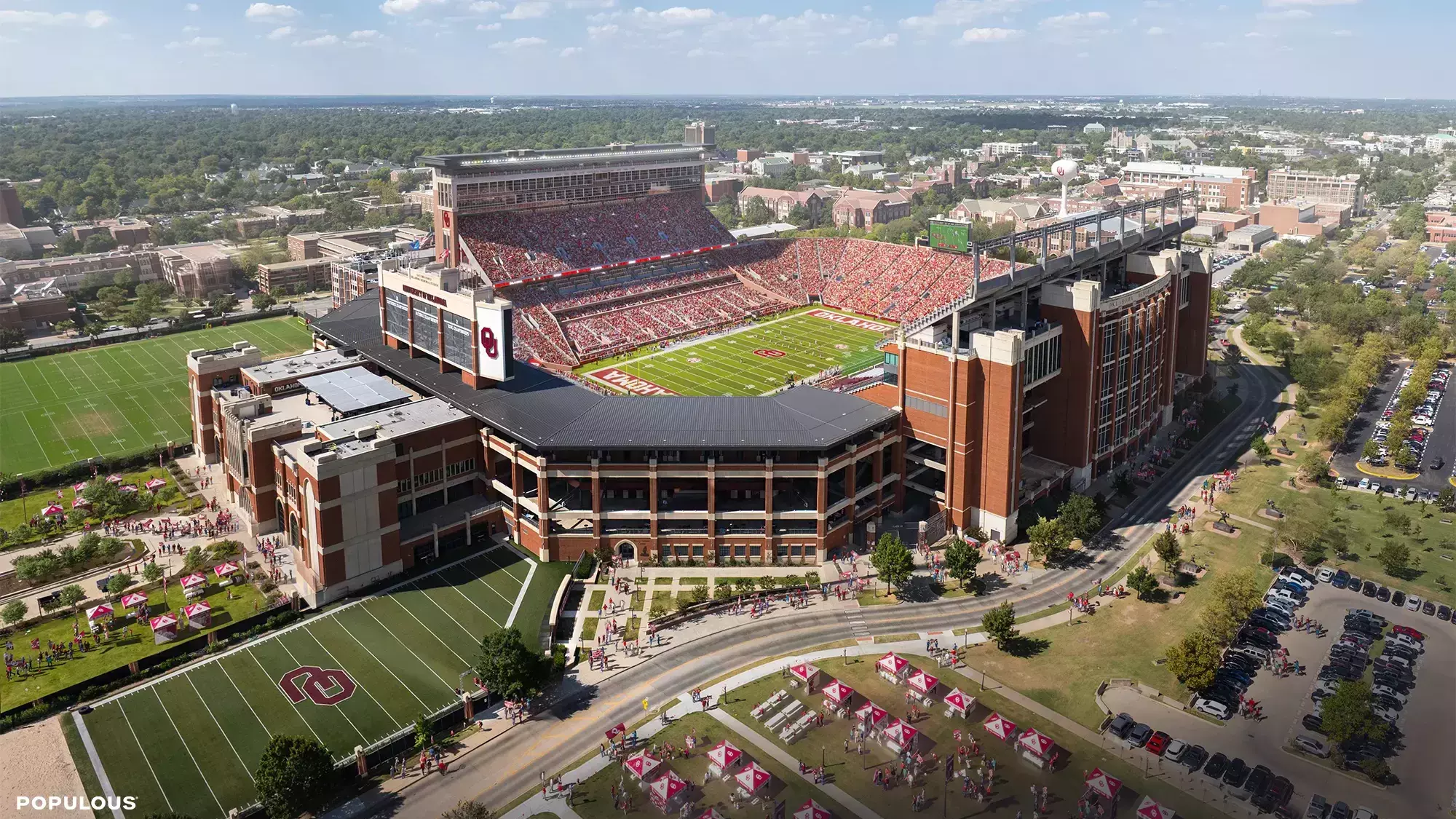
The renovations will eliminate approximately 7,000 general admission seats to make way for 4,000 new club seats, 47 suites and 64 loge boxes with seating to accommodate approximately 280 with six premium club and lounge spaces. Memorial Stadium is ranked among the top 20 largest on-campus college football stadiums in the U.S., with a current capacity of 83,489.
“As experts in collegiate venue planning, we understand a modest reduction in seating capacity is not a loss, but a strategic investment in the long-term quality of the fan experience,” offers Denver Finlinson, Principal Architect for project architectural firm Populous. “Reducing density allows us to improve sightlines, increase personal space, enhance circulation and create new areas where fans can gather, celebrate and stay connected throughout the game. These improvements ensure that every seat delivers higher value, greater comfort and a more memorable atmosphere – strengthening the stadium’s legacy for generations to come.”
They have an eager audience. The OU football team has a 141-game consecutive sellout streak for regularly scheduled home games, which began in 1999. Season tickets for the current season are also sold out.
Other elements that will significantly enhance the game-day experience and home-field advantage include a premier sideline-oriented sports lighting system and upgraded sound – both through infrastructurally increased crowd noise and a state-of-the-art speaker system.
“Our design approach for Gaylord Family – Oklahoma Memorial Stadium is focused on creating a game-day experience that truly prioritizes the fan,” continues Finlinson. “By integrating enhanced technology, expanding social and premium amenities and embracing modern fan-experience trends, we’re designing a stadium that feels more connected, more comfortable and more engaging for every guest.”
Populous and Manhattan Construction are the university’s partners on the project. Construction is anticipated to begin following the 2027 season and be completed by the start of the 2029 season. The renovation will result in a stadium-wide reseating process beginning ahead of the 2028 season.
The renovation will be funded by private donations. No state-appropriated funds or student tuition or fees will be used to finance the project. While no timelines was released, a future north end zone phase will offer the university another opportunity to evaluate the stadium’s capacity and make necessary adjustments.
FREE
 Daily Pulse
Subscribe
Daily Pulse
Subscribe
 Daily Pulse
Subscribe
Daily Pulse
Subscribe