
Lightning In A Bottle: How ‘La Fusa’ Became One of Brazilian Music’s Greatest Live Albums
By Ernesto Lechner
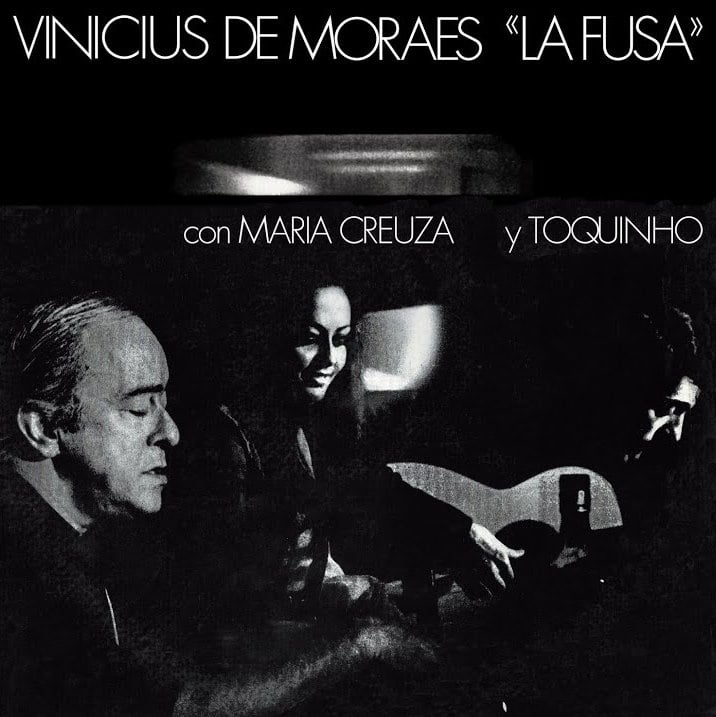
The cover says it all. A stark, black and white photo of three Brazilian performers singing live at a small club in a South American metropolis, it embodies the bohemian charm of the ’60s bossa nova movement – a sound marked by jazzy harmonies, wispy vocals and lyrics celebrating the fleeting beauty of the human experience.
But the image also tells an intergenerational story about an aging poet who took under his wing two emerging artists – a chanteuse with a voice as pure as sunlight, and a young guitarist with an unusual gift for syncopated samba chords. Together, they started a tour that was meant to last two weeks but stretched out for months and resulted in what is probably the finest live album in the history of Brazilian music.
The poet was Vinicius de Moraes, former diplomat and reckless womanizer, the unofficial lyricist of the bossa wave. The singer was future diva Maria Creuza, then 26. And the guitarist was Toquihno, 24, fresh off a lengthy Italian tour. The album they made together was La Fusa, a record that became a best-seller and is still to this day reproduced in its entirety by tribute bands in Buenos Aires.
By 1970, “The Girl from Ipanema” had become a global hit, and the bossa reached its peak. It was the perfect time for de Moraes and his young partners to perform their songs in a chain of small clubs called La Fusa, located across Uruguay and Argentina.
“Vinicius became our teacher,” says Creuza, now 81, from her home in Buenos Aires. “He lent a hand to two young artists who were starting out. To his credit, he gave us complete freedom in selecting the songs that we wanted to perform with him.”
And what a repertoire it was. Besides the expected standards (a luminous “Garota de Ipanema,” a devastating “A Felicidade,” from the “Black Orpheus” soundtrack), the songs on La Fusa underscore the bossa’s frothy, most optimistic side, from de Moraes’ own “Tomara” – about cherishing every moment as if it was the last one – to “Que Maravilha,” an adorable tune by Toquinho and singer/songwriter Jorge Ben about two lovers meeting on a rainy day.
The instrumental backing was simple – guitar, rhythm section, percussion – but the vocal harmonies were incredibly sumptuous: de Moraes’ grave, conversational delivery a match made in heaven for Creuza’s ethereal technique and Toquinho’s softer tones.
“La Fusa was a gorgeous club,” recalls Creuza. “It was small and had a particular luminosity about it. The energy was something else; the warmth, the rounds of applause. People would line up in the street outside, trying to secure a seat.”
The overwhelming success of the shows inspired de Moraes to make a live album, but his perfectionism dictated an astute approach: the stage banter and applause captured at the club was combined with a separate recording done in front of an invited audience – about 30 lucky devils – in a professional Buenos Aires studio.
“The entire album was recorded in two overnight sessions,” says Creuza. “Being night owls, we were in our element. But then I had to return to Brazil, because I had a baby and a family that was waiting for me.”
Sadly, the indelible magic of the first La Fusa record was never recaptured. Creuza was unavailable the following year, and de Moraes replaced her with singer Maria Bethania for a new season of shows and a second live album. A solid effort, it lacks the original’s lightning-in-a-bottle aura.
De Moraes died in 1980 at 66. Creuza and Toquinho developed successful solo careers, and continue performing to this day – sometimes together. The La Fusa record stands as an invaluable memento of the specific moment in time when the bossa mystique shone the brightest.
“I’ve had an amazing career and performed my songs all over the world,” says Creuza with a smile. “But the original repertoire that we selected for that first Fusa album marked me forever. The public embraced me with so much love, and I still think about those moments today.”
FREE
 Daily Pulse
Subscribe
Daily Pulse
Subscribe
 Daily Pulse
Subscribe
Daily Pulse
Subscribe