
The Super Bowl Halftime Divide, Dutch History & What Happens When We Lose Shared Cultural Moments
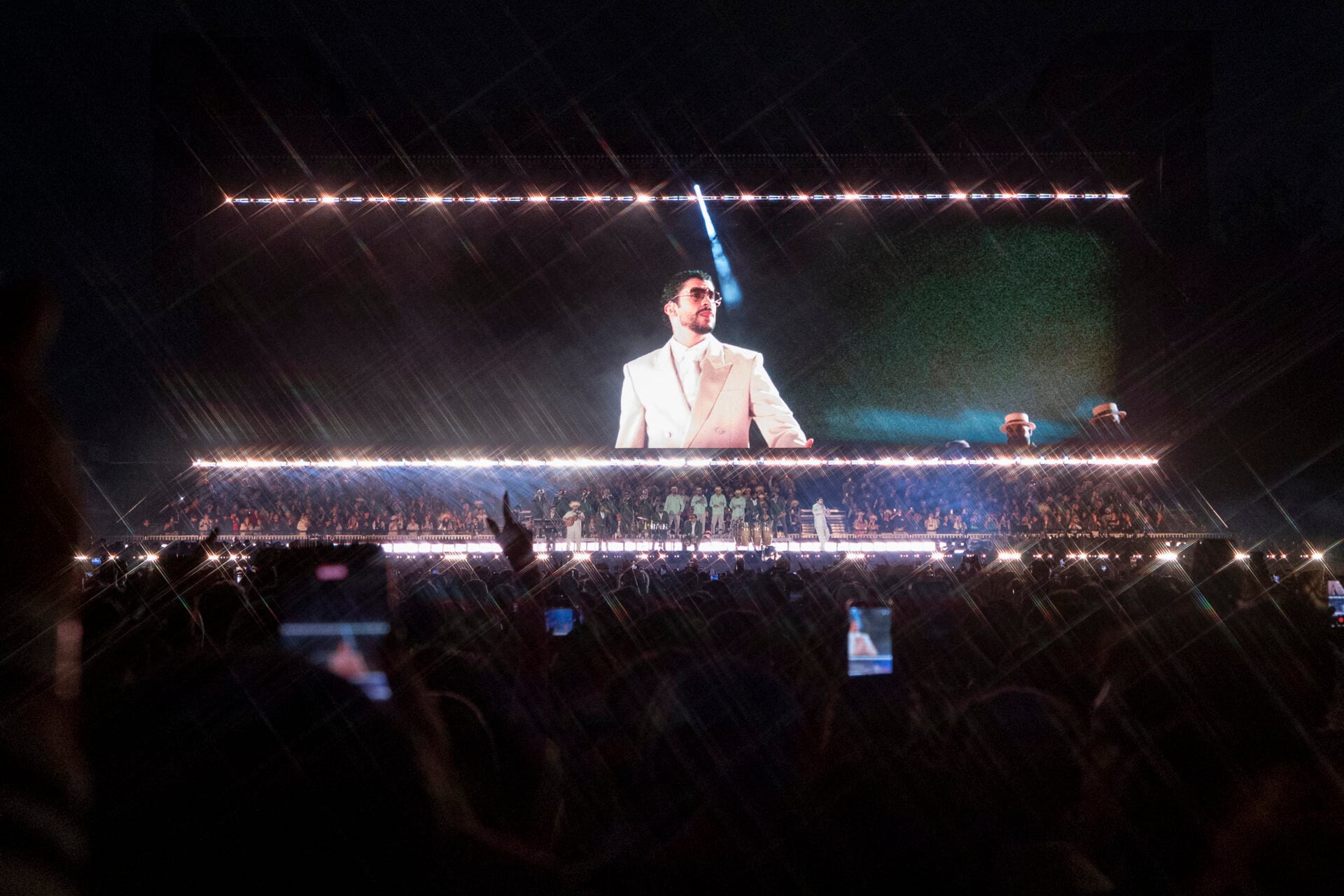
On Sunday, when the horn sounds for the end of the second quarter of Super Bowl LX at Santa Clara, California’s Levi’s Stadium, the New England Patriots and Seattle Seahawks will trod off the field to their respective locker rooms, coaches Mike Vrabel and Mike Macdonald will go through the excruciating tradition of the begrudging sideline interview and in the background, one of the most impressive logistic accomplishments in live entertainment will get underway, as a crew of who-knows-how-many will erect the set for the halftime show.
Long removed from its early days as little more than souped-up college marching performances, the halftime show — with a little help from Up With People — is now an essential part of the extravaganza that is the Big Game and, for the last quarter-century or so, has been led by contemporary hitmakers (though after the 2005 “wardrobe malfunction” performance by Justin Timberlake and Janet Jackson, the NFL did urge producers to gear back into safer, more family-friendly fare; that didn’t last too long).
While complaining about the performer is a national pastime at this point, this year’s choice of Puerto Rican megastar Bad Bunny has been especially controversial. In a time of deep polarization, choosing a singer who performs almost entirely in Spanish and who’s never shy about voicing his criticism of the Trump Administration, particularly on immigration, Roc Nation tapping Benito for the coveted spot has rankled all the predictable people, including the occupant of the Oval Office and his apparatchiks.
Much of the criticism is based on a ludicrous premise: that America’s Big Game should have an American artist. First, the Super Bowl is now global and the NFL’s efforts at internationalizing the game are obvious, with frequent overseas jaunts peppering the regular season. Second, Bad Bunny is in fact an American citizen, as are all Puerto Ricans since the passage of the Jones-Shafroth Act of 1917. And finally, there’s never been a requirement that the halftime show be performed by an American. Unlike Bad Bunny, halftime headliners Rihanna, The Weeknd, Shakira, Coldplay, The Who, The Rolling Stones, Paul McCartney, Shania Twain, U2, Phil Collins and Enrique Iglesias — all of whom have performed at the Super Bowl since the turn of the century — are not Americans.
Nevertheless, Bunny’s selection led to the creation of The All-American Halftime Show, presented by Turning Point USA, the conservative activist group founded by the late Charlie Kirk. Billed as celebrating “Faith, Family & Freedom,” the show, which will be streamed on YouTube and X and broadcast on various religious and/or MAGA-coded cable networks, will feature performances by Kid Rock, Brantley Gilbert, Lee Brice and Gabby Barrett. After plans came together for that, the NFL, in what might be seen as a doubling-down, added Bay Area punk icons Green Day — who have never been shy about criticizing the right — to open the festivities. If Bad Bunny levels his critiques at the administration in Spanish, Billie Joe is all but certain to provide just as trenchant a broadside in throaty English.
It’s worth noting, by the way, that Kid Rock once performed at a Super Bowl halftime, joining Nelly for “Hot in Herre” in 2004. His outfit — a poncho made from a cut-up American flag — drew the ire of Georgia Sen. Zell Miller, a conservative Democrat (remember those?), as a “desecration” of the flag.
But here’s the question: why are we doing this? There are hundreds of streaming services now, growing out of an era of an untold number of cable stations and there are vanishingly few pieces of shared culture in the United States now. Arguably the Super Bowl is the last thing most all of us watch together and discuss together and enjoy together. And the halftime show is part of that. In 2020, Jeb Bush, who no one would describe as some bastion of woke leftist thought and cultural consumption, called Shakira and Jennifer Lopez’s performance as “the best Super Bowl halftime show ever.”
It’s not necessary or even desirable that a country — particularly one as large and diverse as the United States — have a perfectly homogenized culture. But there must be some things that we still share, because down this path is a country where everything is coded as being red or blue.
Starting in the late 19th century, prompted by the views of a charismatic preacher-turned-politician, the Netherlands began an era of what was called “pillarisation.” Virtually every institution in the country — from fairly obvious things like schools and political parties to headscratchers like banks and soccer teams — was separated by religion (Protestant and Catholic) and politics (for the non-religious, there were social democratic and a “general” pillar). Essentially, it all but meant a Dutch person could live the entirety of their life without encountering someone outside their religious or political group, except in the sturm und drung of governance. To draw a parallel, after the Super Bowl, the highest-rated TV programs are usually the State of the Union and presidential debates, which lately haven’t been cauldrons of harmony. Without the Super Bowl, all we’re left with is a venue that’s designed for contentiousness.
The state of affairs lasted in the Netherlands in some form or another into the 70s and 80s, and echoes of it still persist, but the real thaw came when every group was faced with a very real foe, when the Nazis invaded. Stronger together and in need of strategic and tactical unity, the various resistance groups (which originally were in fact pillarised) came together. Culturally, television did much to loosen the old walls, as the Netherlands, like most European countries, had a single national broadcaster (though in 1964, TV too became pillarised, briefly).
The point is this: pillarisation was a choice made by the Dutch, much as our dueling halftime shows and other bits of cultural and social separation are, and it was no doubt a choice made in good faith in the name of harmony. But harmony isn’t four voices singing their own songs in solitude. Harmony is when a mix of voices, bringing different tones to the tune, create a song whose beauty outshines the sum of its parts.
It took a world-historical cataclysm to shatter the Dutch pillars. Let’s hope we find our way out without that.
FREE
 Daily Pulse
Subscribe
Daily Pulse
Subscribe
 Daily Pulse
Subscribe
Daily Pulse
Subscribe