
Alchemy And Architecture Swirl Like A Tropical Breeze At Miami Beach Bandshell
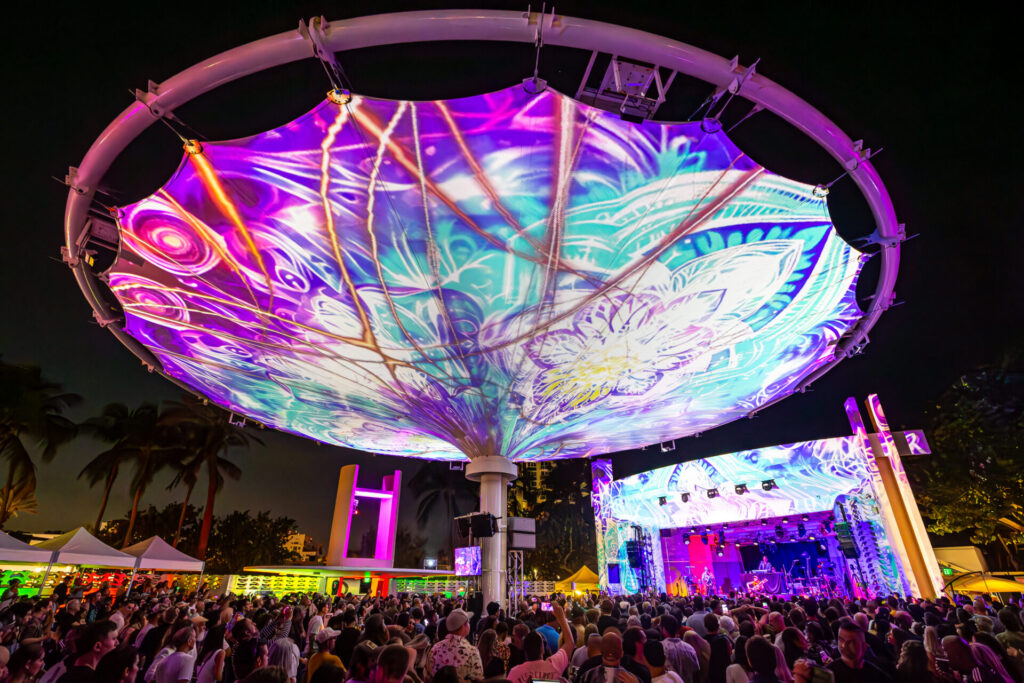
Photo credit Christopher Rivera
The Miami Beach Bandshell is one of South Florida’s most enduring cultural landmarks and a contemporary oasis for underplays and international performers.
“It’s a bit of a hidden gem,” says Adam Ganuza, Executive Director of the Rhythm Foundation, which operates the Bandshell and several other Miami venues. “People love it. I think there’s something about the combination of the architecture and the fact that it’s open air – where you get this beautiful breeze and the silhouette of the palm trees as you see the sun setting behind you and the smell of the ocean. It just makes people feel really good.”
The bowed, concrete shell was built in 1961 as part of the City of Miami Beach’s effort to revitalize the North Beach neighborhood and create a central social hub. It was designed by architect Norman Giller in the distinctive Miami Modern (MiMo) architectural style, which is futuristic with an emphasis on curves, openness and post-war optimism.
The style is unique but not as widely recognized as the neighboring Art Deco district in South Beach.
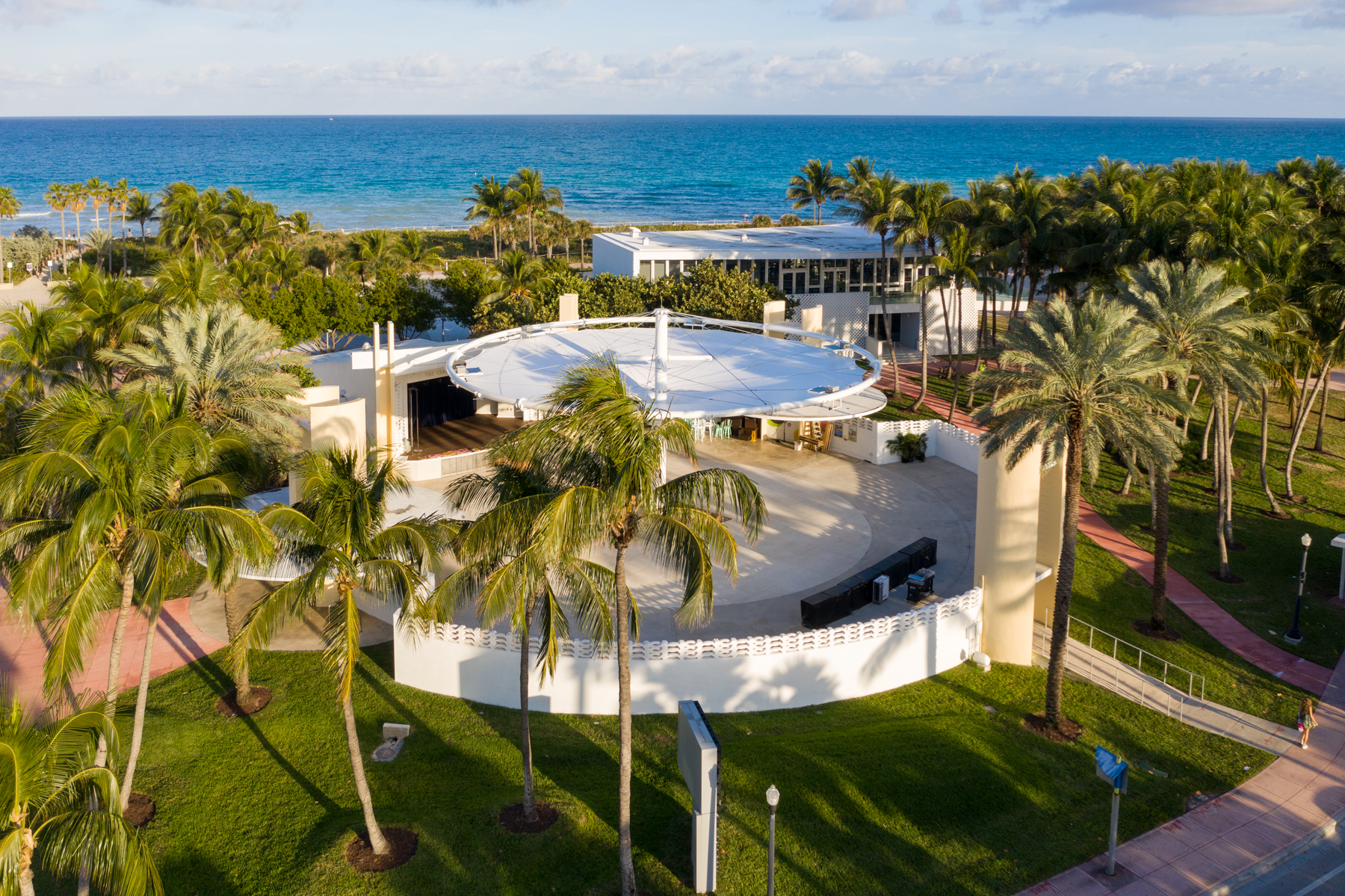
Photo Credit Jonah Gouin
“Art Deco is characterized by a certain degree of playfulness to it, the round windows, bright colors with certain types of horizontal and vertical elements. Art Deco is what you think of when you think of Ocean Drive,” explains Ganuza. “Whereas Modernist architecture is defined by an almost mid-century take on what the future is going to look like – canopied structures and a kind of pseudo futuristic ‘Jetsons’ vibe.”
Owned and funded by the City of Miami Beach, the outdoor venue was a gathering place for families and tourists and a symbol of civic pride and arts accessibility billed as “The Ballroom Under the Stars.”
“On a Saturday night, they would have big bands and all folks in the neighborhood would go out and dance,” says Ganuza. “And for many, many years, that was the main type of programming. From its very inception, it was designed to be center for arts and culture and community life.”
By the 1990s North Beach tourism had declined, funding for maintenance dropped and the Bandshell fell into disrepair. Programming became spotty and the underutilized facility was on track to become a parking lot. The structure survived largely because of local preservation advocates who recognized its architectural and cultural significance.
“There were four of these bandshells in Miami Beach originally, and this is the only one that survives,” says Ganuza. “That’s thanks to the vision and investment by the City of Miami Beach.”
In 2009, the nonprofit Power Access (now operating as the Rhythm Foundation) partnered with the city to restore and manage the venue. Major upgrades included structural repairs, quality sound and lighting systems, accessibility improvements, better seating, weather proofing with a central canopy and a modernized backstage.
“Let me tell you, that building with its post-war engineering and construction – trying to put a screw in the wall is impossible because it is so well constructed,” laughs Ganuza. “It’s a very solid building.”
Difficult or not, the renovation signaled the rebirth of Miami Beach Bandshell as a professional music venue.
Under the Rhythm Foundation’s leadership, shows ballooned from 15 to 140 a year with international, national and local talent as well as collaborations with dozens of area non-profits. In 2023, the Miami New Times named the Bandshell, best live music venue in Miami and in 2024, Time Out magazine dubbed it the best outdoor live music venue in the city.
The Rhythm Foundation has transformed the Bandshell into a curated cultural institution rather than just a rental stage. The mission has been to present culturally important acts, keep ticket prices affordable, serve both tourists and locals, represent the community’s diverse immigrant communities and blend education with entertainment.
Today, the 1,200-capactiy Bandshell is known as a premier world music venue featuring Latin, Caribbean, African, jazz, indie, electronic and heritage acts attracting 80,000+ patrons a year.
“It’s an intimate scale,” says Ganuza. “If you see a show there the artist is four feet, five feet, six feet in front of you. People come and they are just in a great mood. …It’s hard to describe to people, but when you go into the space, you get it.”
The shape of the venue works like a giant ear-shaped amplifier.
“The way the stage itself is shaped, it not only amplifies the sound, it sends it out and along the ring of the Bandshell so it creates this warm enveloping acoustic environment,” says Ganuza. “Remember, this space was designed for acoustic music, for big bands that did not use amplification – amplification was added after the fact.”
Over the years, the Bandshell has hosted artists such as Erykah Badu, Janelle Monáe, Buena Vista Social Club alumni projects, Thievery Corporation, Preservation Hall Jazz Band, Lee “Scratch” Perry, Celso Piña, Antibalas, Los Amigos Invisibles, Ibeyi and Tank and the Bangas.
“What has been key to our success and to the goodwill that we’ve built with our audience is trying to stay relevant and reflective of the diversity that we have here in Miami,” explains Ganuza. “So, our programming tends to lean towards music coming out of the Americas and the Caribbean.”
The Foundation books a third of the dates but also works with local arts groups and a variety of promoters from indies to the majors – but it all booking is done through the lens of what’s best for the local community.
“We do maintain a curatorial vision and voice that’s important for us,” says NAME. “So, we don’t just give every show a date. It has to work because by this time, we have a good sense of what plays well in our market – and what doesn’t. And it’s best we position promoters for success.”
The Miami Beach Bandshell has a 10:00 PM curfew and the Foundation has to be mindful of what they book.
“We are an open-air venue in the middle of a city. So, we become the soundtrack of the neighborhood when we have a show,” says Ganuza. “We are cognizant of everything that happens on the stage at the Bandshell – everybody in the neighborhood whether they want to or not, will be able to hear it. So, we tend to do things that are more family friendly.”
The venue is also home to several festivals including the North Beach Music Festival, Miami Music Week, Art Basel Miami Beach and Montreux Miami Jazz Festival, which programmed a Miles Davis tribute at the Bandshell on Feb. 25. Miami Beach residents were offered discounted tickets with proof of residency to see the Miles Electric Band (led by Davis’ nephew Vince Wilburn Jr.) and the Kind of Blue Acoustic Band.
Affordability is central to the mission. On average, ticket prices are in the $30-$35 range, a beer is $8 and a quarter of the shows are free to the public – thanks to financial support from the city, county, private donors and other foundations.
“If we want to be true to our stated goal of being a cultural anchor for the community, then accessibility plays a role in that,” offers Ganuza. “Especially, because our neighborhood and many of the neighborhoods within our core audiences, the majority are working class neighborhoods, and so we try the best we can to keep our pricing at on the lower end of the market. …Accessibility is a conscious decision on our part.”
FREE
 Daily Pulse
Subscribe
Daily Pulse
Subscribe
 Daily Pulse
Subscribe
Daily Pulse
Subscribe