
Pollstar Live! 2026: Breaking New Artists – The First Tour Cycle
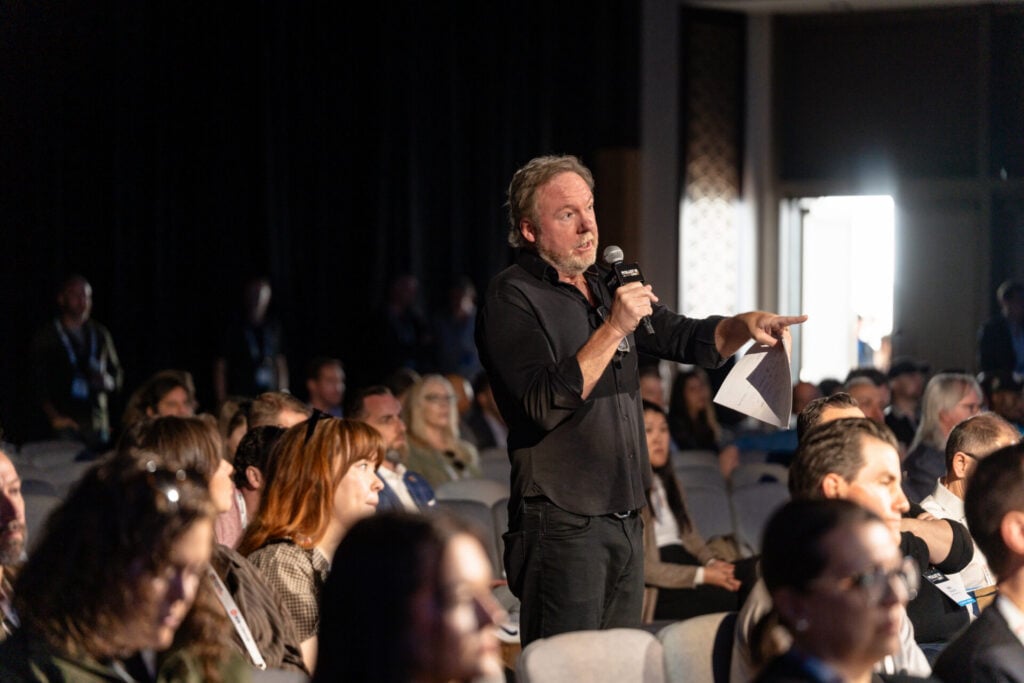
The first panel on the second day of Pollstar Live! called to mind The Clash: “Should I stay, or should I go.”
Not for the early-riser audience, but as it relates to baby bands eager to hit the road.
Moderator Bruce Flohr of Red Light Management worked the floor and navigated questions about timing, tools and the trade with panelists John Chavez of Ground Control Touring, Olivia Mirabella of CAA, Nate Sokolski from The*Team, Nick Storch with Independent Artist Group and Adam Sylvester of Live Nation.
The conversation revolved around how agents, managers, promoters and collaborators including venue operators build a sustainable touring career for a new act from the ground up and the signals when it’s time for an artist to tour.
“The first thing on people’s minds isn’t necessarily ‘How am I going to make this a successful thing?’ It’s more about reaching out directly to their fans,” said Chavez.
Many acts are DIYing their way to recognition with house shows, basement shows playing any small room that gets them in front of potential fans.
“They are beginning to figure out who they are as artists and what direction they want to go,” explained Chavez. “It’s like a primal pull towards wanting to play and make connections with people in the first place. From there, you can look at it and see if this if going to develop into a meaningful career, a touring career.”
Building a base one fan at a time isn’t a new concept, but access to data has changed how decisions are made about where to potentially find them.
“If you’ve done your local territories, you start growing out of it, then obviously metrics that we have access to now will show you where your biggest cities are – where an audience would exist for you if it’s a market you haven’t been to,” said Sokolski. “Having access to that data – which we hadn’t had for a long time – is a bit of a blueprint to where to go and when.”
Storch fielded a question about the overall health of the independent club scene: “There’s more content than ever and more artists are playing, but there’s more things filling the venues. It’s not just bands – it’s comedians, it’s podcasts, it’s everything. So, in a sense, it’s healthy, but I think on the other side of it – thinking as an agent – there is so much more competition to get people’s attention.”
Tools from admats to data is useful, but for Mirabella, working with an artist who has a story to tell and the ability to authentically connect with people is fundamental to success on the road.
“What’s really important is an artist being able to tap into their community and being able to interact on a one-on-one level with their fans and their audience,” she said. “I mean, we’re in the business of monetizing community, so what’s really important is for an artist to know who their fans are and to be able to actually promote their own shows. …Promoters have too much to promote right now. It really is on the artist.”
Flohr acknowledged that if the artist doesn’t have a strong vision, there needs to be someone on the team in the role of creative director to craft the story and oversee consistency of the message across the entire artist ecosystem.
“I’m starting to look at the way I allocate our resources as a company,” he said. “I’m going to start investing more in that side of it and lean in more to the fans. The P1 fans. The real fans who are going to show up every time. Get them on board as opposed to the spray and pray mentality.”
The group took several questions from the audience including best practices for generating attendance in off-the-beaten-path markets where visiting bands are often unknown.
“It goes back to the initial question of when do you tour? And why do you tour?” queried Sylvester. “If there is no awareness for the artist, you’re going to struggle to create awareness. It’s got to come from the artist first.”
For venues, Flohr who has a stake in Ventura Music Hall in California, encouraged small venues to start their own Spotify playlist to help promote upcoming shows and draft off the popularity of one band to lift the profile of another with the “If/Then” approach – “If you like this band, then you’ll like this band,” he said.
Chavez stressed the importance of having a local champion and called out McAllen, Texas, as an example of a market that punches above its weight because of the time Patrick Garcia at Tiger’s Blood has spent building the local music scene.
“Now all of a sudden we have a band that can put up 200 tickets in Austin but we’re putting up 300 tickets in McAllen Texas, and that market is 1/20th the size in terms of population,” explained Chavez. “Having that local champion identifying the people who are there in the scene, within the scene, is really important for building a scene from the ground up.”
The panel discussed ticket pricing ($15-$20), must plays like Baby’s All Right in NYC and Zebulon in Los Angeles, tour packages and when a support position is the right business strategy.
“Support is always a bit of a crapshoot,” said Mirabella. “In theory, it’s always an amazing idea if the band isn’t ready to headline – so what’s the alternative? But a lot of times support is chosen artist to artist. …You actually have to compare fan bases first, rather than maybe overlap in the genre of music that the artist is supporting.”
“It’s really important to communicate to the artist that this first tour isn’t going to be a money maker,” added Sokolski. “It’s so much better for the storytelling to price the tickets low and sell out immediately. That is the goal and the focus and less about the bottom line in the first stage.”
In some cases, new acts have been discovered virally and don’t have experience performing live. Flohr suggested putting them in controlled situations with a built in audience.
“A lot of these artists have to learn how to play in front of an audience if they’re coming from a viral moment, because the bedroom is not the same as the stage,” Flohr said.
The business team around the artist is equally important.
“Honestly, sometimes it’s more important than the artist,” offered Mirabella. “You want to make sure there is no ego in it – you’re all working towards the same goal. There is nothing more frustrating than trying to get something done for an artist and you can’t get the manager to respond or pick up the phone. …You want to make sure that you’re working with good people because that’s where you’re going to find the win.”
FREE
 Daily Pulse
Subscribe
Daily Pulse
Subscribe
 Daily Pulse
Subscribe
Daily Pulse
Subscribe