
From Red Dirt To Red Rocks: Treaty Oak Revival Rises
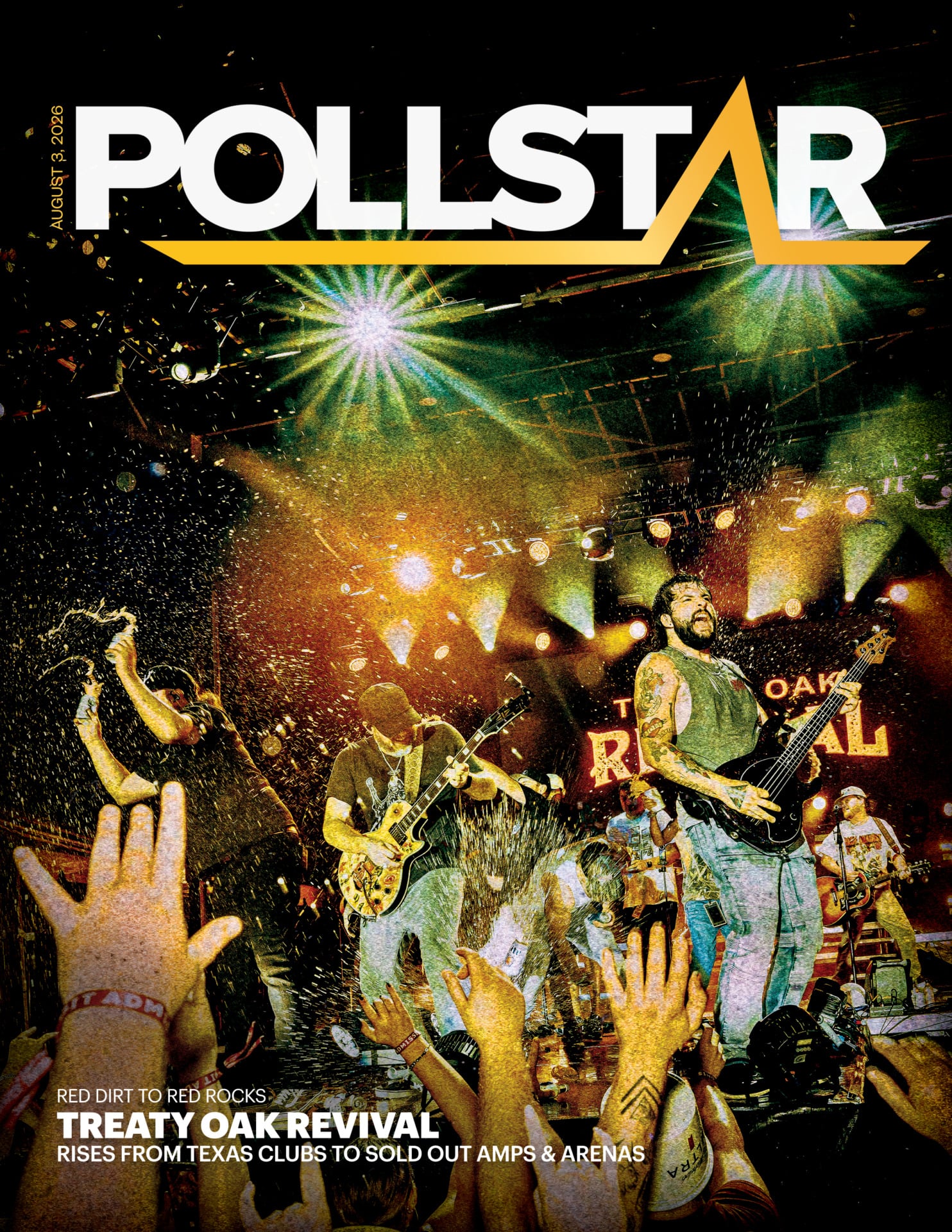
Perhaps too hard for traditional country radio and too country for mainstream rock with dashes of punk, Treaty Oak Revival has created a hybrid that feels fresh, rebellious and very Texas.
Their music combines the storytelling and working-class themes of Texas country with potent guitars, heavy percussion and the attitude of early 2000s punk and post-grunge groups. Lead singer, primary songwriter and guitarist Sam Canty has described the approach as essentially a rock band with a country accent.
“We come from Texas, so in order to do well, I feel like in that market you kind of have to play country music, which is fine – we all like country music – but at the same time we also like rocking out,” he says. “So, we decided let’s just take that kind of vocal style and then apply some heavy guitar and awesome drums to it and go from there.”
Behind the band’s distinctive sound are guitarist Lance Vanley along with Vanley’s uncle Jeremiah Vanley, who is known for his blues/grunge/hard rock-inspired guitar solos, Cody Holloway’s punk-influenced drumming and masked bassist Dakota Hernandez, who joined after founding member Andrew Carey left the group in June 2025.
The band formed in Odessa, Texas, and their identity is tied to the culture of West Texas: oil fields, small towns, desolate highways, hard living, fierce loyalty and mistakes. They don’t project the carefully polished image often associated with Nashville. They come across as a group of friends and family who know how to rock with modest ambition they’ve blown far past.

“Our main goal was just to play music for a living – that was our main goal, and to play shows outside of Odessa,” says Canty. “We thought we made it when we played the Blue Light in Lubbock. So, the fact that it has turned into what it is now is way beyond our expectations. There’s no way we could have seen this coming or even dream this. It’s just…it’s been crazy.”
That intrepid authenticity connects. Fans often describe them as sounding like people they know singing songs about real life not some contrived version of the truth.
The gritty working-class anthems are built around imperfect people and subjects that ring true even when they sting: bad decisions, drinking, regret, broken relationships, loneliness and finding the will to keep moving forward.
“Every song that I try to write, I draw from either personal experience or experience from somebody who I’ve been close to, or who I know,” says Canty. “It all kind of comes from personal, personal problems and personal experience.”
The dark lyrics and vulnerable edge beneath loud guitars connect because the songs feel like genuine treaties on hard living like “No vacancy,” “Ode to Bourbon,” “Missed Call” and “Bad State of Mind.”
“I would say the main thing that caused us to gain momentum and gain traction and actually do this as a job would be original music,” opines Canty. “We were just playing cover songs, but then once I joined and Lance joined and Andrew joined, I had some originals, so we started playing those, and then we found out that we played those songs really well together.
“And like that, they could take these songs that I had that were bare bones and make them into these incredible, incredible songs. I think that is what really let us know that maybe we got something here that can hold up with what other people are putting out.”
From the start, Treaty Oak Revival has remained independent on stage and off.

Their releases have all come out through their own imprint, TOR Records, rather than a major or established independent label.
The catalog shows a clear evolution from raw Texas Red Dirt roots on No Vacancy, to broader more polished songwriting on Have a Nice Day and finally to the heavier, arena-ready sound of West Texas Degenerate, which debuted at No. 1 on Billboard’s Top Rock Albums and Top Americana/Folk Albums charts in November. A live album recorded on the road is currently in the works for this fall.
Despite not being signed to a major label, they’ve numerous RIAA certifications and have received award nominations from the Billboard Music Awards, Academy of Country Music Awards and the American Music Awards all while retaining complete creative control and building an audience through streaming, touring and word of mouth.
One of the biggest indicators of their ascent is the band’s massive streaming growth, which has surpassed 4 billion global streams and is approaching 10 million monthly listeners on Spotify. The numbers are especially significant because it reflects organic discovery on the road rather than heavy radio exposure.
“The guys have earned five Gold singles, five Platinum singles and two Gold albums 100% independent,” explains manager Andy Friday, COO of Bob Doyle & Associates in Nashville. “And I’m just not sure who else is doing that. But I would say their success isn’t manufactured. It’s literally been earned one fan at a time – the scale has changed, but the relationship is the same between the band and the audience.”
Treaty Oak Revival’s live show is where they meet and grow the congregation. The band has earned a reputation as a high-energy, crowd-driven live band. But it didn’t’ start out that way.
“Sam and I would go to local shows, and we would just watch bands, and we’d take notes of what was cool,” recalls Lance Vanley. “We didn’t have a lot of money for a really long time for all these lights and stage equipment. It was like, ‘What can we do for free to make it a better show?’ And that was the thought for years. What can we do better? What can we do bigger, for free? And how does that translate to interacting with the audience? We found practice makes perfect – you learn what lands and what doesn’t.”
“It’s just become what it is,” adds Canty of the flexed sinew of a TOR show. “The fact that it is kind of improvised every night, means that you’re not getting the same show twice, which we like that as well.”
Treaty Oak Revival’s concerts attract fans who are as comfortable at a country festival as they are at a rock show. They have transitioned quickly from Texas clubs to major festivals including Stagecoach, Bonnaroo, Vans Warped Tour and Lollapalooza to opening for Zach Bryan and Koe Wetzel, which Canty refers to as a “business trip” before headlining their own arena and amphitheater dates in 2026.
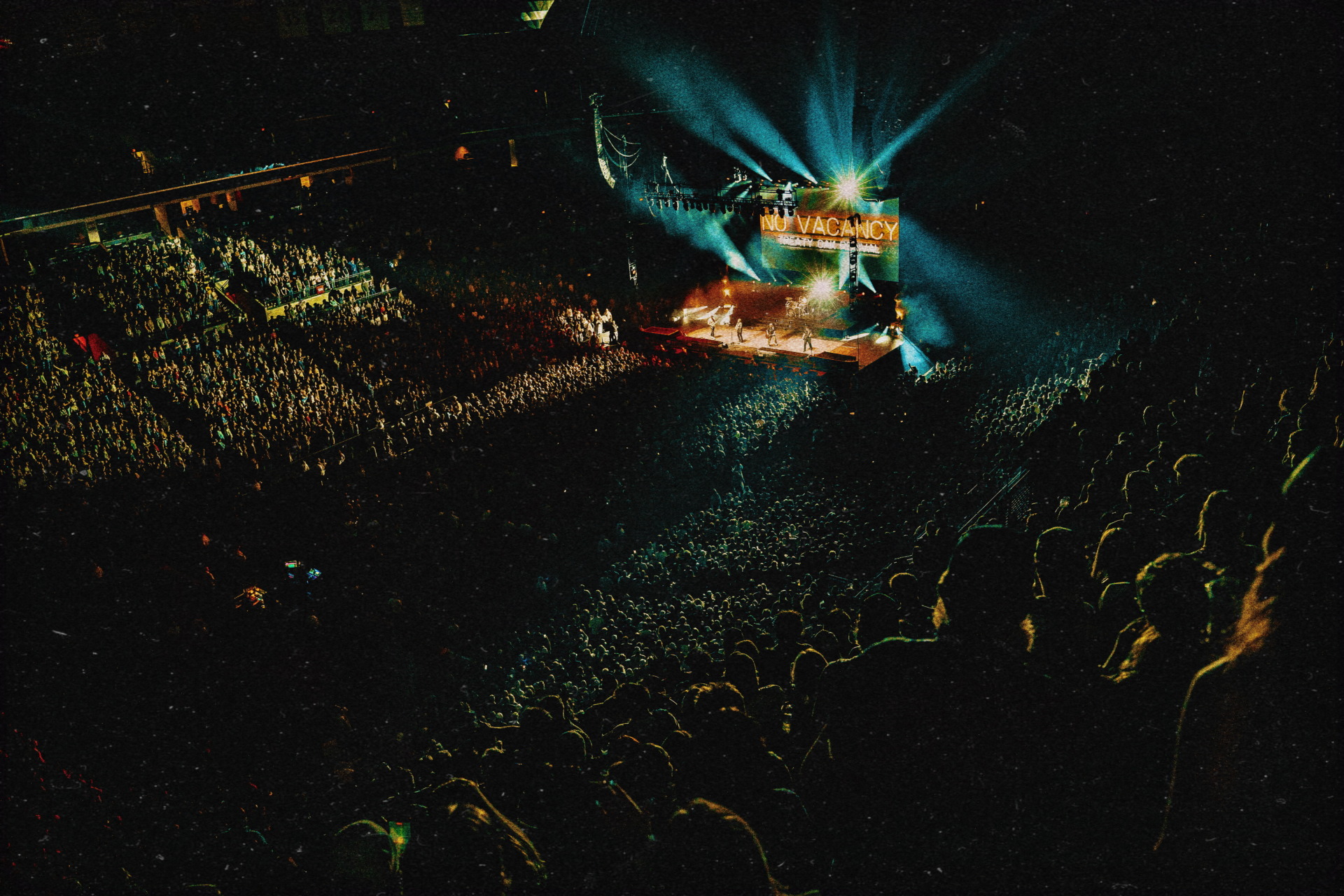
Photo credit Paige Williams
“We tried to learn everything we could from their crew, and their show, and how they did things,” says Canty of being the opener. “We had plenty of time to practice our stage presence and how to work a crowd of that size. So, by the time we got done with that tour and it was time for us to start doing our own arena tour we had already been playing arenas for 45 minutes a night 22 times last year. We were ready to go, you know, just business as usual.”
From Red Dirt to Red Rocks, the band is nimble and the energy encompasses loud guitars, hardline drumming and big sing-along choruses.
“From day one, Treaty Oak and the management team bought into the idea of being hard ticket driven and building your own fan base by putting yourself in front of them,” says agent Andrew McWilliams, owner of Evergreen Artist Group in Austin. “It’s an old-school expression, but building it brick-by-brick, and playing the 300-cap club, and then jumping to the 1,000-cap club, and the 2,500-cap, and the 5,000 and ultimately to what they’re doing now.”
“Hard tickets is what our business has always been about,” offers Bob Doyle, owner and President of management company Bob Doyle & Associates. “I think what you see with this band are great songs, a great show, and they did this really through almost a viral environment. …Without great songs, I don’t think they’d be there. Without a great show, it wouldn’t be what it is right now.”
Early on, Treaty Oak Revival mined the Texas club scene in small collegiate markets like Stephenville or Nacogdoches.
“They’re not always on everybody’s top touring list, but they’re full of Treaty Oak-style fans,” explains McWilliams, who credits agent Lila Woodland with the day-to-day muscle. “And when you go there and you see 1,000 kids that are between 18 and 25 years old at these college clubs, in these college markets in Texas, well, that’s an indication that if it’s going to work here, then it’s going to work in Starkville, Mississippi, or Tuscaloosa, Alabama, or Oxford, Mississippi, and Clemson.”
The Treaty Oak trajectory is one of the more impressive recent examples of a grassroots band becoming an arena-level act. According to 2026 Pollstar Boxoffice Reports through July, the band has played 31 shows with a gross of $23,923,820 and 325,278 tickets sold – the vast majority sell-outs of 10K+ capacity venues.

Photo credit Paige Williams
That includes back-to-back sold out shows in Nashville on May 16 at Bridgestone Arena ($1,033,247 gross/14,107 tickets), followed the next night with a concert at the Ryman Auditorium ($186,814 gross/2,269 tickets).
In 2023, according to Pollstar data, the band logged 52 shows with a gross of $732,339 and 40,349 tickets sold. In 2024, that number jumped to a gross of $3,700,662 from 100,261 tickets sold across 50 shows. Treaty Oak Revival played slightly fewer shows in 2025 and grossed $14,864,534 with 270,097 tickets sold.
“It was never, ‘We’ve got to have the best placement on this festival. We’ve got to support this act in these arenas,’” says McWilliams. “It was, ‘Hey, we’re going to control what we can control. We’re going to do it on our own and we are going to count. We’re going to take ownership of ourselves by focusing on the hard ticket and the headline dates.’ And they weren’t afraid to go grind it out.”
The band is an uncommon independent success story churning it out on the road meeting fans in the trenches.
“There are no barriers between these guys and the fans,” says Friday. “Where a lot of people handle the business different, those guys just see people as people. …They all worked blue collar jobs before all this massive success, and I think that’s what keeps them grounded and what keeps them relatable to people.”
“Any room you put them in, as long as they’ve got that rowdy, fun, excited fan base in front of them, they’re going to deliver the best show that they’ve ever delivered,” adds McWilliams. “And they continue to do it every time.”

Their rise fits a broader movement sometimes called “Y’allternative,” among artists who reject the defined lanes of country, rock, punk and Americana such as Whiskey Myers, Cody Jinks, Bryan and Wetzel. But Treaty Oak Revival’s differentiator is that they lean harder into the punk/rock side than most of those artists.
Seizing swagger and desperation by the throat, Treaty Oak Revival is country enough for Texas but still rock enough for outliers.
“Our fans deserve to have their lives changed by music,” says Canty. “They deserve to have music and songs that feel true to where they are.”
Treaty Oak Revival has captured a moment when a lot of younger listeners no longer see a wall between country and rock. They are essentially making Texas bar-band music for a generation raised on both country and Warped Tour and they have turned that mix into a powerful live experience.
“I think fans today are rewarding authenticity over categories, and Treaty Oak Revival isn’t trying to fit into a lane,” says Friday. “They’re just making music that reflects who they are, and audiences are responding in a massive way.”
Their story is closer to bands like Whiskey Myers or Turnpike Troubadours who built intensely loyal audiences outside the traditional country machine and then broke into the mainstream. The key question now is whether they can convert their passionate fan base into a long-term national and international touring franchise.
“What excites me is the continued development,” says McWilliams. “We’re nowhere close to being done or thinking ‘Hey, we’ve reached what we need to reach.’ There’re so many more markets and opportunities and venues to uncover. It’s just being responsible about pacing and when we play and where we play and really looking at everything we’ve done in the last three to five years and making sure that the next play is meaningful and intentional.”
“Well, at this point, I’m very happy with whatever happens after this,” adds Canty. “I mean, after this year and probably the first half of next year, I will have crossed off all of my bucket list places.”
FREE
 Daily Pulse
Subscribe
Daily Pulse
Subscribe
 Daily Pulse
Subscribe
Daily Pulse
Subscribe