
$7 Billion Worth of Pomp And Pageantry: University Stadium Renovations Reach New Heights

College stadiums are more than football venues. They are a gathering place for generations of students, alumni and fans, a symbol of pride for the university and the backdrop for some of the most memorable moments in gridiron history.
Revered by devotees, stadiums are economic drivers for college athletic departments and today, dozens of programs are wrapping, starting or planning extensive stadium renovations at a combined estimated cost of more than $7 billion nationwide.
It’s changing the game on and off the field.
Athletic departments have shifted from investing in athlete-only facilities such as training centers and high-end locker rooms toward fan-facing stadium improvements, leading to new revenue opportunities.
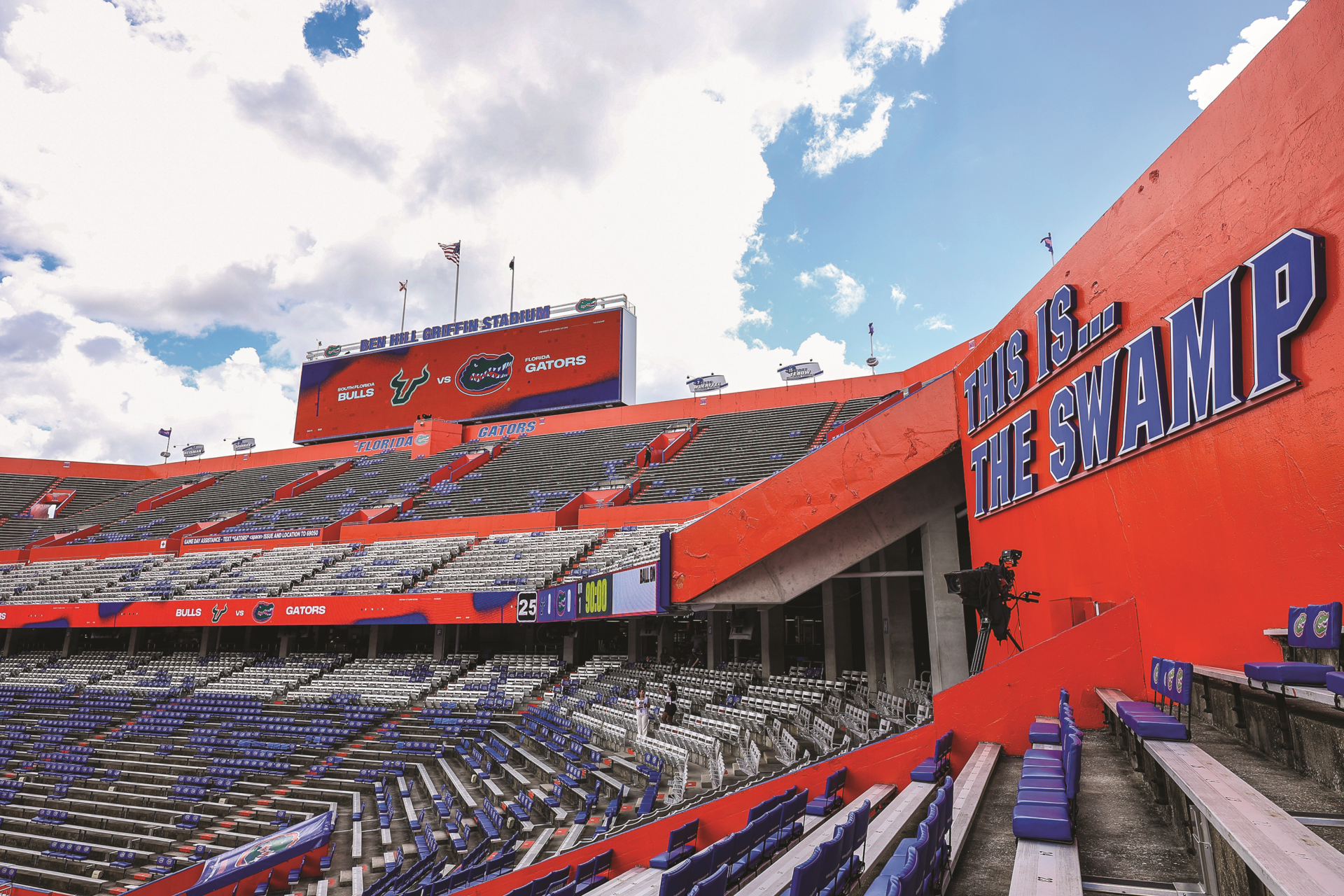
Photo by James Gilbert / Getty Images
“There was this moment in collegiate sport for athlete recruitment and having these beautiful weight rooms and locker rooms, suites and lounges, and it was all about recruitment,” says Ryan Freeland, Principal at architecture and engineering firm DLR Group. “Now with NIL, it’s all about revenue generation to support the NIL fund. We’ve brought this full circle back to the fan, the patron, by creating this multitude of different experiences so that any part of the fandom can choose their own adventure.”
Rather than increasing seating capacity, many schools are reducing general seating to add higher-value premium clubs and hospitality spaces that generate recurring and higher revenue.
This wave of modernization is expected to continue through the remainder of the decade as universities adapt facilities to new economic realities in an era of NIL and revenue sharing.
“There’s a significant gap that’s been created that they didn’t have three years ago with the NIL and the revenue share,” says Nate Appleman, Director of design firm HOK’s Sports + Recreation + Entertainment practice. “And really the only way to close the gap is to further capitalize on the biggest revenue engine that these schools have, which is the football stadium. So, that’s really what has sparked this.”
Renovating stadiums is viewed as a long-term investment that helps universities remain financially competitive while reducing reliance on tuition, student fees or university subsidies.
The NCAA’s move to allow schools to share revenue directly with athletes became official on June 6, 2025, when U.S. District Judge Claudia Wilken granted final approval to the landmark House v. NCAA antitrust settlement. Although the NCAA and Power Five conferences agreed to the settlement in May 2024, it required court approval before taking effect. Division I schools that opt into the settlement can share up to $20.5 million annually with athletes in the first year. The cap is expected to increase over time based on athletic revenues.
The settlement fundamentally changes college athletics by allowing schools to directly compensate athletes in addition to scholarships, while NIL deals with third parties continue under new oversight rules. The settlement also provides approximately $2.8 billion in damages to former Division I athletes who were unable to earn NIL compensation under previous NCAA rules.
Many universities are now preparing to share millions of dollars annually with athletes, which has created a need for new, dependable revenue streams as the costs continue to rise for scholarships, coaching salaries, travel, facility maintenance, sports medicine, technology and game-day operations.
Universities are taking a page from the mainstream venue playbook; premium seating generates higher returns. Luxury suites, club seats and hospitality spaces produce substantially more revenue than traditional seating. Renovated venues also offer more opportunities for naming rights, sponsorships, digital advertising and branded hospitality spaces, creating additional revenue.
“It’s the trickle-down effect,” says Freeland. “You look at the professional leagues, and you start to see that come through in the collegiate and D1, the Big Four – the Power Four, now. It’s the hospitality, the ‘Sportsitality’ approach.”
University stadiums are increasingly designed to be integrated into multi-purpose districts and host multiple events including festivals, commencement ceremonies, corporate meetings, community gatherings and concerts, which generate income in the offseason.
Stadiums that were once out-of-bounds for tours are now welcoming major concerts. The biggest in 2025 was Zach Bryan and guest John Mayer at Michigan Stadium (The Big House) with an attendance of 112,408 – the largest ticketed concert in U.S. history at the time and the first headline concert at the stadium.
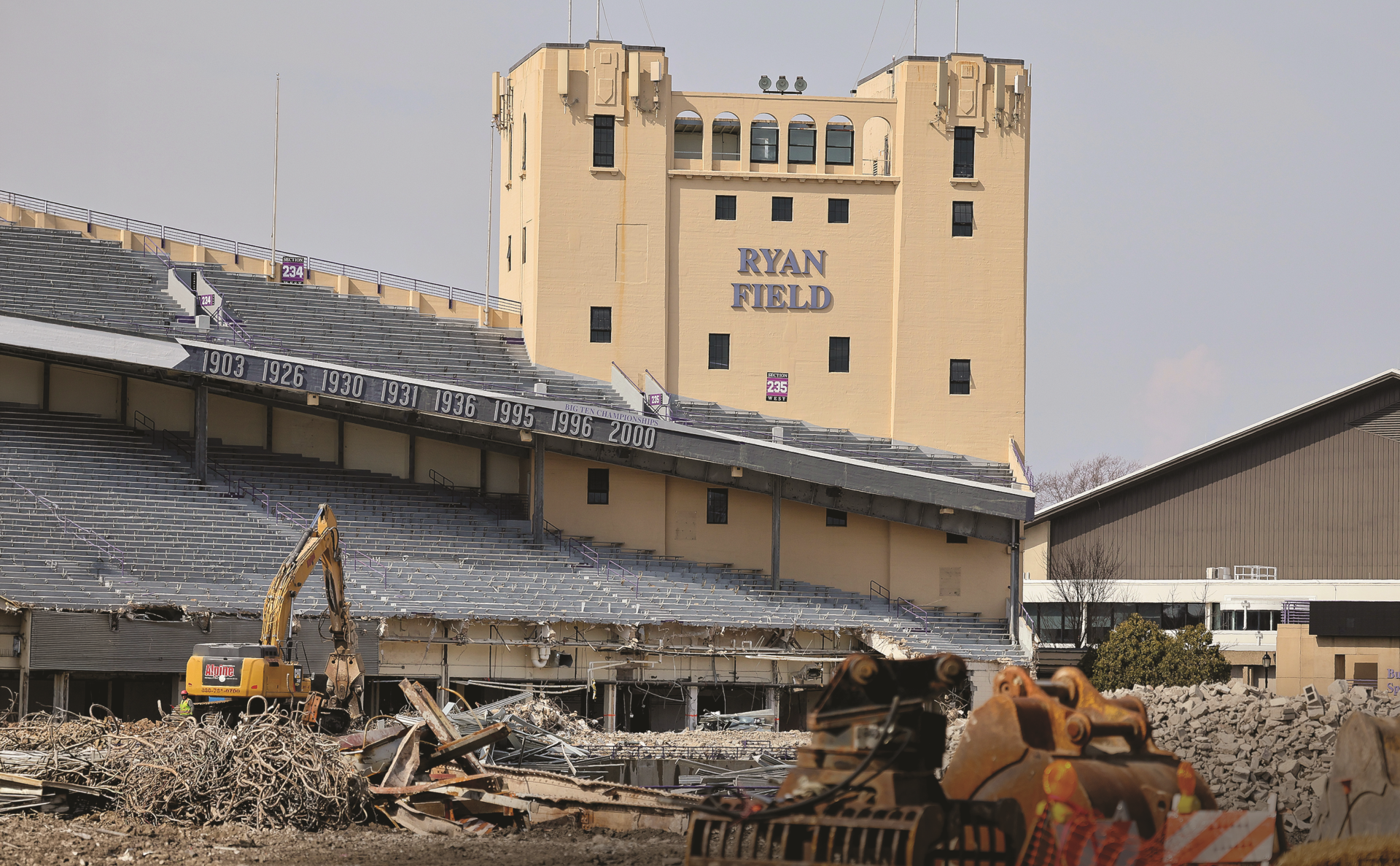
Photo by Michael Reaves / Getty Images
These events generate record attendance, new revenue streams and demonstrate that college venues can serve as year-round entertainment destinations.
Facilities are being updated to appeal to the changing tastes of consumers including comfortable seats, quality dining options, reliable Wi-Fi and mobile ticketing. By providing enhanced amenities, universities are hoping to attract more attendees, encourage repeat visits and increase spending on concessions and merchandise.
The end game provides universities the added financial stability – beyond unpredictable television deals and donor contributions – to support athletes, maintain competitive athletic programs and preserve historic venues.
Except for cases like Northwestern University, which demolished Ryan Field to construct an entirely new $870 million stadium opening this season, most universities are opting to renovate existing stadiums rather than build new, costlier facilities.
“Renovation offers them an opportunity to generate more revenue, spend less money, still keep the history and tradition of the building and hopefully make as many people happy as they can, including the CFOs of the university who are trying to figure out how to balance this out now,” adds Appleman.
Finding a balance between adding modern amenities while preserving the historic character is a priority.
“There’s not a one-size-fits-all approach,” says Freeland, whose company is currently working on projects at Sam Houston State University and the University of Missouri.
“There’s a process. And as we strive for design excellence in everything we do, one of those tenets is designing for the spirit of place, and so we start with research. We start with conversations with all sorts of different stakeholders. It’s being able to cue off of experiences and tradition and really leveraging tradition to help inspire some design language.”
Courtesy Boise State University
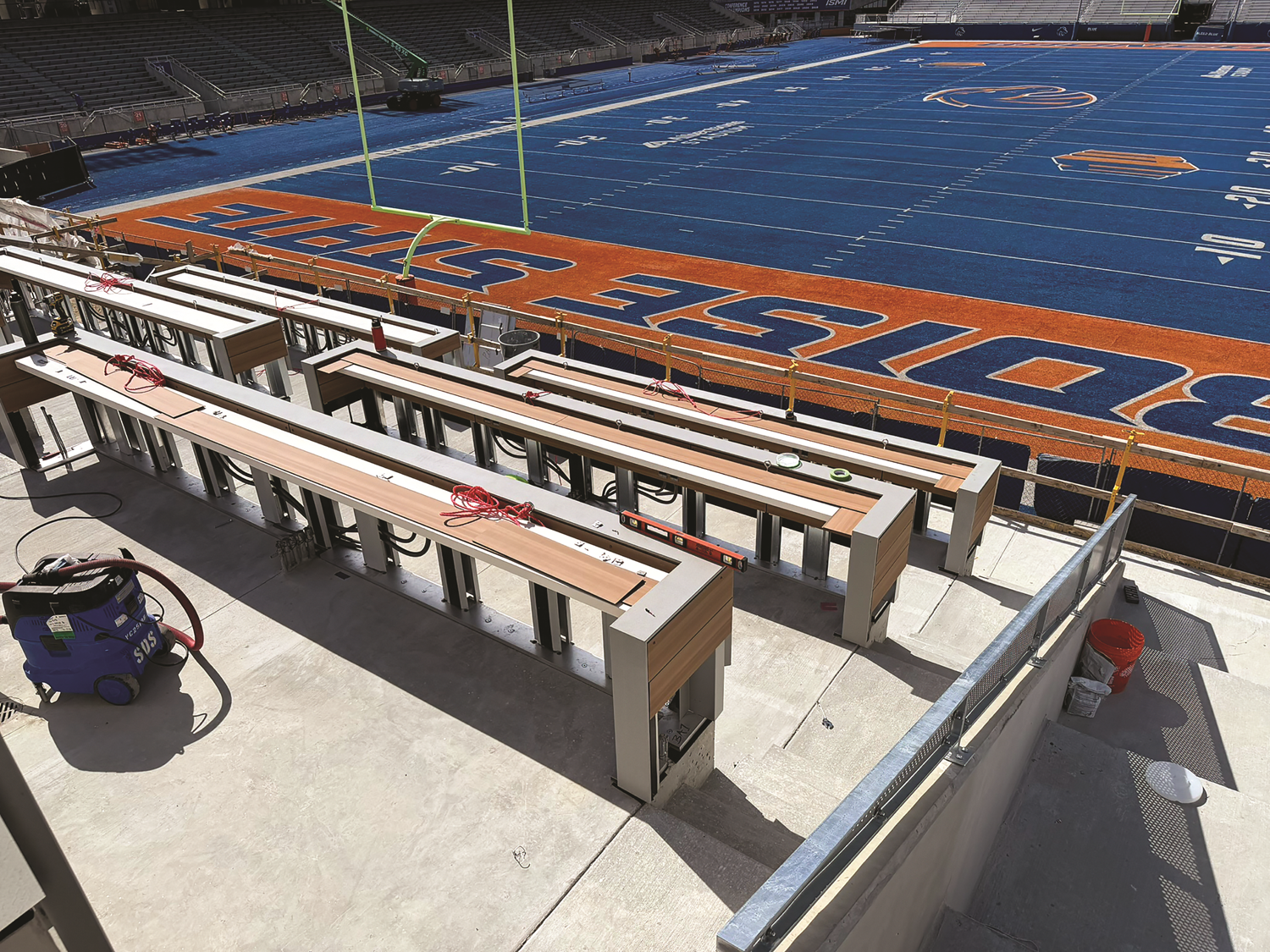
It’s not always easy working around team schedules and stadiums that are sometimes 100 years old.
“In most cases, these buildings are actually a conglomerate of about eight buildings that have been cobbled together over time,” explains Appleman. “They built one west sideline because that’s where everybody wants to sit. Then popularity made them build the east sideline, and then they build an end zone, and then they build another end zone, then they add to the west. So that adds to the complexity of it, but it also adds to the fact that it’s generally not going to pencil out for them to just start over.”
Stadiums are central to campus life and many renovations strive to meet student and university needs from food halls and extra classrooms to student gathering spaces. That collaboration has benefits.
HOK’s current projects include Auburn University, the Kellner Family Athletic Center at the University of Wisconsin and Boise State. At Auburn University, they found the middle ground between the athletic department’s need for revenue and student life’s need for additional space.
“They came together – and this is an interesting point is that this is a new funding stream for building on campus when athletics and student life partner, which is what Auburn is doing,” says Appleman. “That’s roughly a 60-40 split student life to athletic spend on a building at the stadium. …I think you’re going to continue to see this concept of partnership as a viable vehicle to allow these athletic departments to generate revenue, but also to solve university needs.”
Location of stadium sections for students and bands is also a consideration.
“We were cognizant of the adjacencies of some of those elements and the atmosphere that it creates,” explains Freeland. “Some really appreciate the adjacencies as it affects the overall energy and atmosphere of the venue and the game – and others maybe want to see it but be a little bit further away.”
Nearly every major university project includes some – or all – of the following: premium seating, clubs and suites; expanded food and beverage options; digital signage and larger video boards; improved Wi-Fi and cellular coverage; wider concourses; modern restrooms; ADA accessibility improvements; flexible event spaces for year-round use; and sustainability and energy-efficiency upgrades.
Many facilities are adding frictionless concessions and new kitchens to meet upgraded food and beverage requirements.
“Bringing in hospitality offerings, new F&B, a larger spectrum of experiences in these venues is key to their success,” adds Freeland.
The University of Florida is undertaking the largest stadium renovation in college football history with a $1.45 billion transformation of Ben Hill Griffin Stadium, which is affectionately known as “The Swamp.” The project is designed to modernize the nearly 100-year-old stadium while preserving the gameday experience and maintaining the 88,548 capacity. Renovations should be complete in time for the stadium’s centennial in 2030.
“This project represents an incredible opportunity to modernize and elevate the experience at one of the most iconic venues in sports while protecting the traditions that make it special,” states Scott Stricklin, Gators’ Athletic Director since 2016. “We are excited about the momentum surrounding this project and what it will ultimately mean for our fans, student-athletes and the future of Florida Athletics. The Swamp will be bigger, better and louder.”
Stricklin should know. He was instrumental in creating one of college football’s latest stadium rituals. Following the passing of Gainesville native Tom Petty in 2017, the team started playing “I Won’t Back Down” at the end of the third quarter, which has become a tradition.
Northwestern’s new 35,000-seat stadium replaces the century-old Ryan Field and is designed to provide a more intimate fan experience with steep seating bowls and the “Wildcat Wall” standing student section. Ryan Sports CEO Pat Ryan described the venue as the best new stadium in the country, contending the sight lines are better than any other college stadium, with a 300,000 square foot canopy designed like a European-style soccer stadium for both weather protection and sound control.
Penn State is undertaking a $700 million renovation of Beaver Stadium, which will push seating capacity over 109,000 – making the stadium the largest capacity venue in the U.S. by surpassing Michigan Stadium’s 107,601. The multi-phase project includes rebuilding the west side of the stadium while preserving the iconic bowl design with completion expected before the 2027 season.
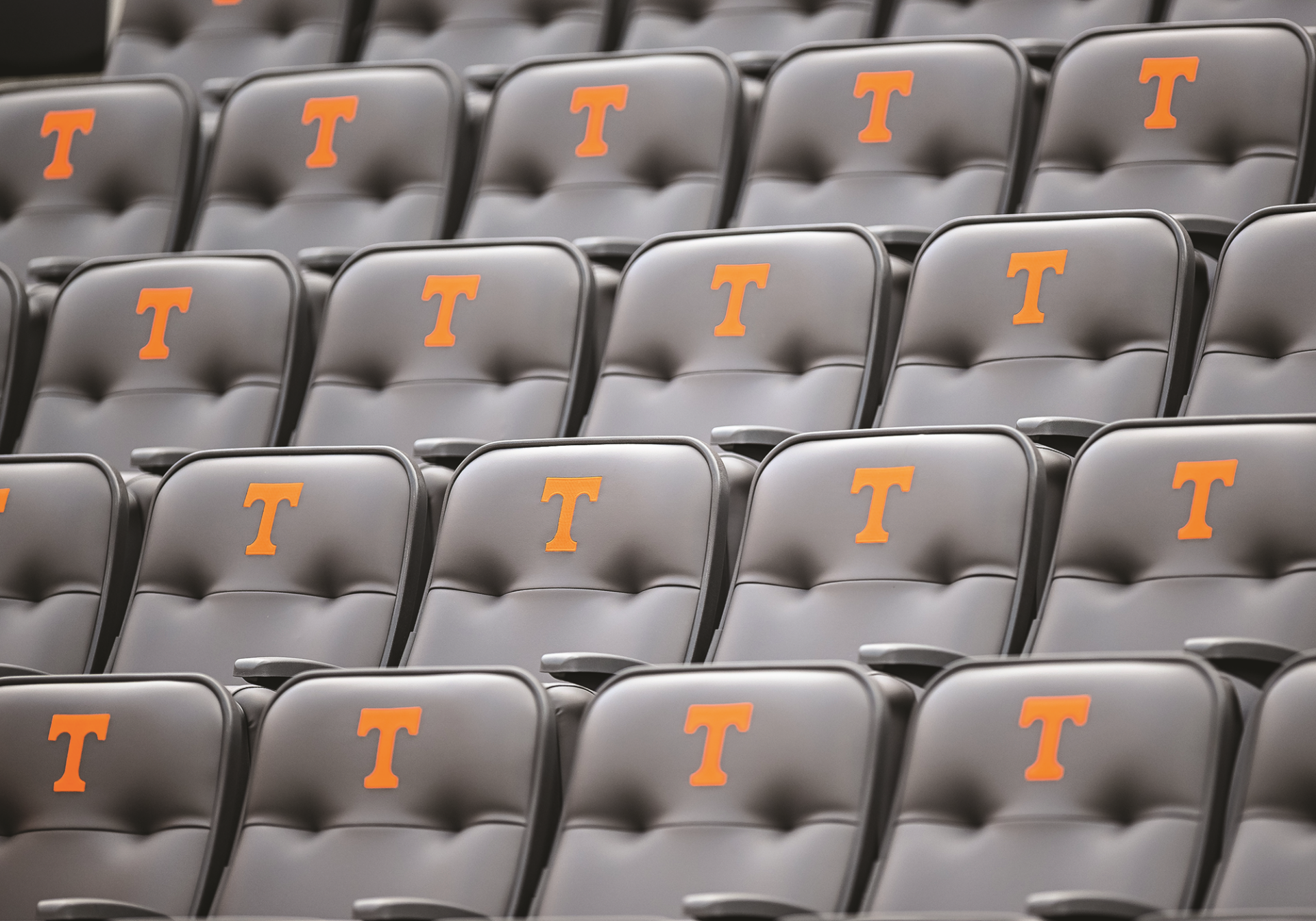
Photo by Bryan Lynn / Icon Sportswire via Getty Images
Oklahoma is renovating Gaylord Family Oklahoma Memorial Stadium at an estimated cost of $450 million. Scheduled to begin after the 2027 season, the current plan focuses on rebuilding the west side of the stadium and reducing capacity from 80,126 to 73,126 by removing about 7,000 GA seats to make room for 47 suites, 64 loge boxes and roughly 4,000 new club seats. The project is expected to be completed in 2029.
Roger Denny, OU Vice President Intercollegiate Athletic Programs and Director of Athletics, was candid about the need for the renovations in an interview with The Oklahoman: “Our expenses continue to increase dramatically year over year over year. We’ve got to pay for that somehow, and a big part of that is going to be the donors that support us.”
Auburn University approved the Jordan-Hare Stadium North Project, the largest capital investment in Auburn athletics history, with a total cost of approximately $323 million. The project includes a $305 million, seven-story, 300,000-square-foot multi-use facility attached to the north end zone along with an $18 million plaza. The development will add more than 3,000 premium seats, suites and club spaces. The project is designed to integrate the stadium more closely with campus life including dining and gathering spaces serving students and fans. Construction is targeted for completion in 2029.
“It’s going to create this vibrant beehive of activity at the stadium that really didn’t exist before, because students are going to use it 24/7,” says Appleman.
Florida State recently completed a $265 million renovation of Doak Campbell Stadium, a Tallahassee landmark since 1950. The work included demolishing and rebuilding an entire section of the stadium, with the goal of improving the fan experience inside the 67,277-cap venue while preserving the stadium’s traditional exterior appearance.
“There’s a lot of history and tradition and we want to make sure that we are good stewards of the facility and that it’s a great place for our football team to compete and it’s a great fan experience for everybody that comes here to watch a game,” states Ben Zierden, FSU’s Senior Associate Athletics Director for Facilities and Capital Projects.
The University of Missouri is investing approximately $250 million in the Memorial Stadium Centennial Project, a renovation that coincides with the stadium’s 100th anniversary in 2026. Construction began after the 2024 football season and is expected to be ready for the current football season. The plan includes three tiers of seating and increasing capacity from 62,621 to around 65,000. The additional 2,000 seats include 600 boxes, 260 mezzanine club seats, 51 suites, 28 cabana-style “Tiger Dens” and 14 field-level suites.
“Everything is centered around the Rock M,” says Freeland of the giant letter “M” made of whitewashed limestone rocks in the north end zone. “Whether you were a child and you knew the Rock M, or you were an alumnus from the university, or even an athlete, you have ties to the Rock M. ”
Collectively, these projects illustrate a broader trend in college athletics, shifting away from simply increasing stadium capacity and instead investing in premium seating, hospitality, technology, accessibility and year-round functionality. These renovations are designed to generate sustainable revenue, improve recruiting and provide modern entertainment experiences.
“The business of athletics itself is changing pretty significantly,” sums up Appleman. “And I think we’re only a part of the way through that. I think that this is going to continue to change and morph. And I think they’re going to continue to look at their professional peers in the NFL and others to find ways to manage how they do this moving forward, because it’s just not what it was three years ago.”
By The Numbers: Current College Stadium Investments
Florida – Ben Hill Griffin Stadium: $1.45B
Northwestern – Ryan Field: $850–870M
Penn State – Beaver Stadium: $700M
Nebraska – Memorial Stadium: $600M
Michigan State – Spartan Stadium: $500M
Kansas – Memorial Stadium/Gateway District: $458M
Oklahoma – Gaylord Family Oklahoma Memorial Stadium: $450M
Tennessee – Neyland Stadium: $337M
Auburn – Jordan-Hare Stadium: $305M
Florida State – Doak Campbell Stadium: $265
Missouri – Memorial Stadium: $250M
Memphis – Simmons Bank Liberty Stadium: $226.5
Iowa State – Jack Trice Stadium: $200M
West Virginia – Milan Puskar Stadium: $150M
Iowa – Kinnick Stadium: $100M
Georgia Tech – Bobby Dodd Stadium: $70M
Boise State – Albertsons Stadium: $65–68M
Sam Houston State University – Elliott T. Bowers Stadium: $60M
New Mexico – University Stadium: $58M
Ohio State – Ohio Stadium: $31M
FREE
 Daily Pulse
Subscribe
Daily Pulse
Subscribe
 Daily Pulse
Subscribe
Daily Pulse
Subscribe