
LA’s All Ages Scene Preps The NextGen & Yields Lollapalooza’s Opener
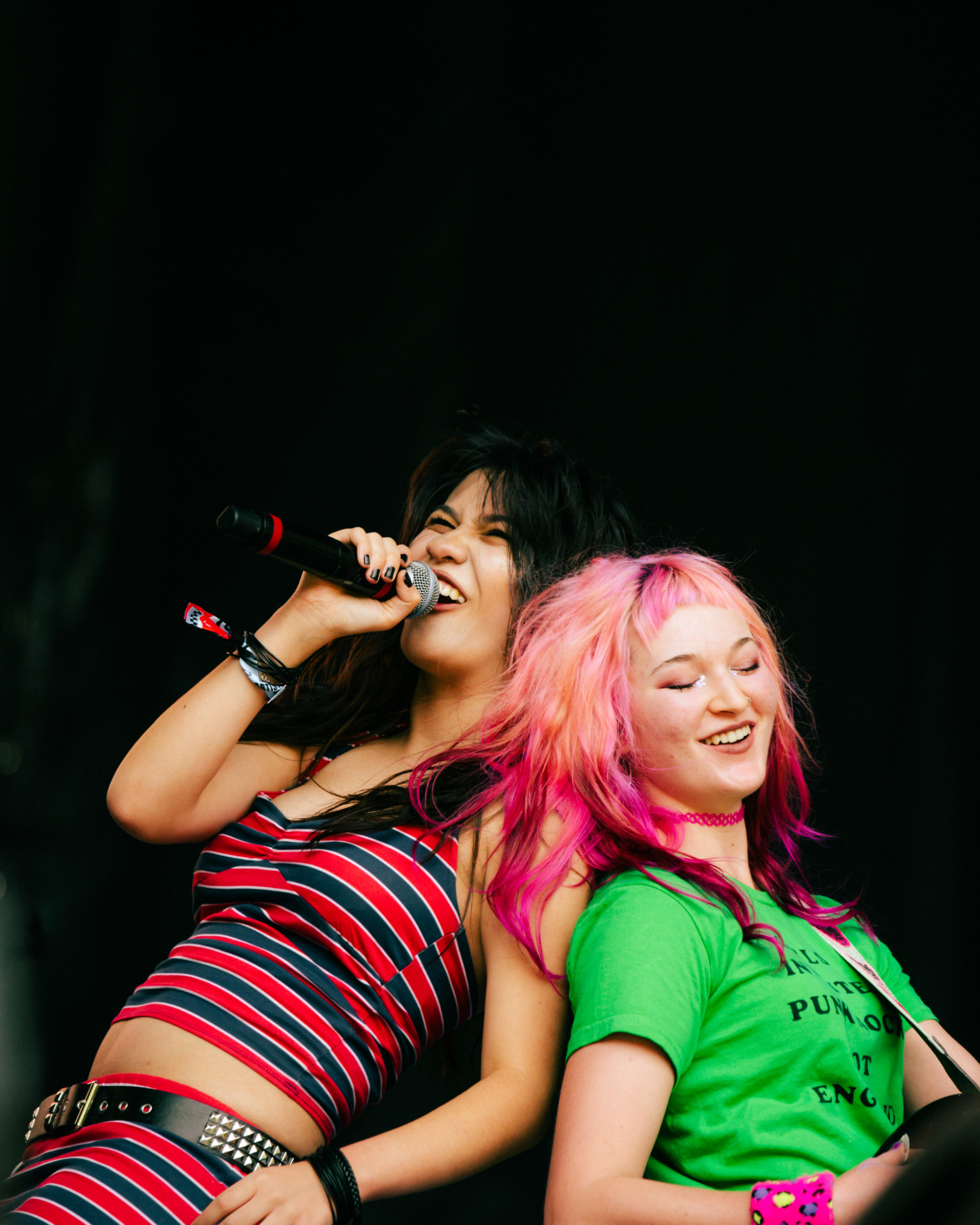
perform at Lollapalooza in Chicago’s Grant Park July 30.
Photo by Frankie Vergara / Lollapalooza
It is noon in Chicago’s Grant Park. It’s a bright summer day in the Windy City. Rain will come later — it’s late July in the Midwest, after all — but for now? It’s the ideal weather for the opening moments of the 2026 edition of Lollapalooza.
Kicking off the festival is Kim Theory — a quartet of teenage girls whose name is a tribute to three great rocker Kims: Deal, Gordon and Shattuck. The Los Angeles-based band — vocalist Audrey Cymone, bassist Lucy Fraser, guitarist Lula Seifert and drummer Zoey Su — rips through a half-hour set of intense rock, a mix of riot grrrl-flecked punk with elements of grunge and indie, differentiated by Cymone’s intense, often nearly operatic vocals (she does plenty of screaming, too) and lyrics that are smart, insouciant and still aimed squarely at their audience of underagers without being juvenile.
The band emerged from LA’s all-ages teen band scene, always vibrant in the City of Angels but seeing a post-pandemic surge which also spawned The Linda Lindas, now a regular support act on national tours. The scene is especially resurgent on the East Side, finding fertile ground in the wake of the Eaton Fire that ravaged Altadena.
The band debuted in August 2024 — Seifert’s dad was on bass for their early shows; Fraser joined later — and since they have become a fixture, playing legendary all-ages non-profit downtown LA club The Smell, joining Bratmobile for “Gimme Brains” after the riot grrrl pioneers heard their cover (Kim Theory will open for Bratmobile in September at The Lodge Room), hitting the stage at the Whisky, but keeping true to their roots in backyards and parking lots. The band’s released two EPs — Bitch Scene and Trophy Wife (apparently, C3 Presents’ Huston Powell delights in finding goofy ways to say the titles of both). The release party for the latter was held behind a Highland Park bookstore, the loading dock converted into a stage (and with three Linda Lindas in attendance).
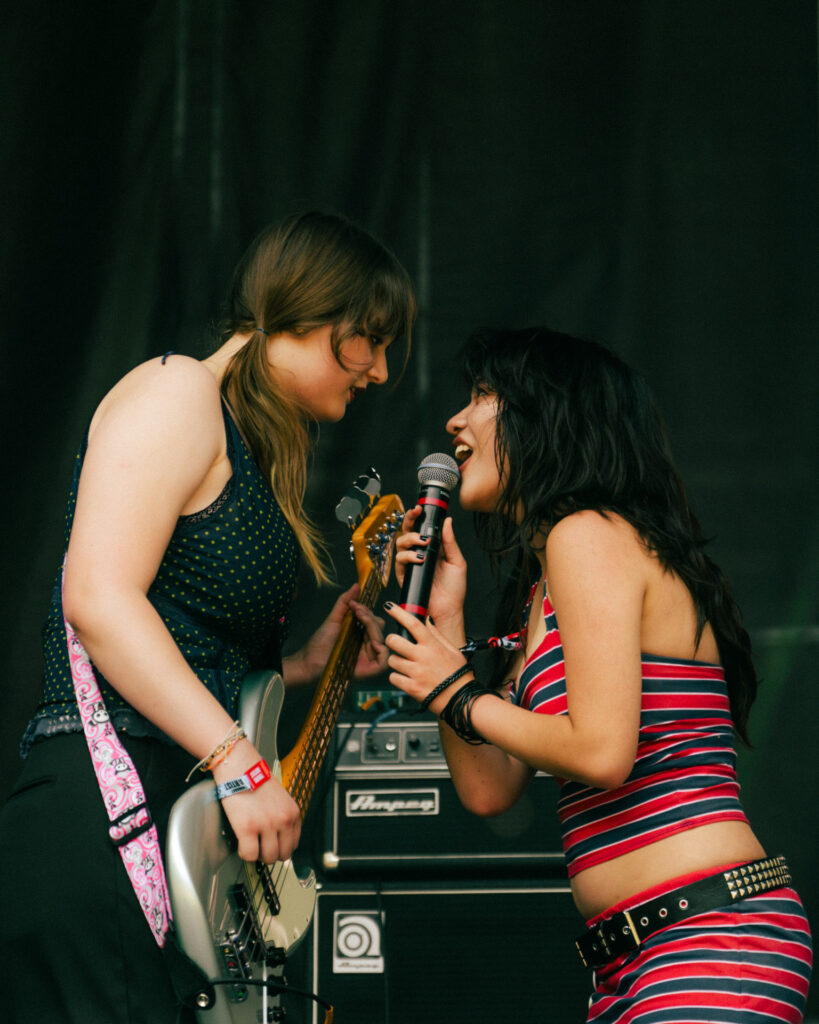
A few days after Lollapalooza, in a Los Feliz coffee shop, Kim Theory is bubbling from their intense weekend by the lakeshore — in addition to the opening set, the band played a sidestage showcase and opened for “Stranger Things” actor Finn Wolfhard at one of the official afterparties — while also gearing up for the start of the school year, because they are, after all, still staring down their junior year.
Needless to say, Lollapalooza was a bit of a step up. The stage, Cymone points out, was bigger than they were used to, physically and metaphorically. She’s an active frontwoman, running and whirling around the stage, dropping to the floor to sing. At Lollapalooza, she had a lot more room, taking laps behind Su’s kit.
“It was a blessing and a curse. It made me really exhausted but it was so fun,” she says.
The band has ambitions — The Troubadour next and ultimately the Hollywood Bowl — and will again get a festival spot at C3’s Darker Waves in Huntington Beach in November, but they have soft spots for the old stomping grounds, agreeing that The Smell — now nearing 30 years old — is their favorite venue to play. Even high school juniors have nostalgia.
“It’s home base,” Seifert says. “I have selfies of us there when we were 13,” Su says, as the drummer and guitarist swap stories of their time in middle school, learning to mosh, hearing music that would shape them. Like much of Gen Z, Kim Theory is very ecumenical musically, drawing from a variety of genres. Similarly, the scene isn’t down-the-middle punk either and Kim Theory finds themselves sharing bills with acts all over the musical map.
“We’ve played with indie groups, acoustic, some hardcore bands and screamo. It’s all over the place,” Su says. “It’s kind of great because it exposes different groups of people to different things and new genres.”
The band rolls their eyes at genre labeling, in general. Why does it even matter?
“They call us punk,” Seifert says. “And we kind of just go along with whatever because I don’t even know what to call us, because we’re also grungy and indie. If someone asks, I say we’re high-energy girl rock.”
It’s an amalgam that’s born from an all-comers scene, itself a product of young people just wanting to be a part of something after coming-of-age during COVID shutdowns and school closures. The problem, of course, is that there’s precious few venues that are open to them.
Why, after all, are venues age-restricted in the first place, they wonder?
“It’s really important we give young people the space to be themselves and to explore themselves and to be able to go out and discover, ‘Oh, I could do something like this,’” Fraser says. “People always expect 17- and 18-year-olds to know what they want to do for the rest of their lives … You have to know what you’re going to do, but you’re not allowed to go see music?”
The lack of third spaces for teenagers is a challenge — it always has been — but also an inspiration. It prompted Su and Seifert, along with Seifert’s sister Sophie and friends Charlie Bernstein and Avery Colvert, to launch Abso-fucking-lutely Productions to put on house shows. They’ve since expanded to bigger spaces such as the Pasadena community space held by Altadena Girls, the nonprofit started by Colvert in the wake of the Eaton fires in 2025; Los Angeles College of Music and The Smell. They’ve learned hard lessons: a venue they’d booked was half the size they’d advertised (and sold out). And they’ve learned the best lesson in live: adaptability. Faced with a long line of ticketholders, they asked the headliner to play a second set, because everyone should get to enjoy the show.
“I felt a strong sense when I was stepping into this role of giving back,” Bernstein says. “I’ve been going to shows for so long and like I’ve been impacted so heavily by music and the community. I feel a really heavy sense of duty to take care of it and make sure it continues.”
That’s always the challenge with growing a scene: will it survive once the generation that birthed it goes off to college? A scene doesn’t just need bands; there’s an entire infrastructure and an orbit of allied pursuits that buttress the whole movement.
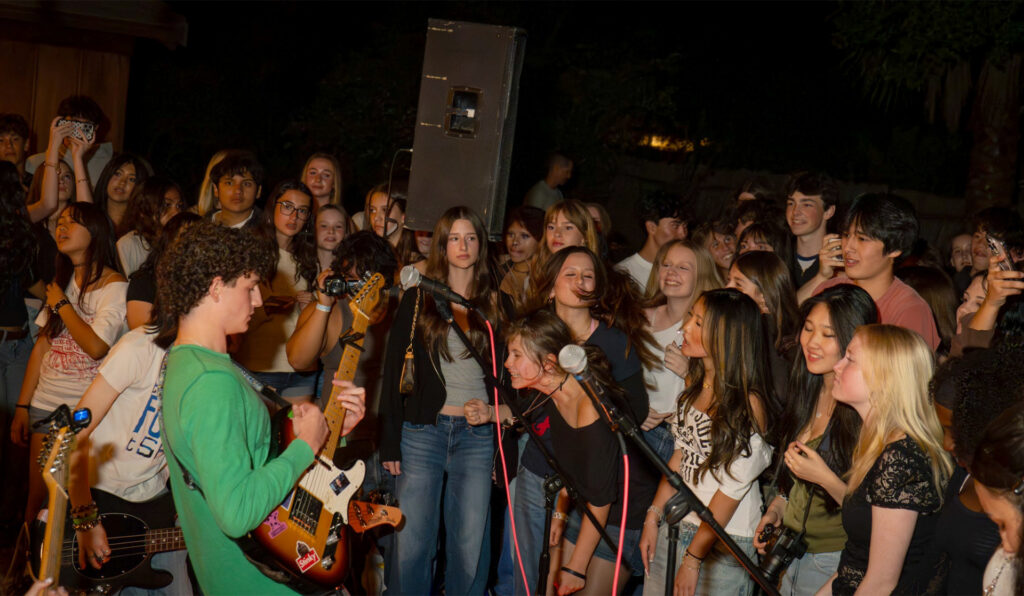
Photo by Joseth Gonzalez / Backyard Party
Backyard Party was started by Matt Chait, a session musician and creative director who was active in the SoCal all-ages scene growing up, and Sandra Denver, who started putting on backyard shows in 2023, when her daughter was in middle school, playing in “a bunch of bands” and needing a performance space.
Before there was Backyard Party, in other words, Denver was putting on backyard parties in Eagle Rock and Mt. Washington.
After the Eaton Fire, Denver and her daughter and her friends organized a benefit, raising thousands of dollars. Chait worked to help replace instruments lost by Altadena musicians as a result of the devastation. And then a mutual friend introduced them.
“Within our first couple of hours of meeting, we decided to start Backyard Party,” Chait says. “She was already throwing the parties and I had the resources to get a stage and a PA system together and up the quality of everything that was happening. Within a few weeks, we started hunting around for location and we found a temporary spot. … Within our second, third, fourth show, it was already packed. The kids were showing up, the families were showing up. It all happened very quickly.”
They’ve felt the scene grow in the year or so since they launched.
” In the beginning, a year ago, getting bands, getting a crowd was different than now,” Chait said. “It’s so many more bands and so much more attractive now than a year ago.”
“The whole world opened up,” Denver says. “There’s endless talent. It’s really amazing how many kids in California play music.”
Backyard Party not only stages shows (the two have done plenty of that since Sept. 2025, including Kim Theory’s album release show that, true to form, had an indie singer-songwriter and a band that describes their sound as “ska-emo” on the bill) but launched a Summer School series that teaches kids (and often, their parents) the particulars of the business.
“I started at 19 as A&R at a record label so I had an early understanding of licensing, royalties, PR and all these things. And I was in the studio musician in my twenties and learned about union stuff and studio etiquette and all of that kind of stuff. And then I’ve been a full-time creative director for the last 15 years of my life professionally, doing graphic design and web design and photo and video editing. A music venue or a scene hits on all of those topics,” Chait says. “So as we were doing more shows, Sandra and I were doing our own little bit of one-on-one education with our interns, teaching them everything from how to run the front of house to the actual house. A mix of parents and kids said we really would like a more focused platform, so we started doing Summer School.”
Summer School sessions — which Chait and Denver plan to extend through the school year — offer one-day classes from industry professionals on eveyrthing from ‘zine making to how to read a deal sheet.
At their shows, BYP emphasizes fairness — all the bands are paid, a commitment the AFL kids share — and access, with a virtual ticket fund that covers the price of admission for youngsters who want to attend but may not be able to put together the $5 or $10.
“The next big arena band that lines the pockets of Live Nation and AEG played in a backyard this weekend,” Chait says. “If these backyard shows and local communities aren’t supported now there is no next wave of artists. They’re all going to be game show contestants and manufactured acts.
“There have been scenes throughout the decades from Georgia to Seattle, but there hasn’t been one in a while and these kids are ready for it,” he adds. “They’ve lived through COVID and on the East Side, in particular, a large majority have lived in some way through the fires, which was completely life- changing. They have stories to tell.”
Now, those stories are getting told at high noon at one of the world’s biggest festivals.
FREE
 Daily Pulse
Subscribe
Daily Pulse
Subscribe
 Daily Pulse
Subscribe
Daily Pulse
Subscribe