
With Daisy Chain Fields, Olivia Rodrigo Started Something…And Kept Something Alive
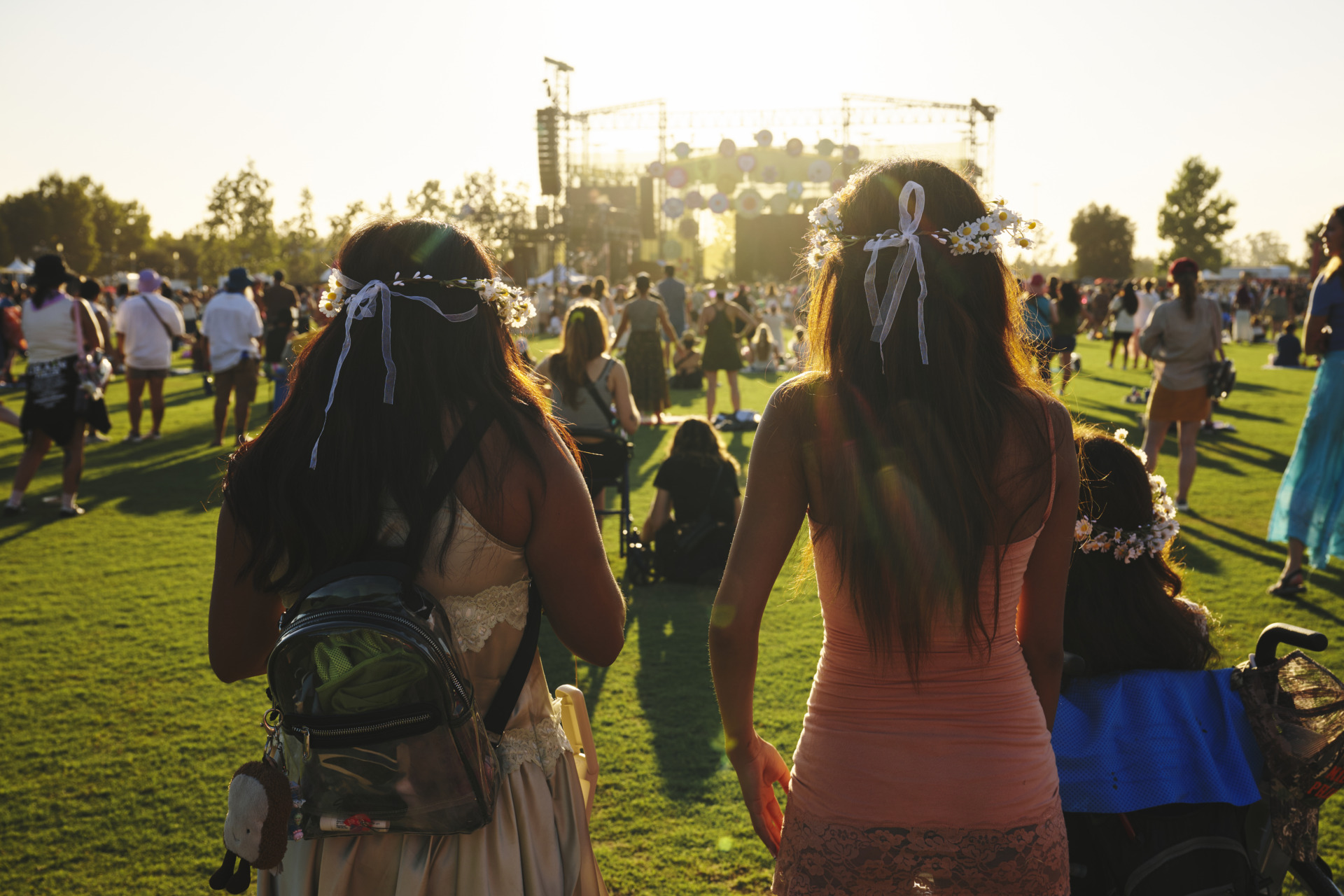
As a 45-year-old man, I am not exactly the target demographic for Daisy Chain Fields, the all-women festival Olivia Rodrigo and C3 Presents put on at Irvine, California’s Great Park Aug. 29.
In 30-odd years of going to shows, I’ve never had to wonder if a promoter was worried about headlining a festival with two people who look like me. I’ve never wondered if a radio programmer would play back-to-back songs by men. I’ve never wondered if I’d be welcome in a mosh pit or if I’d be groped if I crowd surfed. I’ve never though twice about leaving a drink unattended for a few seconds, even around strangers.
That’s what the academics call privilege and I wear it as unconsciously as a pair of slip-on Vans.
So Daisy Chain Fields, to me, could be just another festival, albeit one with a stellar lineup. As with other festivals, there were superstar acts I was excited to see for the first time (Rodrigo herself, Chappell Roan). There were favorites I’ve grown to love in recent years (Mitski, Doechii) and those I grew up loving (The Breeders, Bikini Kill). There were buzzy newcomers (Die Spitz) and mainstays I know always deliver (Garbage). There were, of course, acts I’d never heard of, as there are at every festival, that surprise me (Eli’s modern take on turn-of-the-millennium TRL-friendly pop is delightful).
So Daisy Chain Fields was a festival, and a great one, to me. But it was, of course, more than just a festival and not about me at all.
The headlines will be that the festival drew 45,000 people in the middle of a heat wave to see a diverse and well-crafted lineup — all of whom played for free — and raised $10 million for nonprofits serving women and girls (Melinda French Gates doubled that to $20 million).
And that is important and that is good and it puts paid to the notion that women don’t draw, the largely untested hypothesis that was the raison d’etre for Lilith Fair 30 years ago. And if Daisy Chain Fields comes back, as Rodrigo heavily hinted it would, it will draw thousands more and raise millions more and that is important and that is good.
But none of that captures the spirit that was there. Despite the brutal and unrelenting sun, the back-and-forth between stages necessitated by Rodrigo’s commitment not to have simultaneous sets, the festival-standard long lines for food and merch, the vibes were immaculate. The spirit was the thing.
It was more than the standard we’re-all-having-a-good-time enjoying-the-music that’s commonplace at well-executed festivals. It was more than that. It was ineffable but undeniable. Women and girls of all ages, together, enjoying wildly different kinds of music and knowing something bigger was happening. Not just that the festival was doing good with their money on their behalf, but that the festival itself was good in and of itself.
It bridged genres and generations and brought them all in one place and pushed them together in a way that didn’t seem out of place at all.
My Gen Z daughter and her Millennial mom got to stand side-by-side to watch Bikini Kill, a band they both love who they’ve been trying to see together for six years, a pandemic and a cross-country move having foiled earlier plans. The daughter raced across the festival field to stand with the mom when she heard the opening strains of “Cannonball” by The Breeders (the Deal Twins & co., like several acts on the bill, opened for Rodrigo on tour). Local teen-girl rockers Kim Theory, one of my daughter’s favorites, were a few feet in front of us, watching Kim Deal, one of the band’s namesakes.
Die Spitz, the Austin rockers who flit between metal and punk effortlessly in a way that not many acts have been able or willing to do in the history of those genres, had a bit of a technical snafu at the beginning of their set, so whomever was running the board played “Casual” by Chappell Roan over the speakers to fill the silence and a crowd that had gathered to hear very hard music was having a singalong to Roan’s very torchy tune about a partner who can’t commit.
Moments later, my daughter (she who exposed me to Rodrigo and Roan and Mitski and Doechii) was in the pit. At the end of the set, she met back up with me and her mom, her hair pulled back with a tie she’d not had when she left us. When the moshing began, she said, a girl offered to let her have it to keep her hair out of her face. She shrugged and smiled. No big deal.
“This is girlhood” memes are commonplace on social media. A stranger lending you a hair tie so you could mosh to Die Spitz is definitely girlhood. And it is a big deal.
It’s an example of the optimism that permeated every moment. There was no pretending that things are perfect for girls and women — each act was introduced by a representative of one of the nonprofits benefitting from the festival and they spoke about gender-based violence and the threat to women’s rights and poverty and health challenges and homes lost to disaster — and casting Daisy Chain Fields as a head-in-the-clouds utopia isn’t accurate and isn’t fair. But it was optimistic. Things are hard but they can be better if everyone gets together and looks out for each other. If everyone, metaphorically, lends a hair tie to a stranger in a mosh pit.
And at the center of all this is Rodrigo, the 23-year-old, just months from the biggest tour of her career who, in the beautiful way of her generation, realized you can just … do something. You can put on a festival with a bunch of women who are all over the place stylistically and at different points in their career and you can see if they’ll play for free and you can give the money away. You can just do that.
It helps if you are Olivia Rodrigo, of course, who gets respect and admiration as much from those who came before her — Bikini Kill’s Kathleen Hanna gushes about Rodrigo almost as much as The Cure’s Robert Smith does — as she does from her peers.
Rodrigo doesn’t so much stand on the shoulders of those pioneers. She throws her arms around their shoulders. Of course, she’d duet with Sarah McLachlan, Lilith Fair’s founder. It’s not that Daisy Chain Fields felt like the spiritual successor to Lilith Fair, it’s that it is what Lilith Fair would be now. It’s a continuum. Of course, she’d duet with Alanis Morissette. Musically, yes, Jagged Little Pill clearly influenced Rodrigo, but her music is not an homage to that seminal record. It’s the evolution of it.
She doesn’t see those women — or Stevie Nicks, with whom she dueted on “Landslide” to close the festival — as part of the past to be honored. They are part of the now to be included, just as every little girl and teenager and twentysomething singing along was included. There was an egalitarianism that was central to the whole project (and put in black-and-white: on the festival poster, the acts — from the nooner to the headliners — were listed alphabetically and in identical font, none bigger nor more prominent than any other).
Rodrigo loves Doechii’s swampy hip-hop and she loves Shirley Manson’s beautiful snarling voice on Garbage’s still-innovative music. She’ll take the 90s alt-rock of The Breeders on tour one year and the gritty off-center alt-pop of Devon Again the next.
And she wants you to listen. To all of it. Somewhere there’s an 10-year-old girl who went to Irvine to see Olivia Rodrigo and is now at home listening to Bikini Kill or Die Spitz or Santigold.
And that is beautiful.
But more importantly, she wants that girl to listen to something else: the idea that optimism can be activism and that she has something to say worth listening to, too.
FREE
 Daily Pulse
Subscribe
Daily Pulse
Subscribe
 Daily Pulse
Subscribe
Daily Pulse
Subscribe