
Platform for Sustainability: AJR’s Adam Met Shares His Impact Journey (VenuesNow Conference Recap)
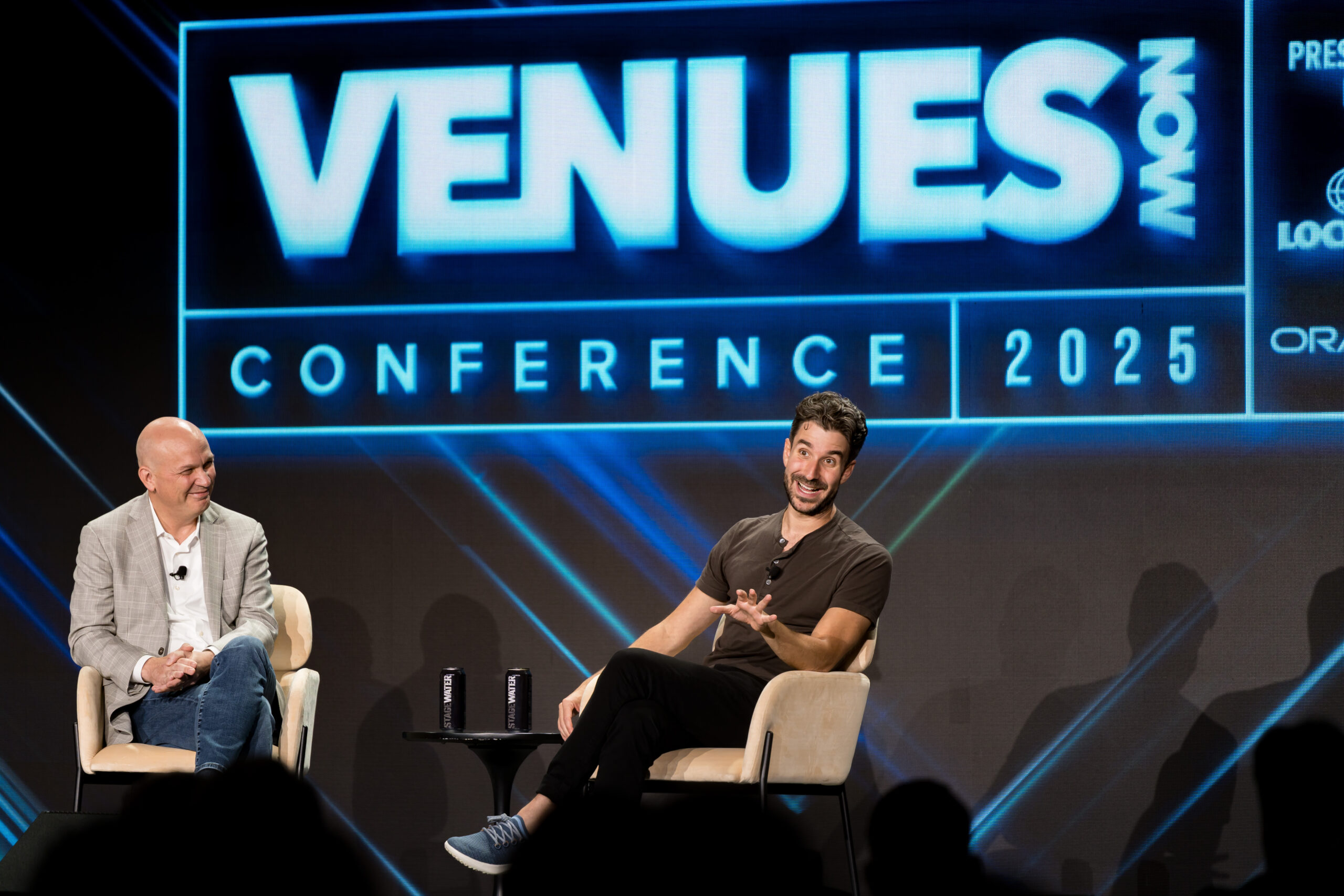
Indie pop band AJR was pulling into San Francisco’s Bill Graham Civic Auditorium, one of the stops on its 2019 “Neotheater World Tour,” when its tour bus was forced to turn off the A/C because of smoke from the nearby wildfires. Multi-instrumentalist Adam Met recalled during Tuesday’s conversation at VenuesNow Conference that the smoke was so bad, the band “needed to actually wear gas masks going into the venue.”
He added, “We realized fans were outside, literally in the smoke, waiting outside to get into the venue. We ended up opening the doors early and invited people to come experience soundcheck. … After the show we moved on to the next city, fans had to experience [the smoke] week after week. It’s happened in so many places. We were in Athens, the entire city flooded … We’re experiencing it first hand and see our fans going through it. That made me focus on [sustainability] on a much bigger level.”
Ahead of inviting Met to the stage at VenuesNow Conference, Oak View Group interim CEO Chris Granger welcomed attendees by bringing up the old saying that what happens in Las Vegas stays in Las Vegas – and adding, “I actually hope it’s not the case on this trip. I hope you walk away with a concept, a learning … something that helps you with your craft and helps you get better at what you do on a daily basis.”
And as Granger noted, what VNC attendees do greatly matters: “Our buildings, when they are at their best, are reflections of our communities. So what does that mean to us in terms of the types of events that take place at our buildings … the people who work in our buildings and how we’re giving back to our communities … that is our opportunity as we think about the platform we all have.”
The Q&A conversation between Met and Granger kicked off the VNC 2025 programming on Tuesday – marking VNC’s debut Las Vegas edition, as well as the first time the conference had expanded to three days and devoted an afternoon to sustainability. The A in AJR had plenty of wisdom and stories to share, thanks to his roles as a musician, educator and advocate. He is the co-founder/executive director of nonprofit Planet Reimagined, a professor at Columbia University and in June he published the book “Amplify: How to Use The Power of Connection to Engage, Take Action, and Build a Better World,” which was co-written with award-winning journalist Heather Landy.
Asked about how he first became socially minded, Met explained, “When I was in high school I went on a class trip to see Mary Robinson speak. She was the former president of Ireland and the United Nations High Commissioner for Human Rights. I’m a testament to the fact that it literally takes one person to inspire you as a kid to completely change your life trajectory. I heard her speak about sustainability and human rights and the relationship between the two and I ended up studying it in school for way too much school. I ended up dedicating my life to it.”
Met spoke about how he’s now influencing others to get involved via his platform with AJR and his work with Planet Reimagined. He notes that the nonprofit started “with the idea that research is done traditionally at universities, sometimes at companies, think tanks. Normally it’s created and sits on a shelf. … It’s not turned into something real. Then there are advocacy organizations that do great work in sustainability and climate. But very rarely are they basing their [actions] on research. So Climate Reimagined was formed as a bridge between the two: How do we do research with an eye to implication as fast as possible? We’ve done this in the energy space and waste, and music …all these different areas, one that I’m most excited about is how we do it with venues.”
Planet Reimagined conducted a massive study with partners including Ticketmaster, Live Nation and REVERB that polled 350,000 fans of all music genres and then used the data to build a program around it based on what kind of issues they cared about and how they wanted to take action. Of particular interest, Met noted that the nonprofit figured out a way to put together the program without using words like climate, sustainability and net zero.
“Honestly, nobody gives a shit about any of that stuff,” Met said to laughter. It’s true – nobody gives a shit about climate change, it’s too far away, it’s too existential, it’s like really, 1.5 degrees that we’re supposed to keep our planet to, nobody knows what the means, so we figured out a way to partner with local organizations everywhere to have actions that people are taking on site around food, around transparency, around energy that are hyper local, that are really relevant to their communities.”
Throughout the 30-minute Q&A, Met emphasized the importance of community and focusing on change on a local level. Though some may not care about community, Met shared an uplifting stat, that more than three quarters of people who attend a music event care about the planet. He added that fans have a better view of the artists if they put their money where their mouth is, by encouraging fans to join them in taking action – rather than just telling them to take action. A subtle but important difference.
“One of things we found in the study is that just as much as music and sports and comedy in your venues build community, doing this kind of advocacy also builds community,” Met said. HE quipped, “Don’t share this with anybody else, but I love bullying. If one person in a friend group goes and signs a petition or engages in something, then bullies everybody else to do it, you have a multiplier effect which is amazing for advocacy.”
After sharing about the success of getting fans excited about the tracklist for one of AJR’s albums via a jigsaw puzzle scavenger hunt, Met declared that rolling out an album campaign is the same thing as rolling out the campaign for any type of social action – with ownership over the process being key. He says, “People want to participate in something that has shown wins before. And they want to see the incremental value of their own participation.”
Met also discussed his views on the need for moving away from individual action and toward collective action.
“ I really advocate for these group collective actions. Some of them are policial, and I know a lot of the fan groups and artists aren’t going to engage in that, but everyone can get behind [things like] food banks and food waste. … I like to think of climate not using the words climate but thinking about it as transportation .. .as the food that ends up on our plate. As the jobs we have, as the homes that we’re building. … For me it’s reframing all of this as issues that impact people in their day to day lives.”
Asked to share any closing words of wisdom, Met talked about how so many other industries look to the live industry as an example in order to address sustainability and climate issus.
“However we should not be the people who are figuring out how to make those changes..we are not the scientists and researchers. I go to conferences a lot and they’re saying how do we as the music industry reinvent trucking? What is the music industry going to do? The thing we should do and the thing that’s going to be the most relevant to us should be early adopters to these new technologies … let them test it out with us, let us show the rest of the world that these things can actually be scalable. Because we are an industry where we have local approaches, and we have national approaches and we have international approaches. We have the perfect pipelines to test out things to see if they work and then instantly scale them up. among all the venues.”
FREE
 Daily Pulse
Subscribe
Daily Pulse
Subscribe
 Daily Pulse
Subscribe
Daily Pulse
Subscribe