
The Unbroken Circle: The Grand Ole Opry Celebrates A Century-Long Legacy & A Bright Future
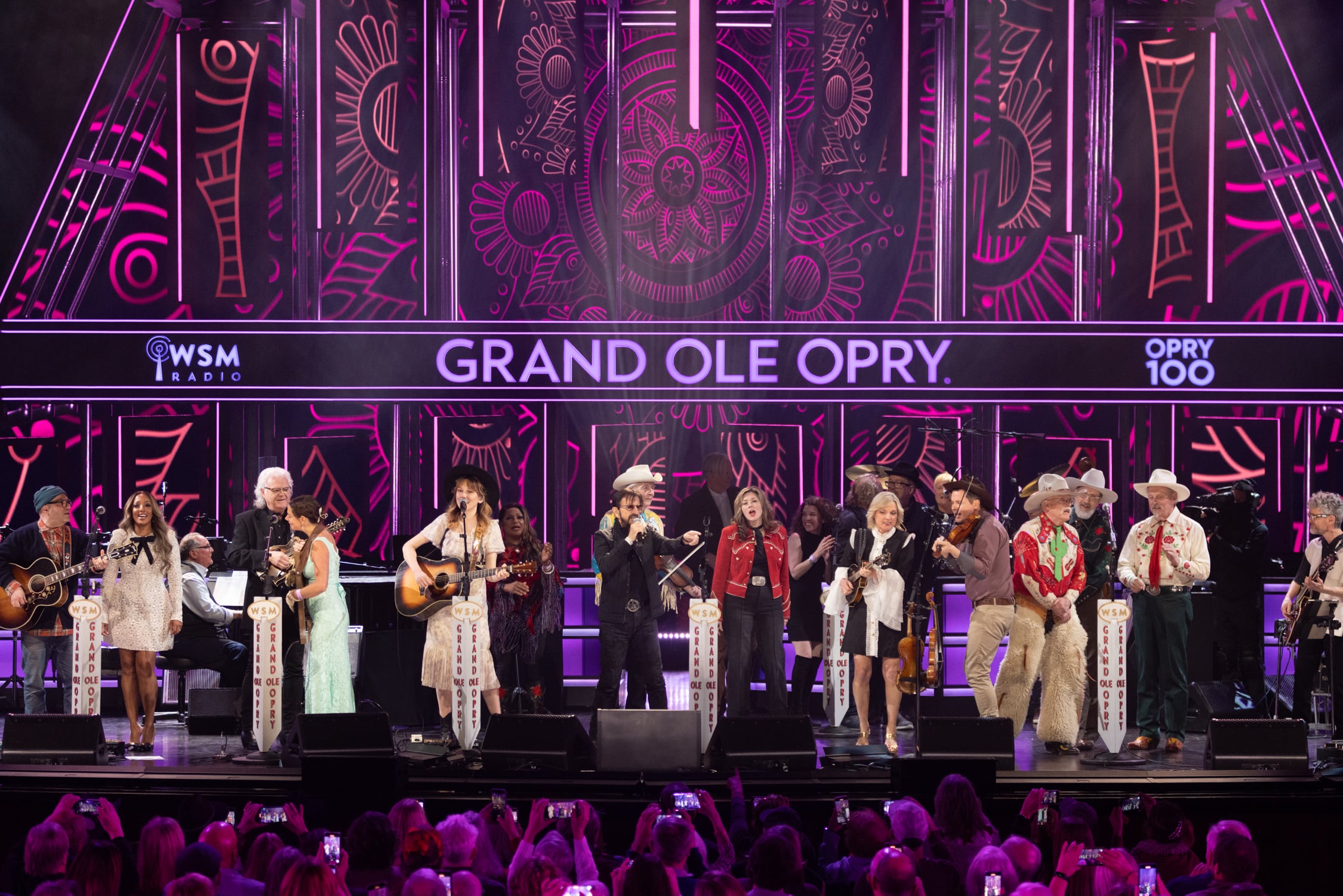
Like many legends, the origin story of the Grand Ole Opry is both misty with anecdote and steely with fact.
In October 1925, Nashville radio station WSM began a segment featuring “Dr. Humphrey Bate and his string quartet of old-time musicians.” In early November, the station brought on America’s most popular radio announcer, a 29-year-old named George Hay, who, encouraged by the in-studio piano player, invited local fiddle legend Uncle Jimmy Thompson to dazzle the radio audience on Nov. 28, 2025. And the Grand Ole Opry was born.
Kind of.
It was still called the “WSM Barn Dance” and would bear that name for another two years. In the ‘20s, the “Barn Dance” followed NBC’s national broadcast of more high-fallutin’ music — orchestral and choral selections — and after one such broadcast in 1927, Hay — though still in his early 30s, already bearing the nickname “Solemn Old Judge” — declared that while the audience had been listening to “grand opera,” they were about to be treated to a “Grand Ole Opry.
From that first night in the studio on the fifth floor of the National Life & Accident Insurance Company building (National Life owned the Opry until the 1980s; WSM’s call letters are a nod to the insurer’s motto “We Shield Millions”) until now, 100 years later, there’s never been a Saturday night without the Opry, so they say. That’s a legend, too — the show didn’t broadcast the night FDR died, though Bob Wills & His Texas Playboys played at the Ryman for the crowd that’d already come through the doors. The show also skipped a live performance the Saturday after Martin Luther King was assassinated, as Nashville was under curfew.
It has persisted through the Depression, a World War, the tectonic changes in music and culture and politics of the 1960s and ’70s, a flood that made it peripatetic for months and a pandemic, when it made people stuck at home feel a little more at home.
Broadcast across NBC’s Red network and over the 50,000 watts of WSM that carried its signal across 30 states, the Grand Ole Opry essentially created what was and is country music out of the foundations of the old-timey music Uncle Jimmy, DeFord Bailey and the Fruit Jar Drinkers started playing a century ago (they probably just called it “music,” genre labels only ever really applying in retrospect and “country” as we know it not really existing until Nashville got its hands on it).
People who listened over the air wanted to see it in person and the Opry became a live phenomenon in short order, demand for tickets forcing it out of the cramped studio to a variety of venues in Nashville until it eventually settled at the Ryman Auditorium in 1943, where it’d stay for more than 30 years before moving across the river to the purpose built 4,000-seat Grand Ole Opry House, where a six-foot circle of Ryman stage wood inlaid on the new stage marks a favored performance spot.
Yes, Johnny Cash kicked out the stage lights (and first met June backstage). Yes, Jeannie Seely defied Opry management and wore a miniskirt and thigh-high boots. Yes, Jerry Lee Lewis really played aggressive rock and cursed prodigiously. Yes, the crowd mocked The Byrds by tweeting at them and yelling at them to cut their hair. Yes, “El Paso” was the de facto Saturday finale song for years because Marty Robbins would go on last since he’d spend much of the evening racing his stock car at the Fairgrounds. Yes, Roy Acuff taught Richard Nixon how to yo-yo the opening night at the Opry House.
All of that – plus the thousands upon thousands of performances — are part of the Opry’s fabric and America’s too. It would be impossible to explain every bit of history, every influence, every way the show has shaped the culture. Even the Opry itself is taking more than a year to tell the story of its first century. And this long celebration has been in the works for decades.
Dan Rogers, senior vice president of the Grand Ole Opry and the show’s executive producer, joined the Opry 27 years ago. Just in time, he says, for the planning of the 75th anniversary.
“The 75th was a point to re-tell the world who the Opry was and what we wanted the Opry to be, but I distinctly remember several references to ‘Oh that’s something for the 100th,’ like we need to be doing these things in order to be ready for the 100th,” he says. “So it’s not an exaggeration to say that I’ve been planning for 25 years now but really the work on 100 began in earnest two years ago now, but I would say five years ago or so I started a file of things we should think about doing for 100 because it’s such a great milestone to look back and celebrate but also to look forward and do things that we haven’t been able to do.”
That’s included trips to the Royal Albert Hall and one coming up at Carnegie Hall next March. It’s included a quickening pace of inductions, as well. Anyone can be invited to perform at the Opry — this year has seen acts like Train and Shinedown; Rogers is holding out hope for his “dream guest” Eddie Vedder — but only a very select few are asked to become members. In 100 years, there’s been less than 250 full-fledged Opry members, selected by management in a process shrouded in a bit of mystery. Even some of country’s biggest acts — George Strait and Kenny Rogers, for example — have never been made Opry members. In many cases, it’s because Opry membership requires regular Opry performance; in Strait’s case, his tour-heavy schedule and affection for life on his Texas ranch during his downtime mean he couldn’t commit to the schedule. That helps make the point: the Opry is both a radio (and now TV and streaming) show and live concert. Putting on a show like that at least twice a week — and in the high season, as many as five times a week — with eight or 10 performances each night, plus requisite stops for ad reads and station breaks, requires perfect timing and a level of expertise akin to air traffic control
Tyler Bryan is the senior stage manager for the Opry, where he’s worked for more than 40 years. Acuff and Minnie Pearl were still telling aw-shucks jokes when he started as a stagehand, and he’s seen country music move and shift from the countrypolitan days of the early ’80s to the neo-traditionalism of the ’90s to … well, whatever the now-capacious definition of country music contains these days.
“When I started in ’84, it was simpler from a standpoint of how many audio inputs it took to do an Opry show, but now it’s like 72 inputs or something to do an Opry show. We have artists that bring pedal boards; you didn’t see all of that back in the day,” he says. “Now, we have all of this other stuff and we have to work all that out from a timing standpoint: how long is it going to take to get this band set up so what the people are seeing on stage looks seamless.”
And every show is different, but Bryan always remembers — even after having worked on more than 8,000 Opry shows — that it’s always the first time for someone, an artist, a band member, someone on the crew or someone in the audience.
“One of the things that I try to do on my end is, No. 1, make the artist feel comfortable because nine times out of 10 they’re nervous when they go out there, even artists who’ve been around a long time, so if we can make them feel comfortable and let them know that we appreciate them being there they’re going to give us a better show for the audience,” he says.
They’ll all be excitedly nervous Nov. 28 when, 100 years after the Old Solemn Judge cued Uncle Jimmy, the Opry’s birthday show takes the stage.
“I would hope that if you just landed on planet Earth on Nov. 28, 2025, and sat in those pews, after that show, you would really understand what makes the Opry special, where it’s been over the past 100 years and where it’s going the next 100,” Rogers says.
The Opry’s longest-serving member — Whisperin’ Bill Anderson — and its newest — Kathy Mattea — will both be there. As will its oldest — Stu Phillips (92) — and its youngest, 33-year-old Scotty McCreery, who holds the honor by being just a few weeks younger than Kelsea Ballerini. It’s a legacy that’s always around, always laying heavy, heavier this year than ever. But when it’s showtime?
“Seven o’clock, on the dot, the video ends, the curtain goes up, we’re off and running,” Bryan says.”And at that point, it’s let’s put on a good show, and we give them everything we’ve got to help our artists. It’s very gratifying to know that you’re a part of the history of something that runs unlike anything else you’ve ever done. There’s nothing else out there like it.”
FREE
 Daily Pulse
Subscribe
Daily Pulse
Subscribe
 Daily Pulse
Subscribe
Daily Pulse
Subscribe