
Pollstar Live! 2026: The Evolution Of Live Event Partnerships
In its current state, it’s a well-known fact that the music industry relies heavily on touring to generate revenue. Hard ticket sales are what help keep the lights on for artists, but the rising costs of transportation, travel and production have been eating into that source of income, leaving many to search for other avenues to offset those costs.
That’s where sponsorships and brand partnerships come into play. It’s been a part of the music business for a long time, but the art of the partnership has evolved in such a way that what was once seen as “selling out” is now an “organic” move that becomes part of the artist’s identity.
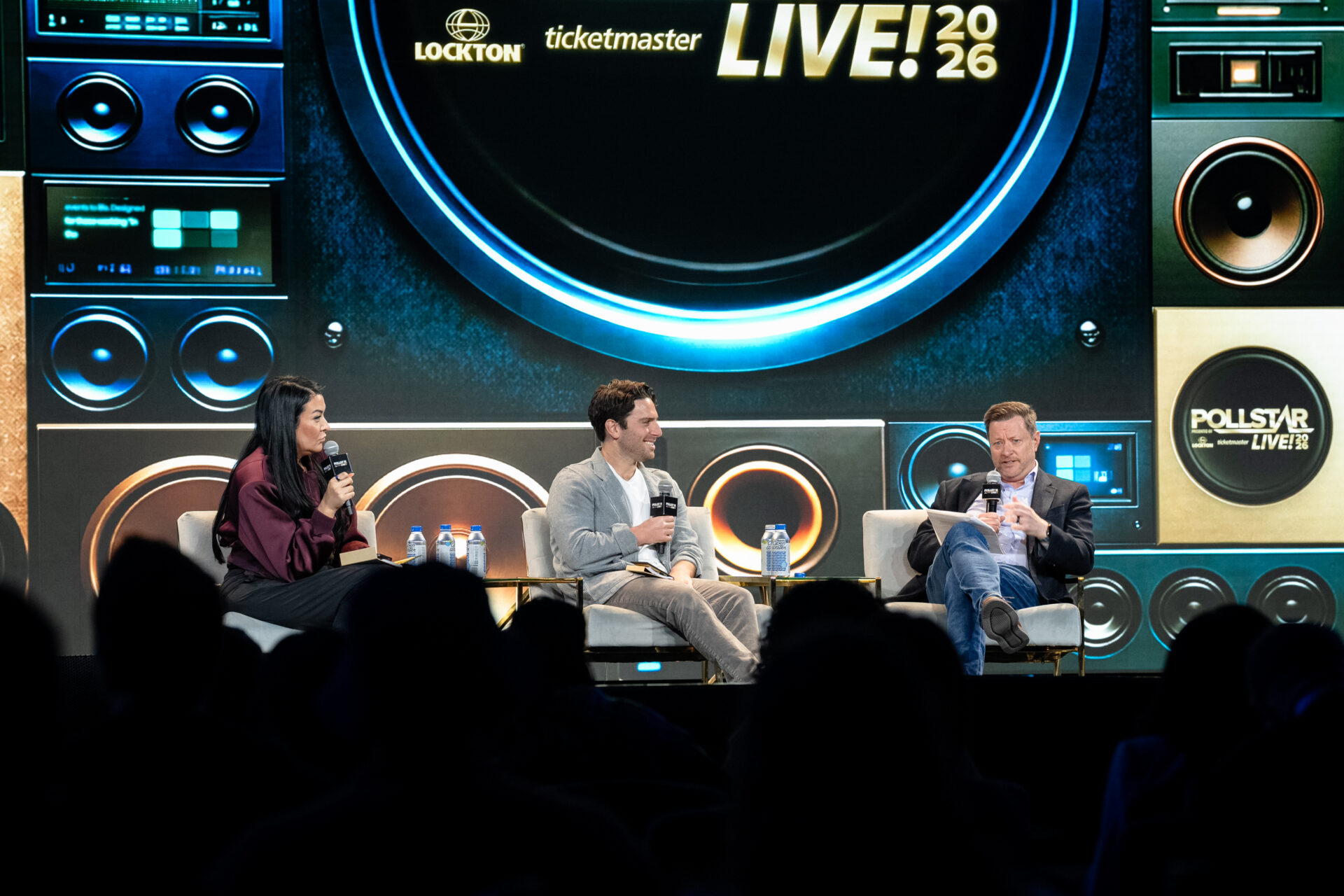
That notion was just the starting point for the “The Evolution of Live Event Partnerships” panel on the first day of Pollstar Live! at Loews Hollywood Hotel in Los Angeles on Tuesday, and the insightful conversation featuring representatives from Oak View Group (parent company to Pollstar), Independent Artist Group and Red Light Management touched every facet of brand-artist collaborations, from the management side to venues to festivals.
“I don’t care what decade you’re in, what day you’re on, there is no shortage of people who are looking for revenue these days,” said Dan Griffis, OVG’s president of global partnerships. “It’s topical, whether it’s 1995, 2005 or 2026, and so with the rising costs in the system, artists are having to get more creative in terms of the partnerships that they’re trying to put together to help subsidize the cost of the tours, to continue to build their relevancy, to sell more tickets.”
Jake Perlmutter, vice president of brand partnerships at Red Light Management, which has over 400 acts on its roster, said that sponsorships and brands can account for anywhere between 10-20% of a major artist’s income, and are essential to develop when going on the road.
To better understand the artist’s interests, Red Light has them complete a questionnaire, which can lead to unique partnerships that align with their brand and identity.
He recalled one instance three years ago involving an agency looking for to cast a country artist in a heartburn campaign.
“I was like, ‘There’s no fucking way,’” Perlmutter said. “I have to find A, someone who wants to give a public talk about this, and B, that it’s going to work with everything that they wanted to do. … I didn’t know anyone who was going to put their face on that.”
Turns out that Red Light knew of several artists who took medication to alleviate heartburn, and country singer Mitchell Tenpenny jumped on that opportunity.
“It was his first time on a billboard in Nashville,” Perlmutter said. “It was a fun moment for him, and it ended up working out. So even the weirdest tidbits that you wouldn’t necessarily think you could monetize against work.”
Brianna Colell, vice president of brand partnerships at IAG, said such deals are sought after by most artists and are now commonplace in the business. One that she applauded her agency for was a collaboration between 2 Chainz and True Religion celebrating the artist’s 10th anniversary of his T.R.U. REALigion mixtape, which featured a limited-edition capsule collection.
“That just spoke to a great partnership that really leans into culture,” Colell said. “It’s always nice to have a brand that also really gets it and wants to lean in and embrace those things because that doesn’t always happen.”
It’s also refreshing for Colell and Perlmutter to see partnerships that develop over time along with the artist. Colell noted that Coco Jones and Grey Goose developed a relationship that grew over time and culminated with the spirits company sponsoring her.
“Those baby steps in the beginning led to the following year when Coco brought home tons of Grammy nominations, Grey Goose, who typically sponsors the Grammys itself, actually invested in Coco and sponsored the artist that year instead of the actual show, which I thought was a win.”
Perlmutter admitted that the artist-and-spirit partnerships are a bit saturated, but can work as long as they help convey the artist’s story. He cited Chris Stapleton and his Traveller Whiskey, which has been integrated into his tours and became the first official whiskey of Major League Baseball.
Those are the kinds of deals Perlmutter hopes to see artists make down the line after investing in their own businesses.
“There’s definitely been an influx of artists starting their own businesses, starting new lines, but less so on the equity side, but it’s not as widespread as it really should be,” Perlmutter said. “And there’s a risk—there’s taking somebody out of the category for an indefinite period of time, unclear exit-related questions, but everyone will reference the 50 Cent Glacéau Vitamin Water sale to Coke and the Kobe Bryant Body Armor sale to Coke. There’s just so many great stories like that where athletes and artists have done considerably well.”
Colell said she’d like to see more long-term development between the brand and the artist as Grey Goose did with Jones.
“I really want to continue to see brands really come into the artist’s world and build around the artist’s world, not just doing the one-off partnerships, not just doing the tour sponsorships … to the point where these multiyear deals … come into all aspects of that artist’s career, being a part of all their moments and building a story with them.”
She closed the panel with one more note: “I also would like to see the DEI budgets come back.”
FREE
 Daily Pulse
Subscribe
Daily Pulse
Subscribe
 Daily Pulse
Subscribe
Daily Pulse
Subscribe