
Mrs. GREEN APPLE Dominates Arenas & Stadiums, Takes J-Pop To New Heights

The word “globalization” is common in the music industry when describing the growing popularity of genres once considered niche or domestic, like K-pop and regional Mexican.
The massive success of artists like Bad Bunny marks a notable shift in the industry, redefining pop music as it’s no longer dominated by the English language or Anglo markets.
While acts across the globe are entering uncharted territory, Japanese artists are simply reestablishing themselves on the global stage they’ve influenced for decades through anime, manga, film and gaming. (The recent “Resident Evil” U.S. film adapted from the long-running Japanese video game series is the most critically acclaimed movie based on a video game of all time.)
Japanese music is primed to become a major contributor to that movement and a bigger player in the booming live entertainment industry, and Mrs. GREEN APPLE is leading the charge with high-energy pop anthems, Brian May-esque riffs and infectious hooks.
The three-piece pop-rock band, comprising lead singer and guitarist Motoki Ohmori, guitarist Hiloto Wakai, and keyboardist Ryoka Fujisawa, performed four nights at the beloved National Stadium in Tokyo last summer, attracting approximately 280,000 fans—a rare feat for any act.
“From an artist’s perspective, this venue represents a major milestone—a benchmark of sorts—where performing in it feels like a truly significant achievement,” Takaaki Ota, general creative director for Mrs. GREEN APPLE’s live events, told Pollstar in July. “In terms of an artist’s history, holding a four-day run there is a feat only one other act has accomplished: Arashi. That makes us the first rock band to do so.”
It’s one of many milestones for Mrs. GREEN APPLE, also known as MGA, this year. In addition to the success on the road, the trio released the official song for the Japanese dub of the massively popular film, “Spider-Man: Brand New Day,” titled “Brand New,” and just dropped its sixth studio album, POPS, via EMI Records and Universal Music Japan.
To promote the new LP, MGA embarked on its first arena trek in three years, kicking it off Sept. 30 at Anabuki Arena Kagawa. The 28-date Japanese tour across 14 cities includes stops at Hiroshima Green Arena, Tokyo’s Yoyogi National First Gymnasium, Sundome Fukui, GLIO ARENA KOBE and Pia Arena MM in Kanagawa before wrapping up with a two-night stand, Dec. 27-28, at Aichi Sky Expo.
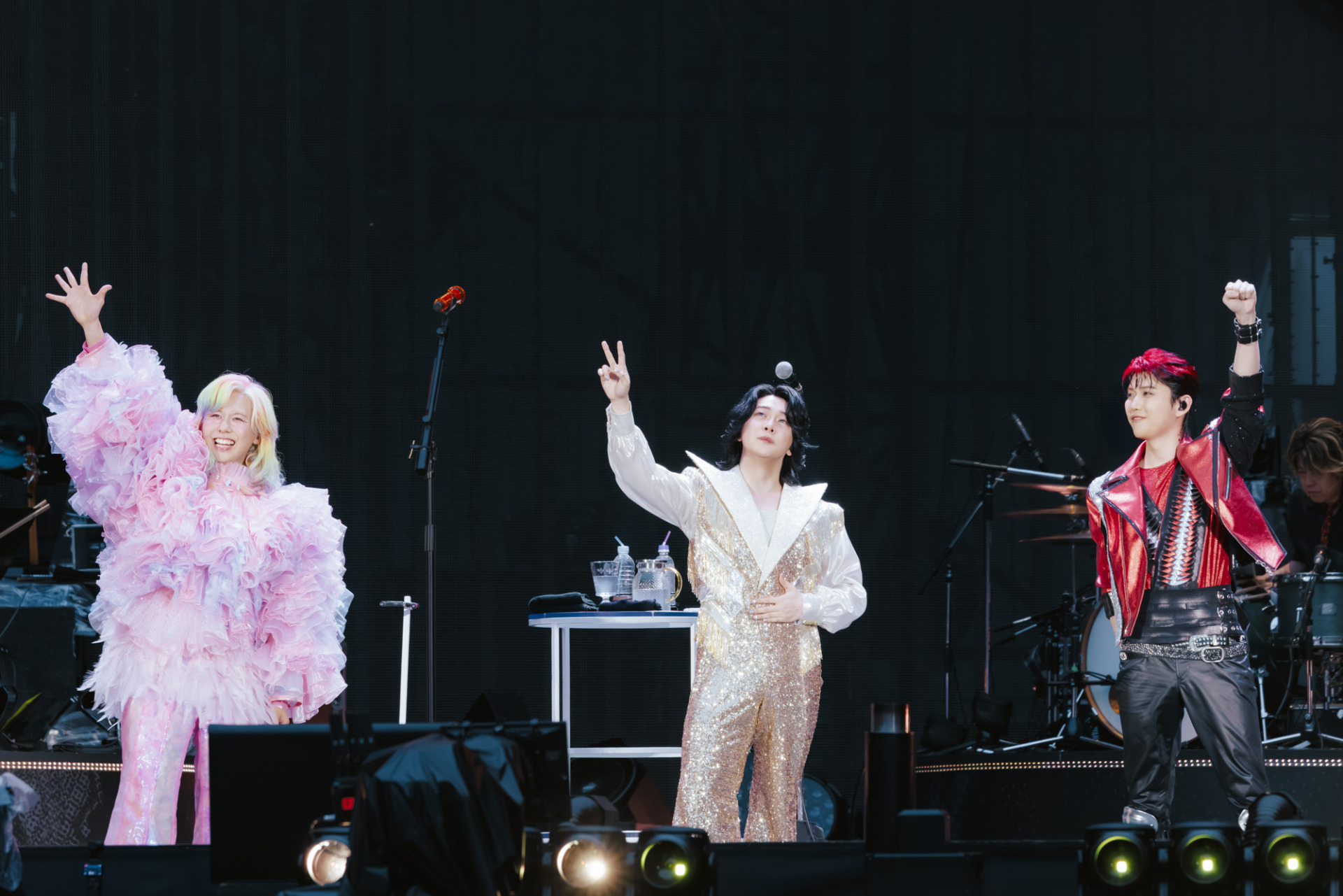
These new, ambitious touring ventures mark the band’s latest creative phase. MGA began Phase 3 on Jan. 1, eager to thank fans after a massively successful Phase 2.
“The distinction between what changes and what stays the same is a fundamental aspect of Phase 3. We wrapped up Phase 2 last year, and since we met so many fans during that time, I feel that the most important thing for Phase 3 is to pour all my love into the people I’ve connected with,” Ohmori told Pollstar. “I can’t even begin to imagine what the future holds or what form things will take, but what matters most is the scenery we create together with the fans.”
The stadium concerts sold approximately 390,000 tickets and garnered 570,000 viewers on the livestream, according to the band’s reps. The brief run was titled “ZENJIN MITO TO IM/MUTABLE,” and tickets were available exclusively to members of the band’s official fan club, which is known as Ringo Jam.
“The title ‘Immutable’ was chosen to commemorate the fan club’s 10th anniversary. It incorporates a slash to suggest both ‘immutable’ and ‘mutable’—representing things that remain constant alongside things that evolve,” Ohmori said. “This title embodies the journey we’ve shared with our fans over the past decade, and we are deeply grateful for the fulfilling activities we’ve been able to pursue in recent years.”
Playing stadiums gave the band the chance to make history and express themselves in a way few Japanese artists have, with a large production featuring large screens to showcase the band’s new Phase 3 color palette and a walkway that wrapped around the entire bowl. The concept for the massive production comes from the phrase “zenjin-mito,” which translates to uncharted territory.
“It represents the kind of raw, fundamental live performance a rock band delivers when starting out—selling their own tickets and performing without a support crew,” said Ota, a seasoned promoter who has helped major acts like Justin Bieber realize their vision in Japan. “The focus is simply on letting the audience experience their music in a straightforward rock-band setting. They’ve curated a setlist that traces their history—showcasing the music they create now alongside tracks from their past, including material that will particularly resonate with core fans.”
Ota added that the band wanted to do “something that has never been done before” while presenting “what a rock band should be.”
MGA said they invested “a great deal of money” in the stadium venture to ensure a “fun, exciting spectacle.”
“I believe that this approach—prioritizing hospitality and ensuring the audience has a good time—ultimately leads to something greater,” Ohmori said. “In a way, temporarily setting aside the fact that this is commercial music is actually a crucial part of succeeding in the commercial music industry.”
The band has set a new standard for an industry that has grown tremendously since the pandemic. The Japanese live business reached a record-high ¥865.4 billion (more than $5.4 billion USD) in estimated ticket sales for domestic concerts and stage performances last year, a 12.6% year-over-year increase, according to PIA Research Institute, which analyzes the country’s live entertainment market.
There were also 100,820 events in 2025, marking the first time since 2019 that performances surpassed 100,000.

Rising ticket sales and live-event attendance are driven by more arena and stadium shows and the expansion of premium hospitality, the report says, and it predicts Japanese live entertainment will surpass ¥1 trillion by 2035.
Artists like Mrs. GREEN APPLE have helped drive growth in the local market, and while that kind of success is enough to tempt management and acts to go beyond one’s borders, MGA remains focused on their music and sticking to venues in their home country.
“I started the band when I was around 16 simply because making music was fun. Holding onto that initial spark—that drive I felt at the very beginning—is what matters most to me. I feel we’ve entered an era where the boundaries between the domestic scene and the global stage are disappearing,” Ohmori said. “When I speak of ‘the world,’ I don’t mean it in any strange sense; it’s not something I’m consciously fixated on. Rather, we operate on the belief that if we simply keep creating what we ourselves think is good, someone out there will eventually take notice.”
International agencies and promoters are certainly noticing, with a few in attendance at MGA’s stadium concert in July, where they witnessed the influence the band has on its audience, which was so engaged that rarely did anyone step away to even use the restroom.
Ota, who has worked with the band since 2018, believes that while J-pop is growing globally, with acts like YOASOBI expanding their brand in the U.S., MGA isn’t necessarily looking to be “bigger,” but rather to redefine the local music scene.
“It’s about firmly establishing the J-Pop we create—focusing on how to craft something solid right here in Japan and defining what that artist persona looks like,” he said. “We are trying to establish what J-Pop is at this current level—to say, ‘This is what J-Pop is right now.’ This might be a huge digression from the topic of live performances, but we do have a genuine desire to redefine what J-Pop actually is within Japan.”
Their desire to innovate the genre and cement themselves at home doesn’t make the band any less global. The International Federation of the Phonographic Industry, whose charts capture global streaming, downloads and physical formats in every country from participating labels, ranked MGA No. 13 on its Biggest-Selling Global Artists of 2025 list, which included Taylor Swift, K-pop group Stray Kids, Bad Bunny, Billie Eilish and Morgan Wallen.
“We really want to get Japanese rock and pop bands out to an even wider audience,” Ohmori said. “I think we’re increasingly seeing that kind of potential—that room for growth. People tend to fixate on the idea of ‘going overseas,’ but for us, it’s not just about ‘going global’ in a superficial sense; it’s about reaching many people while staying true to our own pace and style. That’s our fundamental approach, so we find the current situation incredibly exciting.”
With 34 songs surpassing 100 million streams, MGA seems to have already redefined J-pop and laid out a new blueprint for aspiring acts to follow. The band formed as a quintet in 2015 and broke onto the rock scene with its energetic music inspired by the music and stories Ohmori grew up with. The band ended Phase 1 in the summer of 2000 and went on hiatus. They returned in the spring of 2022 as a trio for Phase 2, experimenting with more vibrant pop sounds and visuals that match Ohmori’s cinematic vision.

Music and visuals have always gone hand in hand for Ohmori, who has a deep affinity for movies and soundtracks, especially Disney films.
“It strikes a deep chord and touches the heart. It brings back memories of my childhood while also making me want to cherish the present—it’s the kind of music that creates a genuine emotional connection,” he says.
MGA has also developed that kind of connection with younger audiences, writing songs for anime series such as “Fire Force” and “Yu-Gi-Oh! Arc-V,” fitting Ohmori’s storytelling approach to songwriting and guitarist Hiloto Wakai’s ability to find the right chord progression to build up the emotion conveyed in the lyrics.
“I really want to expand what I can do; I want the guitar to play a bigger role in taking Mrs. GREEN APPLE’s music to the next level,” Wakai said.
Creating new music essentially keeps the band whole and emotionally centered. Keyboardist Ryoka Fujisawa said that it was difficult to put into words how he felt about his bandmates and the patience they have for him despite his “weaknesses.”
“Yet they face those sides of me with me, thinking things through together. It brings me such happiness to be able to make the music I love alongside the two of them,” he said. “Every day, I just want to express my gratitude and work hard so that they’ll want to keep doing this with me.”
Ohmori echoed Fujisawa’s sentiment: “I feel like if we reached a point where we couldn’t say what we wanted to say, we’d probably fall apart. But even after speaking our minds—and no matter how large the audiences are that we get to perform for—at the end of the day, it’s us making the music; it’s strictly about what the three of us want to express through our sound. So, I’m always deeply conscious of wanting to cherish that aspect above all else.”
With an arena tour through December, the trio has plenty more to cherish during Phase 3, and that success will only strengthen the case for planting the J-pop flag in other territories.
If that idea enters Ohmori’s imaginative mind, he will find a way to make it happen. He always has. When asked if he could have envisioned performing in a stadium in front of 70,000 fans, Ohmori simply smiled and replied in English, “Yes.”
FREE
 Daily Pulse
Subscribe
Daily Pulse
Subscribe
 Daily Pulse
Subscribe
Daily Pulse
Subscribe