
Game Changers: DEMAND & Pollstar Data Cloud Launch

–
At Pollstar Live! 2020 Google’s Area 120 and Pollstar unveiled DEMAND and Pollstar Data Cloud, two groundbreaking, invaluable and complementary data tools for the live industry. These new resources, with big data at their core, enable far more detailed insights into the live business than ever before available to artists, their managers, promoters, agents, venues, sponsors and other touring business stakeholders in strategic decision making. In other words, these new data tools are game changers. And it was entirely appropriate that Pollstar Live! was the launch site.
“The first thing I did was take Parag to last year’s Pollstar Live!,” says Nick Turner, co-founder of DEMAND along with his partner Parag Vaish –both part of Area 120, Google’s experimental laboratory. “We walked around the conference and I showed him the industry, who was there and what they do and we listened to all the panels.”
Two things stood out in the duo’s early market research that helped guide their vision for DEMAND: 70% of all ticket purchases begin with a Google search, which meant valuable and meaningful data was available exclusively to them. Also, the live business doesn’t have great access to real-time data.
“They were using Pollstar for historical data,” Turner says, “but other than that, decision was very much, a gut reaction: ‘The Eagles are going out. Well, how should we price the Eagles? Well, what are Fleetwood Mac doing? What are they pricing at?’ There was a lot of that going on. We knew we could change that.”
Turner and Vaish’s eclectic and complementary backgrounds made them uniquely well-suited for the task. Vaish, who worked on the digital side of such companies as Tesla, StubHub, Disney, and ESPN, intimately understands big data and how it can be used to the benefit of an industry. Long before coming to Google’s Area 120 he tried using Google Trends to make predictive stock picks, which he said gave him early insight, for example, into the rise of Best Buy and the demise of Circuit City. He also cites “Moneyball,” the book and subsequent film on how the Oakland Athletics’ Billy Beane used data analytics to upend long-held recruitment wisdom and build a division winning team.
Turner, in addition to working in music and technology at Live Nation, Vevo and Artist Direct, is the only music industry-tech exec who personally knew Sid Vicious, Rat Scabies and Joe Strummer. He was also the drummer for The Lords Of The New Church fronted by the late great Stiv Bators of the Dead Boys along with Brian James (The Damned) and bassist Dave Tregunna (Sham 69).
–
–
“It was punk rock. What can I tell you?” Turner says modestly when asked about the Lords. This even though the group’s cover of the Grass Roots’ “Live For Today” some four decades earlier was an alt-rock staple. “We were something of an early-80s, punk rock supergroup,” he says. “We played with the Ramones, we knew the Clash and the Sex Pistols. REM opened for us, Guns N’ Roses opened for us. We opened for The Police and U2 at these huge festivals in Europe.”
With these unique bona fides, the duo went to last year’s Pollstar Live! Conference and met with representatives from Pollstar. In addition to discussions about what would eventually become DEMAND, there were talks about elevating Pollstar’s existing database. While Pollstar has the most robust data in the live industry, it was still surrounded by relatively rudimentary tools to sort, analyze and create data sets.
“Finding a good technology partner was essential if we were going to turbocharge our data for today’s increasingly high-tech live business” says Ray Waddell, president of Oak View Group’s Media & Conferences division, which oversees Pollstar. “And who understands big data better than Google?”
The two entities, Google’s Area 120 and Pollstar, worked on two different products over the course of 2019. DEMAND leveraged Google’s big data, including “trillions” of Google and YouTube searches as well as data from Android, Google Play and third parties such Pollstar’s ticket pricing to produce a new product; while the Pollstar Data Cloud would harness the power of Google Cloud Platform Marketplace to power Pollstar’s industry-leading data with the engineering prowess of Area 120 and Pollstar’s internal IT team led by Dan Martin and its Boxoffice Editor Brad Rogers.
DEMAND and Pollstar Data Cloud would launch Feb. 5 at the 2020 Pollstar Live! Conference with separate panel discussions and demonstrations.
The DEMAND panel, moderated by Oak View Group’s Director of Booking Eric Gardner, included co-panelists Turner, Vaish and Jeffrey Azoff, CEO of Full Stop Management (which represents John Mayer, Lizzo, Harry Styles, Travis Scott and Meghan Trainor among others) which explained the new data tool’s functionality and its impact on real-life strategic planning.
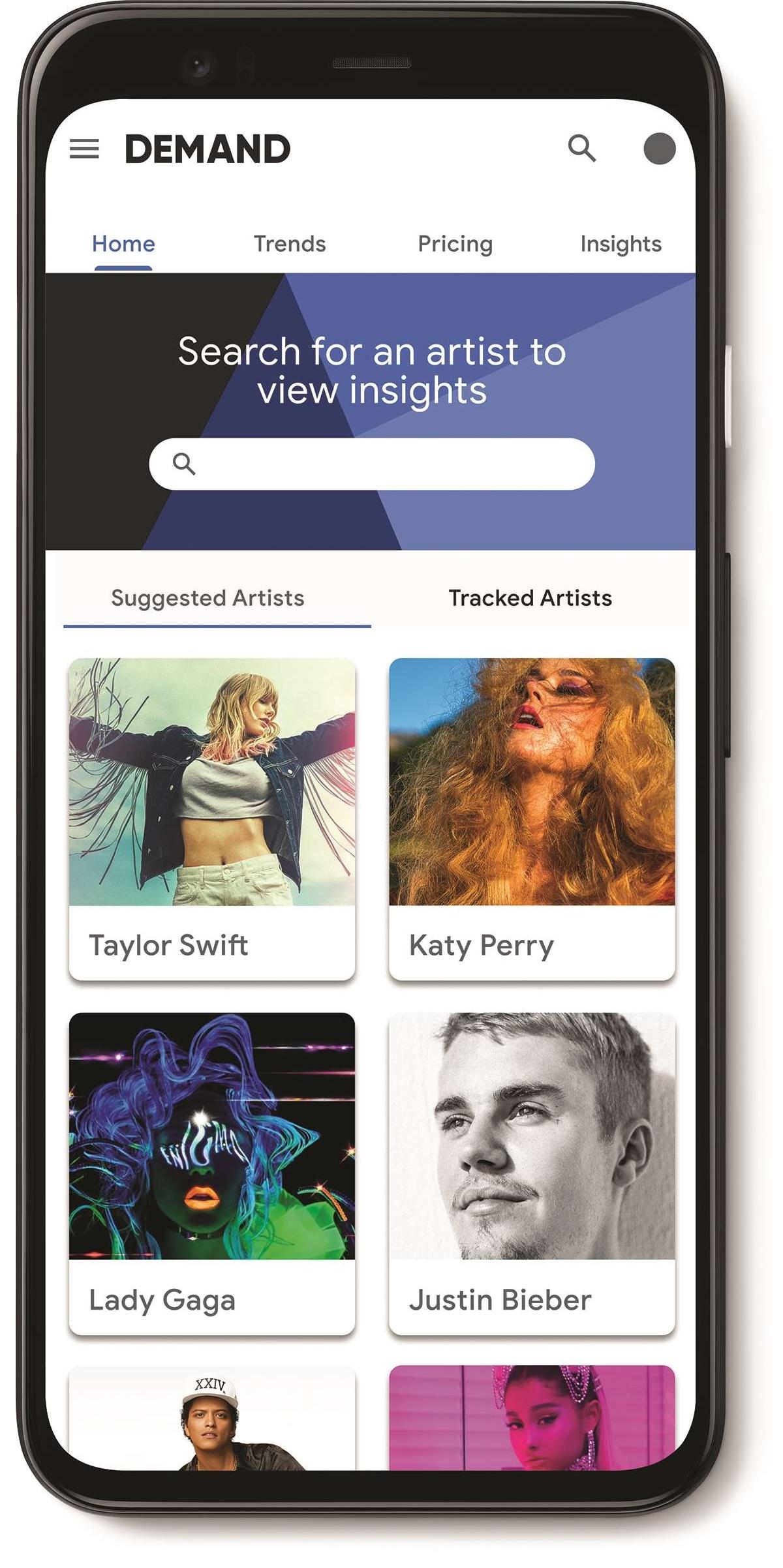
DEMAND’s four sections are as follows: Trends, which enables users to view the Google search and YouTube search interest in an artist or artists by date and geographic location; Pricing, which allows for a comparison of an artist’s primary and secondary ticket prices; Announcements, which gauges buzz for artists within the first three days of a tour announcement; and Insights, where fans’ brand preferences are broken down by category.
While this product is available for free to anyone in the industry, Jeffrey Azoff explained during the panel two use cases where DEMAND has already proven invaluable. When he saw the search buzz for Harry Styles over-indexing in Atlanta following his tour announcement, for example, Azoff made the informed decision to add another Styles’ date at Atlanta’s State Farm Arena where he will be now play this July 29 and July 31.
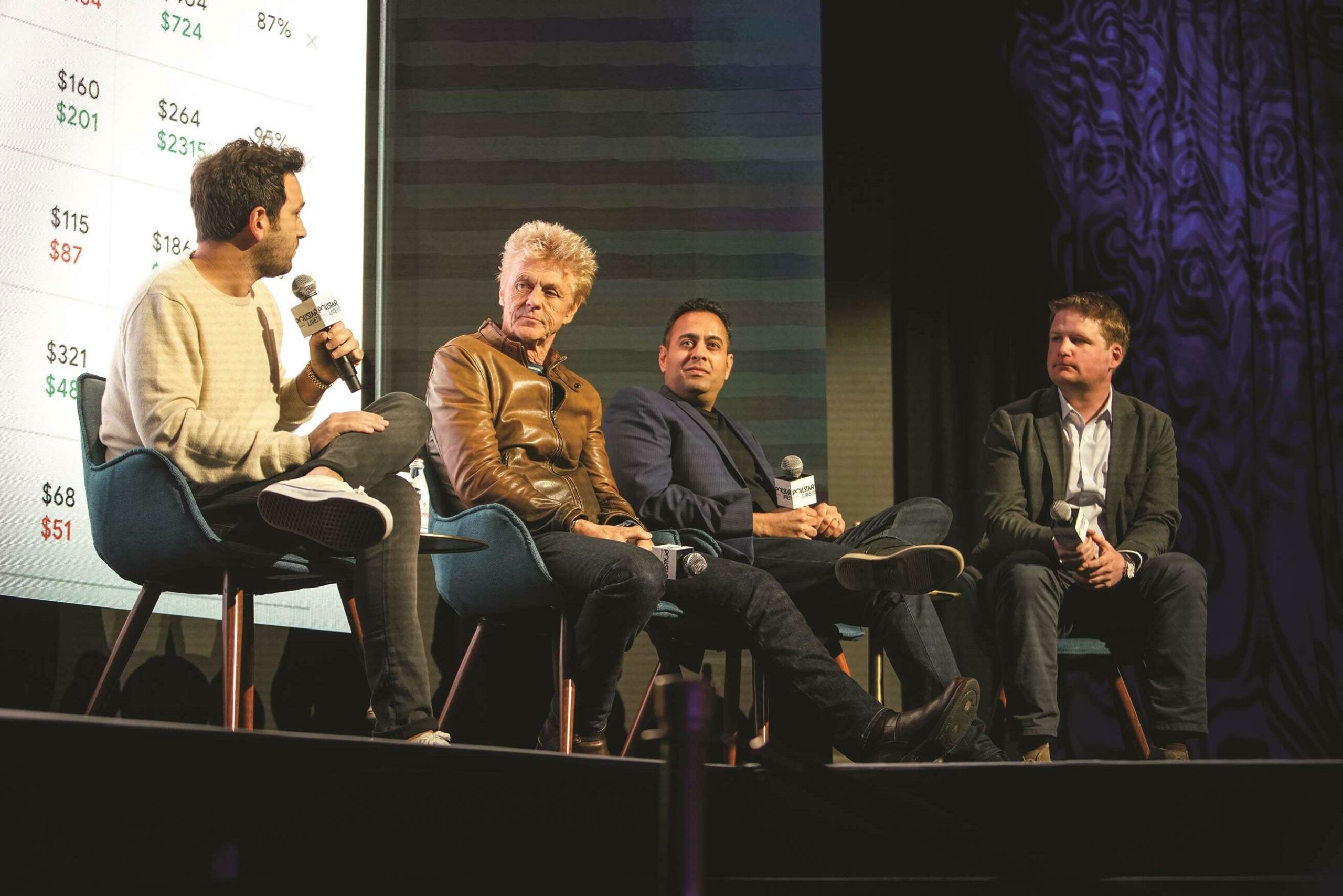
Black Coffee Productions – In Demand:
Full Stop Management’s Jeffrey Azoff Google Area 120’s Nick Turner and Parag Vaish, and OVG’s Eric Gardner introduce DEMAND Feb. 5 at Pollstar Live! 2020.
Black Coffee Productions – In Demand:
Full Stop Management’s Jeffrey Azoff Google Area 120’s Nick Turner and Parag Vaish, and OVG’s Eric Gardner introduce DEMAND Feb. 5 at Pollstar Live! 2020.
Styles’ name was also put into the Insights tab which generated his fans’ favorite brands over the last 30 days in different categories. The superstar’s fans, it turns out, have a predilection for Nike in Fashion, American Airlines in Travel, Starbucks in Restaurants, “Minecraft” in Video Games and Jeep Wrangler in Automobiles.
Later the same day John Guynn, VP of Operations for OVG’s Media & Conferences division moderated a Pollstar Data Cloud panel with Area 120’s title technologist Uday Ghatikar, UTA agent and partner Ken Fermaglich and OVG’s Gardner.
Both Fermaglich (whose clients include Guns N’ Roses, Muse and Paramore) and Gardner spoke of the importance of using tour histories, a service Pollstar has provided for nearly four decades, when setting up tours. These histories traditionally listed tours, venues, gross, ticket prices and attendance in a raw data form, but to be able to customize and creatively constrain the parameters to make new data sets to show comparisons, growth or other insights was, at best, limited and time consuming.
With the Pollstar Data Cloud, which includes Pollstar’s entire Route Book and Box office data for the last five years, the possibilities are limitless and a few clicks away.
In a panel use case, the data was filtered to show all shows on June 1, 2019, for the state of Nevada which instantly generated all Boxoffice Reports totaling some $24 million in ticket sales. “That’s something we never would have been able to do with the old system,” Fermaglich said.
In a second use case, the data was layered for two clubs, The Independent in San Francisco and The Troubadour in Los Angeles. Parameters were further constrained to show artists who in 2019 sold more than 400 tickets and grossed more than $10,000. Within seconds a report was generated that yielded 119 shows complete with venue, show date, grosses, prices, tickets sold and promoters.
Adding to the Pollstar Data Cloud’s luster is that it’s hosted by Google Cloud Services which allows the data to be used and licensed in conjunction with other data platforms.
”Think of the Google Cloud Platform Marketplace as an App Store,” said Area 120’s Ghatikar. “So it’s a curated catalog of a whole bunch of services, data, from our partners, from Google, from Pollstar and it allows you to, just as you would in a phone, in the app store, download things that are valuable to you and you can use it with multiple other applications to do things downstream from the app store.”
At the PDC panel weather data was offered as an example of something that could be paired with Pollstar data to forecast what days might be optimal for outdoor performances in a particular locale.
“The DEMAND product is giving you an overview of consumer demand for different artists across different regions. You think of their pricing, what happens at announcement day and what are some of their fans’ interests,” said Area 120’s Vaish, who worked on both data products. “Doing a deeper level of analysis is where the Pollster Data Cloud comes in, and you want to go and investigate and get more details and the 100 column views of things – that’s the difference.”
All of which begs the question: How can these two distinct products work together for the betterment of this industry?
As a use case illustrating the complimentary functionalities of DEMAND and Pollstar Data Cloud, we randomly selected Green Day and researched which two Texas markets would have the most demand and revenue for a possible tour.
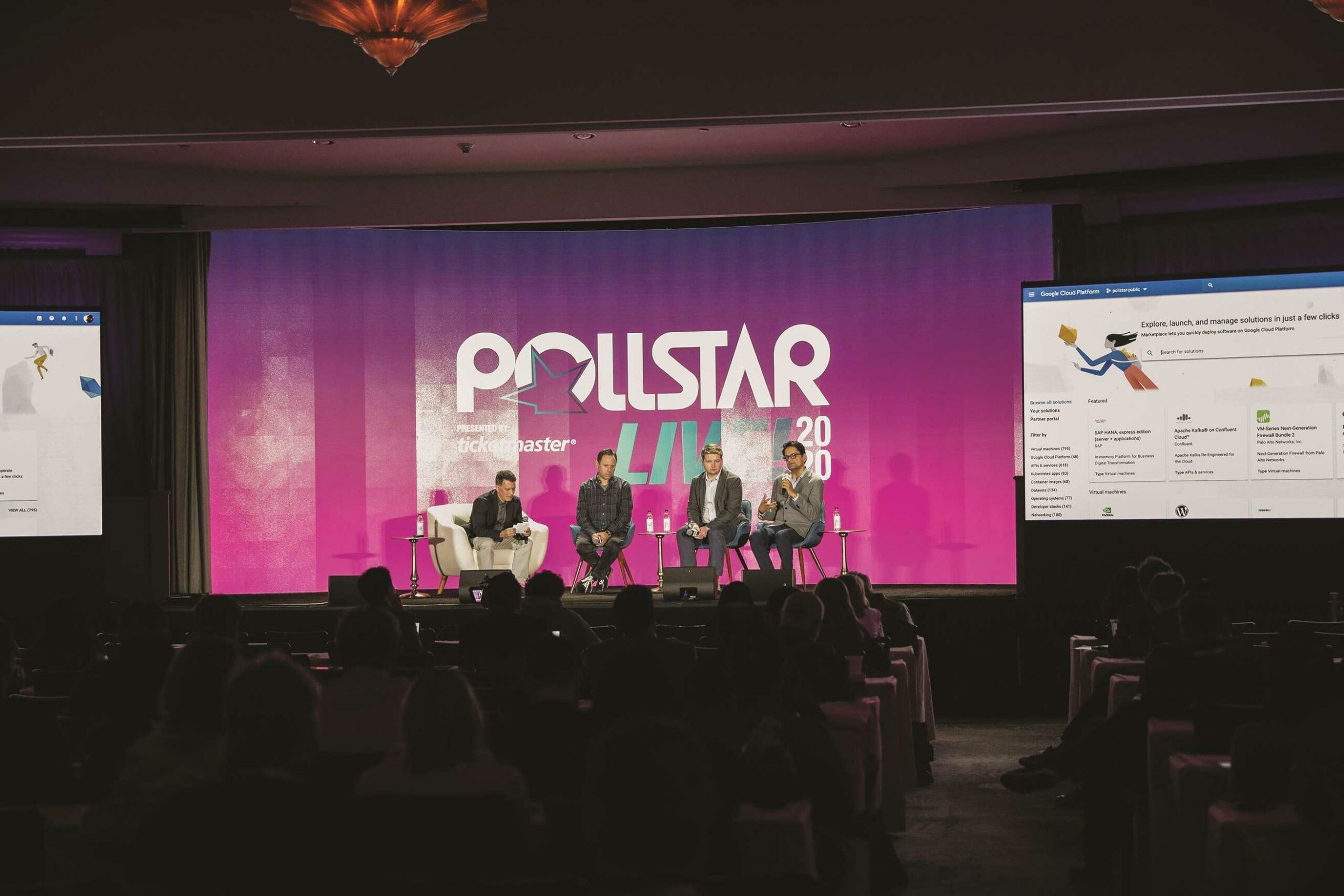
Black Coffee Productions – Head In The Clouds:
OVG’s Jon Guynn, UTA’s Ken Fermaglich, OVG’s Eric Gardner and Area 120’s Uday Ghatikar help launch the Pollstar Data Cloud Feb. 5 during Pollstar Live! 2020.
Black Coffee Productions – Head In The Clouds:
OVG’s Jon Guynn, UTA’s Ken Fermaglich, OVG’s Eric Gardner and Area 120’s Uday Ghatikar help launch the Pollstar Data Cloud Feb. 5 during Pollstar Live! 2020.
In terms of DEMAND’s Trends for Google searches of Green Day in Texas over the last six months, Houston had four spikes near or above the 80th percentile (which correlated with the announcement of the “Hella Mega Tour” with Weezer and Fall Out Boy; Oct. 1, when fans ranted about “Wake Me Up When September Ends” jokes; a performance at the AMAs; and a New Year’s performance in the group’s native Bay Area).
Dallas/Ft. Worth had four spikes, but three were in the 90th percentile of interest. The tour announcement, AMA performance and New Year’s performance all correlated with spikes, but the largest one was Jan. 26 (correlating when the band performed at the NHL All-Star Game and Billy Joe infamously swore on live television), when interest reached 100%.
El Paso had three spikes, two just near the 80th percentile, and, perhaps most importantly, the swings in interest were much more dramatic, frequently dropping to zero, suggesting less consistent interest. Austin and San Antonio only had 2 spikes, and also frequently dipped to zero in terms of searches.
In terms of Green Day’s lift for Announcements, Dallas and Houston “Strongly Exceeded” demand above other Texas markets.
To drill down on these cities and see exact revenues, tickets, and venues Pollstar Data Cloud is indispensable. If we perform a Data Cloud search for Green Day and Texas the band’s highest gross in the state, according to Pollstar reports, was a March 4, 2017 show at Dallas’ American Airlines Center where the band grossed $632,000 and moved 13,154 tickets. The second-highest gross was in Houston at the Toyota Center on March 5, 2017 which grossed $609,000 before 11,111 fans. Both shows exceeded the band’s average gross of $509,000. The band plays in San Antonio’s AT&T Center and Austin’s 360 Amphitheater grossed $508,000 and $465,000 respectively. Green Day’s El Paso Coliseum show grossed $333,000.
Dallas and Houston would, in a vacuum, seem like logical choices as tour stops for our hypothetical Green Day tour through Texas.
On the day DEMAND and Pollstar Data Cloud were released, Oak View Group’s CEO and co-founder Tim Leiweke said in a statement that “the industry changed today.” He was not exaggerating. Having these complimentary data tools at our industry’s fingertips is going to raise all boats, including fans who will be able to see more of their favorite artists than ever before possible. And that’s a game changer.
DEMAND is available at no cost to live music professionals at demand.area120.com. Sign up for Data Cloud at pollstar.com/datacloud.
FREE
 Daily Pulse
Subscribe
Daily Pulse
Subscribe
 Daily Pulse
Subscribe
Daily Pulse
Subscribe