
Pricing, Parent Parking & Promised Lands: ILMC 2025 Highlights
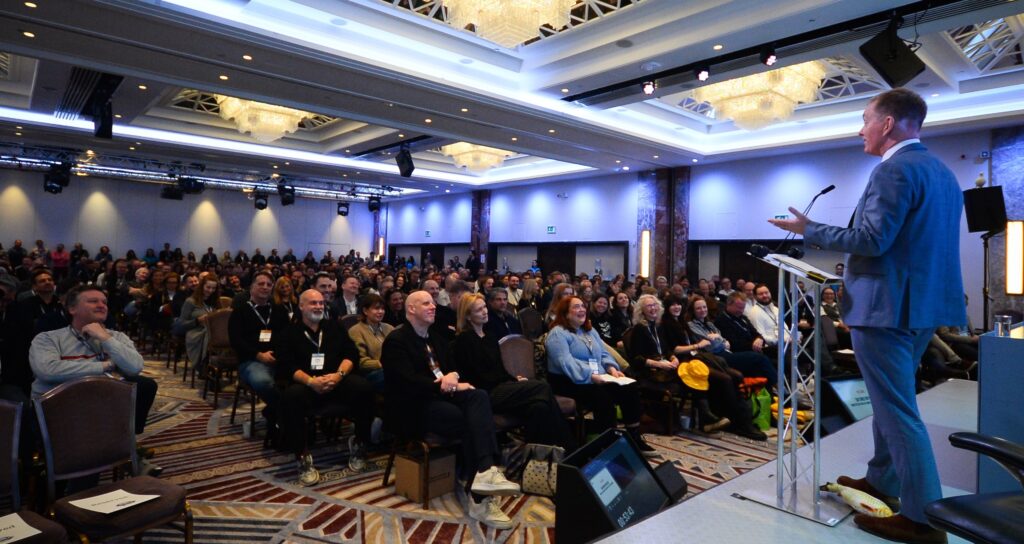
ILMC 2025 went down in London Feb. 25-28. The I in ILMC stands for international, and with some 1,600 registrants arriving from 60 countries to celebrate, analyze, and discuss this wonderful industry, the conference truly lived up to its name.
ILMC head Greg Parmley kicked things off by introducing a new award, the Brick Award, which went to Brian Kabatznick, executive vice president, business development and facilities, OVG, for his outstanding career and services to the live biz. He accepted the honor hinting that his work was far from done.
The UK’s minister for the creative industries, arts, and tourism, Chris Bryant, took the podium next, laying out the current government’s plans for ensuring that London remains “the best place for live music.” He said the onus of allowing artists to tour Europe freely post-Brexit was on the European governments. He also talked about a 10-point plan for music the UK government intends to publish in June. It aims to tackle proper music education for children, better remuneration for artists and songwriters in the age of streaming, and secondary ticketing.
“Up or flat?”
ILMC’s opening session, chaired by CAA’s Maria May, followed, and May summed up 2024 perfectly, when she said, “it’s been a great year for some and a hard year for others.” Aside from the two biggest tours of the year being out on the road at the same time – Taylor Swift, which has grossed more than $2 billion, and Coldplay, which sold more than 10.3 million tickets at the time of writing – it also was a year of firsts: Fred Again.. announcing his LA stadium show six days in advance; Anyma at Sphere; and Adele in Munich.
Meanwhile, there’s been loads of festival and tour cancellations, artists are generally touring shorter because of costs, and there are concerns about the collapse of grassroots touring. “So,” May wanted to know, “is the biz up or flat?”
Good Business On All Levels
Veteran agent Sam Kirby Yoh (UTA) said ticket sales were good in general, even for smaller shows. “If you understand the artist’s audience, and work with local media and promoters, you can make it work,” she explained, adding, “we have to be super flexible.”
DF Concerts CEO Geoff Ellis confirmed: “the business is as strong as its ever been on all levels.” He said he’s had more shows at King Tut’s Wah Wah Hut – a true grassroots music venue – in 2024 than in 2023, which had already been up on 2022. He emphasized that it wasn’t easy, though: “costs are higher, margins are lower, but the appetite is bigger than ever.”
Buzz Without Booze
One thing that’s affecting margins a lot is the fact that the young audience drinks less alcohol – way less alcohol. Ticket price increases alone cannot offset that, but there are ways to leverage the appeal of the top acts, where higher prices can be charged, and where there’s loads of opportunities for premium offers.
The continued appeal of premium, and the fact that the European business is far from pushing the limits of what’s possible in that area, was addresses in multiple sessions. Kirby Yoh warned, however, that it made no sense to look at prices in the U.S. when setting prices in Europe.
FKP Scorpio’s Folkert Koopmans said ticket prices for festivals had reached a ceiling. He explained, “people don’t want to spend €250 to €300 on a festival,” adding that this could be seen across Europe since the pandemic, during which “we’ve lost a generation.”
“In the headline business there seems to be no limit,” he continued, “but we have to acknowledge that we’re selling to an elite.”
India: The Promised Land
Also on the opening panel was Ashish Hemrajani, founder and CEO of Big Tree Entertainment and BookMyShow, who shared some mind-blowing stats on the recent developments in the country.
To most Westerners, India is a patchwork of 33 states, all with their own culture, look, food and people, “like Europe stitched together in one country,” as he put it, before breaking it down as only someone born in India could.
According to Hemrajani, there’s “the London of India,” some 5 million people with the highest purchasing power across the top eight or 10 cities. 65 million Indians, which he described as “the United Kingdom of India,” which are people with private healthcare, private education, sending their kids to study abroad. “This unit controls about 65% of the GDP of the country, and 80% of the consumption of the country,” he said.
There’s 400 million Indians he described as “the Brazil of India,” the emerging middle class, whose average monthly household income was only increasing, with consumption increasing accordingly. Finally, 300 million Indians (“the Haiti of India”) with no means for consumption.
The country, he continued, boasted the largest demographic in the world under the age of 35. “There’s 300 million Indians speaking English as their first language. Unlike in China, Netflix, Spotify, YouTube all exist in India. Therefore, kids grow up listening to the same music as the rest of the world.”
BookMyShow just did some of the world’s largest ticketed concerts in history: Coldplay at Ahmedabad, which sold 114,000 tickets per night, plus three shows almost as big in Mumbai. All sold out within minutes.
The company also took Ed Sheeran deep into the country, the first artist to play a proper circuit of eight cities. “We developed an opened new markets, but he’s the type of artists that loves India, wants to go deep. It wasn’t easy, but it was historic.” The average ticket price was $100, and Sheeran performed to 17,000 to 18,000 in some markets, 40,000 in others.
The one thing India is lacking is arenas, limiting the concert season to October through April, maybe May, because of the Monsoon season that follows. To turn outdoor spaces into venues, Big Tree Entertainment/BookMyShow owns barriers, ground covering, scaffolding and everything else.
But things are about to change: “We’re building an 18,000-cap arena in Mumbai,” Hemrajani said. It’s easy to imaginemore international artists playing a full Indian tour leg, once more cities get 18,000 to 20,000-cap, air-conditioned arenas. But even now, India should be on the itinerary of any tour coming through the Middle East and South East Asia, as it makes a lot of sense routing-wise.
Experience, Experience & Experience
ILMC’s festival panel began with the assessment that while double the number of festivals canceled in the UK compared to 2023, others are doing better than ever. Ben Ray, promoter of Slam Dunk Festival, said it was hard to assess the health of the sector as a whole, as it differed massively across the range of camping, non-camping, indoor, outdoor, national, and regional events.
AEG Presents’ Jim King agreed: “You have to break it down to the individual event. It’s evidently clear that grassroots festivals are having a tough time, and it’s really hard to figure out how to navigate out of it. But if you look at the headline-driven ones, there’s all the reason to be optimistic.”
“Experience is everything” has become this industry’s mantra. Fans expect different things from events nowadays, including being involved in the conversation around designing the actual festival, Jana Posth (Dreamhaus), who runs Rock am Ring festival, explained: “Experience doesn’t just mean ‘fun stuff’, it also means not queuing upon entrance, when buying beer or going to the toilet, etc. And that’s hard work.”
Headliner: No Problem
Most panelists didn’t think this industry had a headliner problem, and BST Hyde Park 2025 makes the case. “We’ve got the youngest BST ever. Zach Bryan is doing two nights, and I don’t know if we’d even booked country two years ago,” said King. He also pointed to other young acts, who had some of the biggest tours out there.
The potential of sponsorship was addressed as well, as another way of compensating for rising productions costs as well as less alcohol consumption.
How Is The Ticket Priced?
ILMC’s ticketing panel broke down the many fees that are added to a ticket and explained how they were calculated. Given that a lot of fees are added on top of the ticket price set by artists and their teams, the sensibility of displaying the all-in price right out the gate was discussed. Displaying the all-in price was already law in Norway, said CTS Eventim’s Marcia Titley. In California, as well, added AEG Presents’ Kelly Stelbasky, saying, “I think this is where it’s headed. It’s a better experience [for the fans].”
One problem with an all-in price would be taxation, as ticket sales tax (VAT) is already quite high in the UK, and if it gets charged on a higher price, instead of separately on incremental fees, it would reduce the promoters’ margin even further.
When moderator, Tim Chambers, asked whether artists typically received a share of those additional fees, or whether the promoters saw some of that money, it got real quiet. “I don’t think we’ve established a safe word for the panel,” joked Stelbaski.
Live Nation’s Phil Bowdery pointed out, in all the outrage over high ticket prices people tend to forget that promoters make a loss on shows that don’t sell. Companies had to make a profit to offset those losses.
Which prompted a question from UTA’s Jules de Lattre about whether the model was flawed, if you had to compensate for the high-risk side by making the most of the low-risk shows guaranteed to sell.
Dynamic Pricing got addressed, as well, and Titley said it was up to artists and promoters. “If they want it, we do it,” she said, adding that one could see the huge impact it had in markets where it was banned, meaning the loss in revenues.
Bowdery clarified that dynamic pricing didn’t exist in the UK, explaining that artists might set levels with their teams to introduce differently priced tiers for their shows.
Talking secondary ticketing, Bowdery said the UK biz would welcome a cap on how much a ticket could be resold for. “We advocated 10%,” he said, adding that the topic of secondary ticketing may be part of the UK’s annual King’s Speech, which lays out the policies for the coming year.
At one point the conversation took a turn that suggested, the fact that people pay the prices that are being charged, and do so willingly, as evidenced by the many sold-out blockbuster shows every year, meant the price was right. Many European promoters, after looking across the pond and seeing what’s possible with premium, think the continent often underprices tickets.
De Lattre objected, saying it was possible to go too high, and just not be aware of it, because die-hard fans would pay anything to see their favorite artists live at all costs.
Venues: Prime Time For Premium
Europe’s venues are facing the enormous cost pressures, too, of course. Ignacio Taier of Grupo Quality said the price increases couldn’t all be offset by raising ticket prices. So, his team decided to focus on f&B, step up its game in all regards, encouraging people to spend more.
OVG’s Rebecca Kane Burton said she was obsessed with f&b. “It needs to be good on every level. It’s bloody difficult,” she said, taking her hat off to the vendors. “The margins are tight, you have to be built out of teflon,” she said, adding it was the reason OVG decided to bring as much f&b in-house as possible.
Live Nation’s Tom Lynch said, promoters have started collaborating to offset costs. “We’re seeing some arena shows coming through sharing equipment, stages etc.,” he explained. And he added, premium was one of the biggest opportunities to further offset costs, and not just for a tiny elite, but across the board. He thought 20% of the house could be premium offers, which includes convenience-focused ideas like queue jumps, or parent parking, meaning: parking the parents in the lounges of venues, while their kids enjoy the show. Win win.
According to Lynch, merch was getting better as well, allowing artists to charge a premium price for good quality. “Fans will pay for that,” he said, adding there was loads of work to be done to make the retail experience match the quality of the merch.” He saw a big opportunity in selling merch throughout the day, and open the venue for that purpose specifically.
ASM Global’s Marie Lindqvist agreed that this was “such an important part of fan engagement.” She recalled Taylor Swift’s concerts in Stockholm, where merch was being sold for a week before the show. Thousands showed up all week, she said, adding that her team was looking at every single space around a building to see how it could be utilized, all in an effort of turning arenas into 365 destinations, including restaurants, co-working spaces, nightclubs, and more.
On a different note, Lindqvist said, that stadiums and arenas did not cannibalize each other. “If anything,” she said, “they complement each other.”
And Kane Burton pointed to the many stadiums around the world that stood empty most of the year, and the opportunities they held – especially considering what such mega events did for the surrounding cities.
Honorable Mentions
There was loads more to be discovered and learned at this year’s ILMC of course. In another session, some of Coldplay’s team, including WME’s Josh Javor, Live Nation’s Phil Bowdery, and production manager Chris Kansy talked about the ongoing tour, with Bowdery saying, “We’re not finished yet.”
The Middle East had its own day full of sessions, talking about the state of play in the market, as well as the venues it boasts. Touring Entertainment Live returned as a format, focusing on the non-concert tours out there generating enormous business. Koopman’s talked about their potential on the Open Forum, saying that alternative show formats like the Minecraft Experience his company promotes held real opportunity.
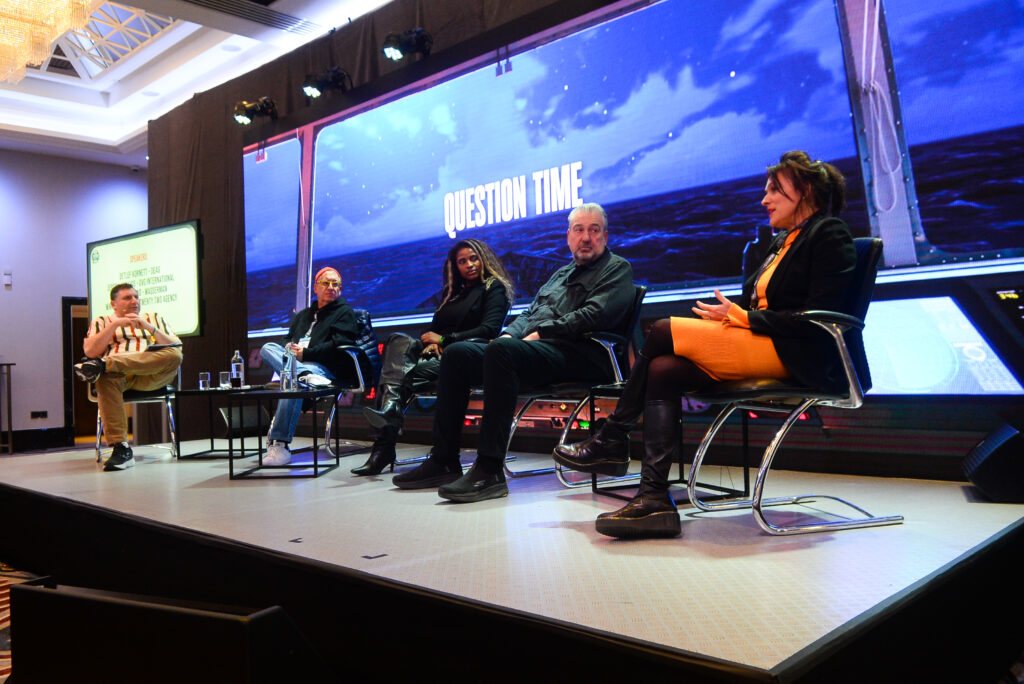
A new format called Question Time was introduced at this year’s ILMC: delegates could submit questions, which Dan Steinberg (Live Nation) presented to a panel that included Wasserman Music’s Marty Diamond, OVG’s Jessica Koravos, DEAG’s Detlef Kornett, and Whitney Asomani of Twenty:Two Agency.
There were prize draws, karaoke, and morning runs, and much more – the physical and metal well-being of those working in this biz was a big topic at ILMC 2025 in general. And if the buzz inside the Royal Lancester Hotel ever got too loud, one could always head out the front door, and step onto a Pieter Smit nightliner for a coffee and a tour.
FREE
 Daily Pulse
Subscribe
Daily Pulse
Subscribe
 Daily Pulse
Subscribe
Daily Pulse
Subscribe