
From Packed Pews to Packed Arenas: Not Your Daddy’s (Or Mommy’s) Contemporary Christian Music
“They’re not good for Christian music. They’re good. Period.” – Jared Gibo, CEO, TPR
It’s a new day with a savvy next generation of Christian music execs and artists like 31-year-old phenom Forrest Frank, who produce music, market themselves and understand the internet moving away from the traditional contemporary Christian music system that relied heavily on radio, record labels and genre gatekeepers.
Instead, they’re building audiences on TikTok and streaming, then turning that momentum into tours, big and small, with the help of new leaders. Live show production has improved, too: in-the-round stages, arena-level production with leading technologies and major tours from artists like Brandon Lake, whose biggest headlining tour, “The King of Hearts Tour,” sold out arenas from Boston, MA to Saint Paul, MN to Charleston, SC show that CCM now rivals mainstream pop and rock acts in spectacle and reach. Per Pollstar Boxoffice Reports, Lake’s sold-out double night final show at the Credit One Stadium in Charleston on May 1 & 2 averaged $1,270,203 with 22,658 tickets sold.
Compared to veterans like Chris Tomlin and CeCe Winans, who built their careers on radio and worship music at traditional faith venues, it’s clear that Christian music hasn’t just evolved. The entire ecosystem, which includes booking, promotion, production and even annual awards ceremonies, has been overhauled, running at a scale the genre has never seen before, taking its faith-based message from pews to packed arenas.
Modern CCM’s rise can be traced back to 2019, which kickstarted five years of growth, with Christian music streaming growing by more than 60% by 2024, per Billboard. During that period, artists like Elevation Worship, Phil Wickham, and Maverick City Music brought worship to the masses with arena-scaled shows, through music that blurred the lines between secular tunes and CCM. Pollstar Boxoffice Reports reflects this carried over momentum from the charts to the stage, with Maverick City Music launching their first headlining arena tour in 2021, which quickly sold-out, grossing $5,448,960 with 111,554 tickets sold across 21 shows. While Elevation Worship grossed $3,552,975 during their 2021 8-show tour and Phil Wickham scored $2,324,178 on his 2022 32-date tour, per Pollstar Boxoffice Reports. Then, amid the pandemic, Dan Fife, the founder and president of Awakening Events, kept the growth going with the “Drive-In Theater Tour.” The tour featured TobyMac, Zach Williams, Mac Powell, CAIN, Jordan Feliz and Colton Dixon, among others, and grossed almost $3 million, which helped the Franklin, TN-based promoter top that year’s Pollstar mid-year North American chart. Other Awakening Events acts also found themselves on the chart with TobyMac landing at No. 4, Chonda Pierce (No. 31), Skillet (No. 35), Zach Williams (No. 56) and Steven Curtis Chapman / Big Daddy Weave (No. 60). “What made all the difference for us was really focusing on what we can do instead of what we can’t,” Fife told Pollstar in 2021, regarding the CCM’s major touring success at the time. “We rotated these artists around the country and created something that I referred to as ‘base hits.’”
At the same time, country music continued its mainstream presence with certified hits, and some of those tracks contained faith-based themes. Artists like Morgan Wallen, Zach Bryan, Blake Shelton, Kane and Katelyn Brown and Cody Johnson offered records with focuses on spirituality. Newer country acts like Anne Wilson even moved from country to CCM, with the 24-year-old Kentuckian emphasizing her relationship with Jesus as the center of her musicianship. It’s conditioned the mainstream for more faith-focused music. But it wasn’t until Forrest Frank’s willingness to streamline worship and the art of CCM through social media channels used by the youth that the genre would begin to hit another level of popularity.
In early 2023, Frank went viral with his track “No Longer Bound,” a collaboration with Reach Records rapper Hulvey, which then peaked at No. 19 on the Hot Christian Songs chart. The genre reached record highs in 2024 and 2025, hitting a milestone when two CCM songs, Frank’s “Your Way’s Better” and Lake’s “Hard Fought Hallelujah” featuring Jelly Roll, also charted.
Yes, Frank was already known as part of the pop duo Surfaces, who were famous for the 2020 hit “Sunday Best.” But, when he moved into Christian music, the native Texan doubled down on doing everything himself, producing his own songs and working independently. Instead of using the old system, Frank built his own with just his phone. And now, according to several sources, Frank is expected to be hitting stadiums across America on his next tour outing. Other artists who are following a similar TikTok-heavy path include newer CCM artists like Josiah Queen, Madison Ryann Ward, rapper Kieran the Light, and Miles Minnick, who is the first openly Christian rapper selected for XXL’s annual Freshman Class, earning the fan-voted 10th spot in June.
The numbers highlight how meteoric this growth has been. Luminate’s data shows that streaming now accounts for 92% of all music consumption in the United States. According to Luminate’s 2025 year-end report, Christian and gospel-related music saw an 18.5% increase in on-demand audio compared to 2024, second only to rock and Latin, and well ahead of the overall industry’s growth. Midyear numbers are even more impressive: streams of new Christian music releases rose 8.9% through late May 2025, more than double the industry average of 4%, while most other genres declined. Luminate analysts credited Frank, Lake, and Elevation Worship specifically for this surge. And finally, Spotify listening data, per Luminate shows the audience is skewing younger: millennials and younger listeners made up 39% of CCM’s audience in 2021 and 45% by 2024, which is the opposite of most older genres that are struggling to keep and attract young fans.
Many experts see TikTok and social change as the main reason for this shift. Unlike radio, where artists need approval from programmers to reach listeners, TikTok’s algorithm shares songs based only on engagement. This means a worship song or a Forrest Frank track can reach millions without a label, publicist or radio play. Frank used this tactic from the start, making songs for short-form discovery and turning that attention into streams and chart success. For example, in 2026, Frank struck viral gold, again, with his track “Jesus is Alive.” The song gained momentum after supporters responded to the artist’s “open verse” challenge, which found multiple fans adding their own verses to the song on TikTok, Instagram, and YouTube. “Jesus is Alive” would then become the artist’s second No. 1 song on the Christian chart.
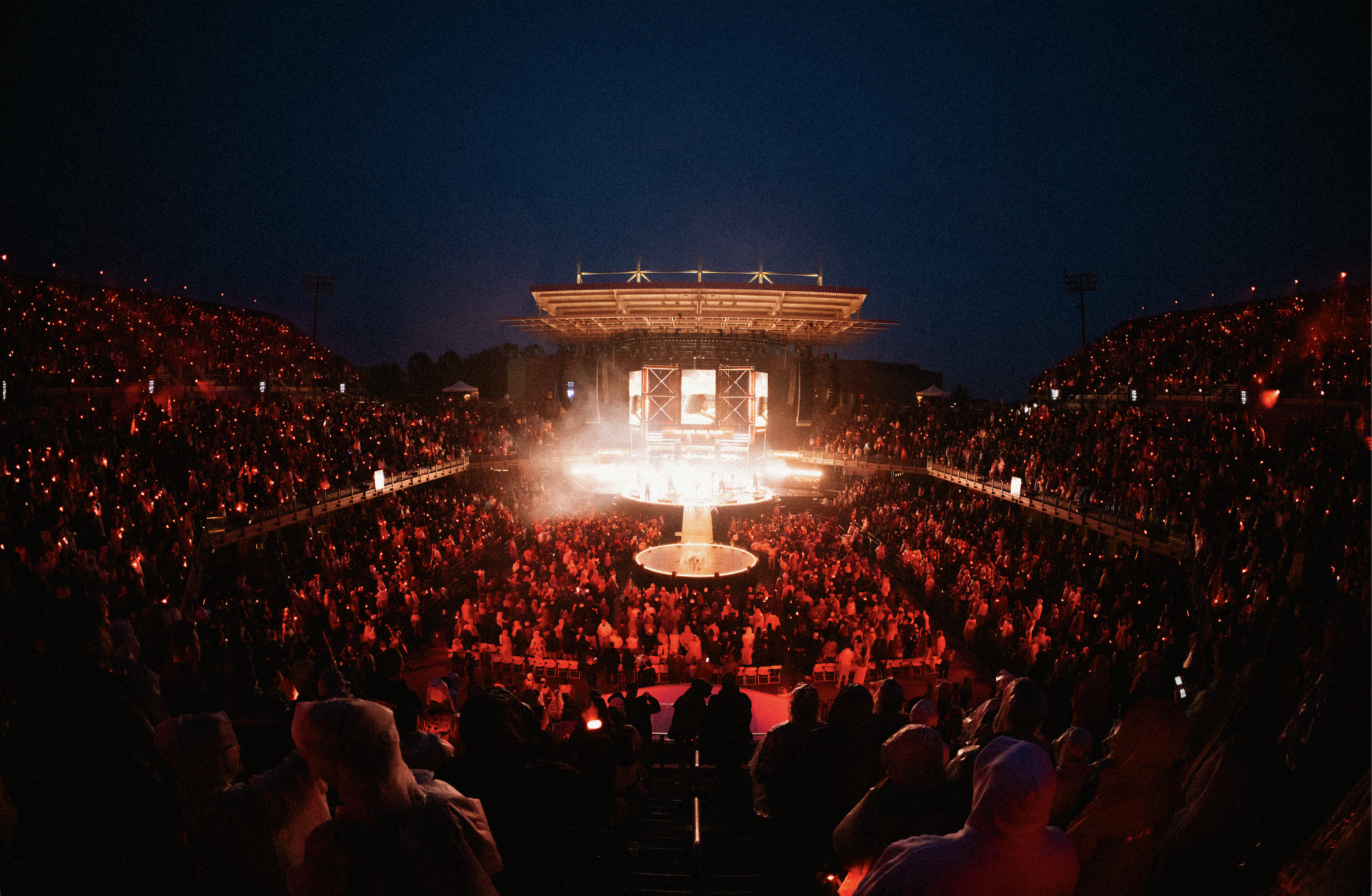
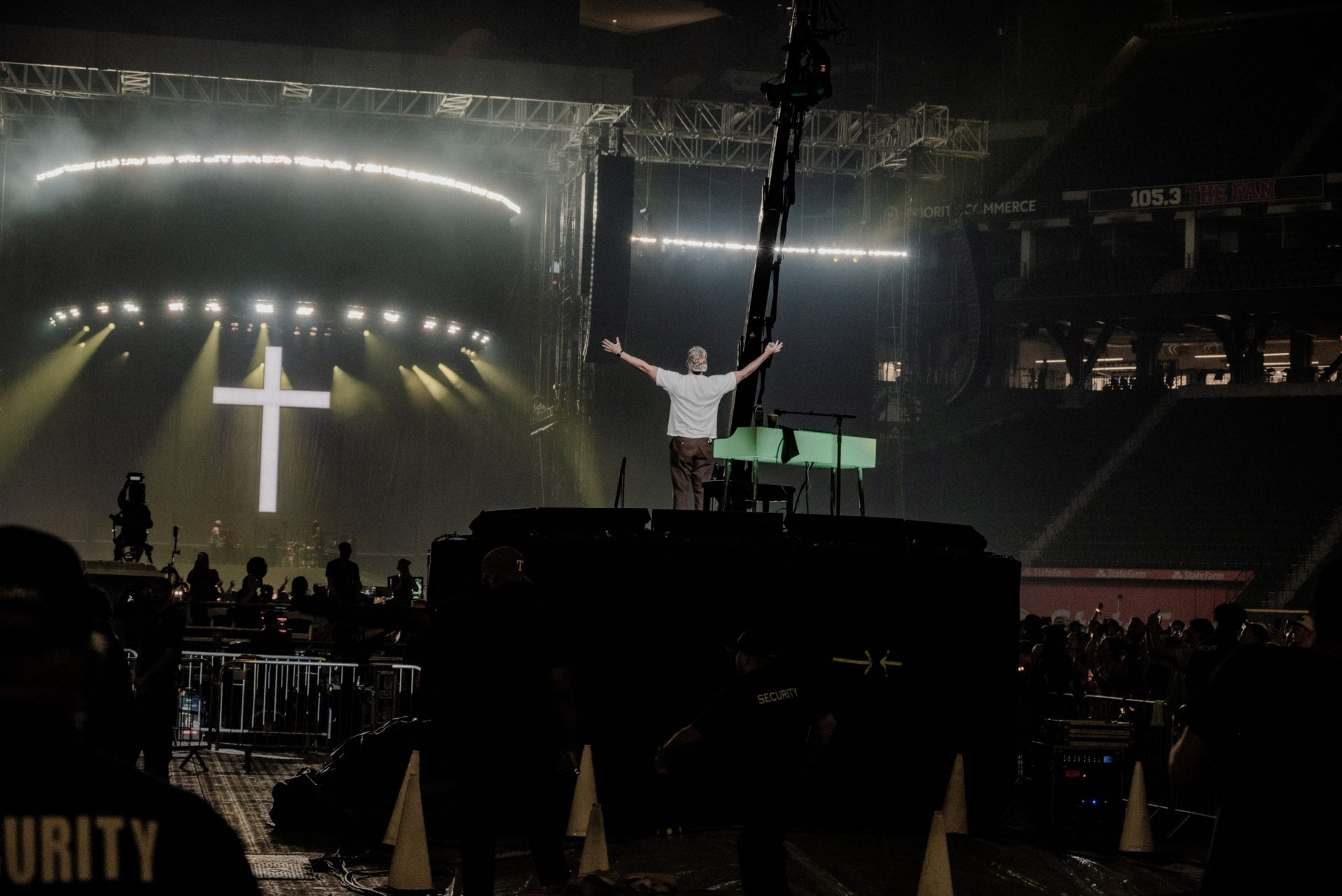
That raw momentum and excitement continued into Frank’s live show. “The Jesus Generation Tour” began on June 1 in Tulsa and included 29 shows at major venues like Madison Square Garden (New York), Allstate Arena (Chicago), Little Caesars Arena (Detroit), and Ball Arena (Denver). The tour ended on Aug. 1 with a sold-out show at Globe Life Field in Arlington, Texas, drawing more than 35,000 people and establishing “The Jesus Generation” as the biggest Christian music tour of all-time. This feat followed his completely sold-out “Child of God Tour Part 2.” “Child of God Tour Part 2” featured Frank’s in-the-round staging, designed specifically for outdoor stadiums instead of being adapted from an arena setup, putting him on the same level as pop and rock stadium tours.
Pollstar Boxoffice reports confirm the scale: Frank debuted at No. 5 on the LIVE75 chart, earning “Hot Shot” status for the highest-ranked debut, and reached No. 12 on Global Concert Pulse with an average of $1.46 million per night, behind only Bad Bunny, BTS, Luke Combs, and Iron Maiden. At Hersheypark Stadium, Frank drew 27,365 fans for a single show. Pollstar Boxoffice Reports show Frank topping the 2026 Gospel & Christian Q3 chart (Nov. 13, 2025 – Aug. 12, 2026) averaging $49,017,709.40 across 565,207 total tickets sold.
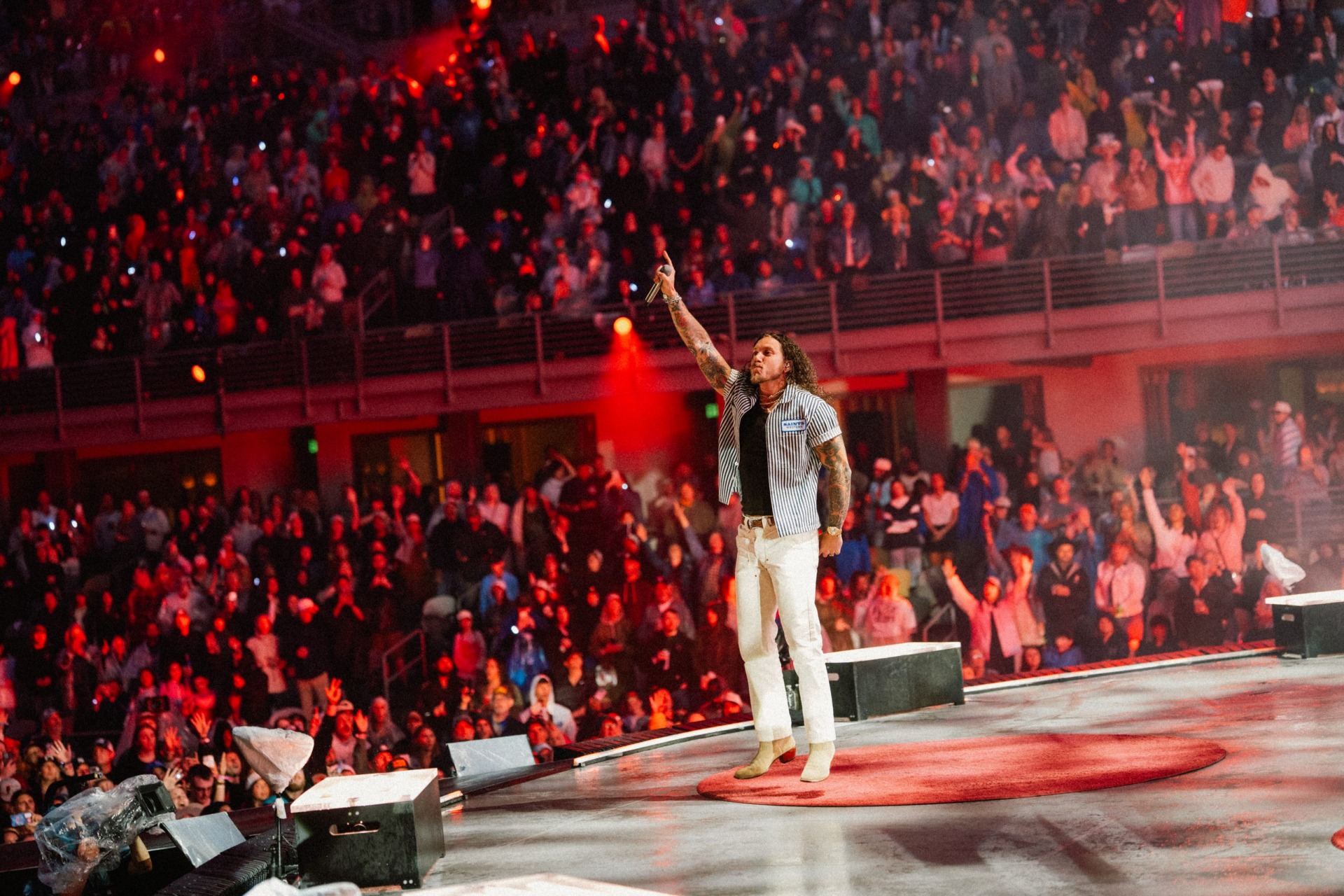
Lake’s “King of Hearts Tour” began on Oct. 2, 2025, in Sunrise, Florida, and continued through Fall 2025 and Spring 2026 across 48 cities. It’s his biggest headlining tour so far, with sold-out dates in cities and venues like Cleveland’s Wolstein Center, Detroit’s Little Caesar’s Arena, Philadelphia’s Xfinity Mobile Arena, Boston’s TD Garden, Charlotte’s Spectrum Center and his home market of Charleston. There, the tour ended at Credit One Stadium, where Lake had already sold out the Daniel Island venue during his “Tear the Roof Off” tour in 2024. Lake finished the final show with a joint performance of “The Author” alongside pop superstar Nick Jonas. Lake’s tour matches Frank’s at the arena level, with immersive screens, detailed lighting and a stage that moves fans between quiet worship moments and full-band performances. Per Pollstar Boxoffice Reports, the immense touring success has landed Brandon Lake in second place on the 2026 Gospel & Christian Q3 chart, grossing $24,965,750.80 across 403,976 total tickets sold.
Kyle Burnside, TPR executive vice president of global touring, whose team produced the “King of Hearts” tour, agrees. “It was one of the best concerts I’ve ever seen in my life, any genre… a testament to the force and energy behind this exciting new era of CCM,” he says.
Phil Wickham’s fall “Song of the Saints” tour, also produced by TPR, will go even further, with production designed by Sooner Routhier and Curtis Adams. Routhier previously worked on Coldplay’s critically acclaimed, mulit-year “Music of the Spheres” tour, produced by Live Nation.
“Forrest has certainly changed the ceiling,” says Gibo. “He’s broken through ceilings that we didn’t know were possible.” Gibo says Frank and Lake have been trading records back and forth. “Brandon’s tour was the biggest, then Forrest, then Brandon again; they keep pushing each other,” Gibo says. “They’ve taken the industry and the genre to places we never thought possible.”
Burnside has seen this growth up close through booking. Both Lake and Frank have been TPR clients since their first headline tours: Lake since 2022, Frank since 2024. “Brandon’s first arena tour averaged about 8,000 people, and the next one jumped to 12,000,” he says. “It was the same for Forrest. His first arena run was about 8,000, then he switched to in-the-round staging, which more than doubled it to about 18,000.” Burnside explains that these decisions are now based more on data than instinct, with streaming and social media numbers joining traditional tour history to create a market-by-market view that CCM artists didn’t have a decade ago, when radio spins were almost the only metric that mattered in the industry.
Frank’s view on industry validation is clear. In October 2025, before the 56th annual GMA Dove Awards, he announced he would no longer attend award shows, naming both the Doves and the Grammys, even though he was nominated for several awards that year. “I will not receive a trophy for something that is from Jesus and for Jesus,” he said, calling salvation the “true trophy” he seeks. Some peers, including country star Jelly Roll, felt a way about his decision.
Jackie Patillo, president of the Gospel Music Association, doesn’t see Frank’s decision as a threat to the awards’ importance, even with the youth movement in CCM taking hold. The industry vet sees it as proof that the genre could always support different approaches at the same time. “I love Forrest Frank. His music is impacting people in ways we haven’t seen in decades,” Patillo says. “As a trade organization and as a fellow believer, I think there’s room for everybody.” She adds, “The way I do business now is different from how I did business 15 years ago. Neither one is right or wrong and we grow.”
CeCe Winans has seen the music industry change over a 40-year career, and she thinks Frank’s way of doing things is just a new version of what has always mattered to fans. “I absolutely believe it’s possible today,” Winans says about building a touring career outside the usual Gospel or CCM paths. “You don’t necessarily have to wait for someone at a record company or radio station to tell you that you have permission to have an audience. If the music connects, people will find it, share it and support it. I think that is a wonderful thing.” Still, she adds from her own experience, “There is something valuable about development…Getting people’s attention quickly and building a career that lasts are two different things.”

Behind the artists is a booking system that has had to grow just as fast. Few have watched this side of the business more closely than Jonathan Roberts, who leads United Talent Agency’s Christian Music division.
Roberts joined UTA in May 2024 after 12 years in the industry, most recently as VP of global touring for Premier Productions, working with clients like Lauren Daigle, Elevation Worship, Dude Perfect, and Hillsong United. A few months after he joined, UTA launched a dedicated Christian Music division around him as part of the agency’s Heartland initiative, quickly building a roster that includes Lake, Phil Wickham and Frank. “We are witnessing an unprecedented moment in the music industry at large… where Christian music is resonating with wider audiences because of the accessibility, old and young audiences; the throughline here is that people are hungry for hope, they want truth,” Roberts tells Pollstar. “Bridging that gap between the old guard and the youth through booking…represents something that CCM in particular can do that a lot of other genres have struggled to accomplish. It has brought change.”
“A lot of the mainstream institutions that CCM artists used to chase are now coming to us,” he says. “The growing popularity of acts like Forrest Frank, Brandon Lake, Lecrae, Phil Wickham, and even newer voices like Jamie Macdonald shows how much things have changed. These kinds of arenas, stadiums, sell out in minutes across the country…God is good.” The fact that a major mainstream agency created a whole division for Christian music in 2024, instead of adding those artists to a pop or country roster, shows just how much the industry has shifted.
Burnside has experienced the industry’s changes firsthand. “We used to not even go to Pollstar’s conference. It felt like these people didn’t care about what we were working on,” he says with a laugh. Patillo shares a similar story: “A decade ago, Pollstar wouldn’t want to interview me.” Now, venues and media outlets alike reach out to Burnside’s team weeks in advance, and Patillo does television interviews before the Doves each year as the ceremony has become what she calls “a beautiful cultural expression” in its own right.
This investment in bigger shows isn’t limited to artists’ tours; it’s happening at the genre’s major events, too. When Patillo joined the GMA in 2011, she says the organization and the Dove Awards were “on life support.” For about 12 years, the Doves were held at Lipscomb University’s Allen Arena, which seats around 3,200, and that venue sold out months in advance before the GMA finally moved. Last year, the ceremony moved to Nashville’s Bridgestone Arena, which drew 10,000 people. “Does it cost more? Oh my gosh,” Patillo says with a laugh. “LED screens were not the thing 15 years ago, but now we have LED walls with beautiful messages and interactive content for worship.”
How has this new machine impacted the genre’s longtime stars? Chris Tomlin has sold out Madison Square Garden, the Hollywood Bowl, Nashville’s Bridgestone Arena and Red Rocks through a career built on radio hits and worship classics. This fall, he’s returning with a three-city outdoor “Worship Under the Stars” tour at venues like the Greek Theatre and the Rady Shell at Jacobs Park in San Diego. CeCe Winans, the best-selling and most awarded female gospel artist in the genre’s history, with 18 Grammys, is starting her biggest headlining tour yet with the “COME WORSHIP! Tour,” her first headlining arena tour, even after decades in the business, playing major venues like the BOK Center in Tulsa and Dickies Arena in Fort Worth. On these new tours, even Tomlin and Winans will elevate their production scale to match the genre’s newer acts, signaling how the gap in stagecraft that once separated CCM from mainstream touring is closing quickly.
Patillo is quick to explain what sets Winans apart as a touring act and Christian musician. “She’s the queen because she is pure in heart. What you see is what you get, in the music and in her spirit,” Patillo says. “It’s pure; it’s not diluted, it’s not compromising. And this new generation of listeners can feel that.” Winans built her career the traditional way, with years of radio play, label support, and church and denominational connections, and she’s still growing her audience during the current youth movement.
Winans is one of the few artists who works in both Gospel and CCM, two genres that have long had separate radio stations, church communities, and listeners. She notices that these old divisions are disappearing, especially while touring. “Those distinctions still exist, but I definitely think the walls are coming down,” Winans asserts. “A playlist doesn’t necessarily care what category a song belongs in. If somebody loves the song, they add it…I think touring is helping that happen as well, because once people experience this music live, some of those industry labels become much less important.”
This idea played a part in Gibo creating a company that brings both generations together. TPR was formed in October 2024 by merging Transparent Productions, Premier Productions, and Rush Concerts. “We felt like if we took the best from every company and combined them, we’d realize synergies,” Gibo says. “The company doubled” in its first year. The biggest change he’s noticed since then is the audience. “The most notable shift I’ve seen is a flood of young people coming into the genre. Not just fans but artists. There is a huge youth movement happening within and around Christian music, and it’s exciting to see.”

Gibo says that range, from a five-year-old attending a Brandon Lake show to watching Bill Gaither, still touring in his 90s, is intentional. TPR books stadium tours, small 300-person club dates, and church tours, covering every level of the artist ecosystem and every level of worship engagement for fans. “We’re doing more small 300-person club shows than we’ve ever done in the history of our company,” he says. “That is a sign of a healthy genre… we have to keep breaking new artists for sustainability.” Gibo remembers a planning meeting with Phil Wickham, who aptly summed it up: “I don’t care what room we play. We just have to go to the right room in every market.”
This approach is most evident in the part of TPR’s business that is less like modern touring and more akin to the genre’s original roots: booking churches. “Booking churches is really nuanced and really relational,” Gibo explains. “It’s not like traditional venues where you place holds and challenge dates. In many cases, these are decades-old relationships at work, it has a personal layer to it.” So personal, in fact, that his team often texts pastors directly to set up dates.
But when does this “trend” end? Gibo isn’t sure it is a trend at all; the exec no longer thinks there’s a limit to CCM’s influence and success. Burnside sees the genre’s growth the same way, focusing less on one artist reaching a peak and more on how many artists the system can lift to that level at once. Patillo describes this moment in spiritual terms, not as a business cycle but as a season of revival. “We’re living in a season of revival where people are hungry for truth,” she says. Roberts sees the same shift from the booking side: “It is bigger than any one of us, and it brings generations together socially and spiritually.” Wilson, known for her Billboard-charting singles, “My Jesus” and “Rebel,” echoed Roberts’ sentiment. “I think the biggest change I’ve seen is people discovering Christian music because of the conversations happening around it and the number of people listening to and streaming it,” Wilson told Pollstar. “They may not be Christians, but they’re craving something that offers hope and joy.”
From her perspective, Winans frames the shift as a genuine redistribution of power rather than a loss of relevance for one system. “I think the audience has definitely gained more power,” she tells Pollstar. “Radio, awards shows, churches, record companies and other institutions are still important…but they’re no longer the only doors. Today the audience can decide that they love something and create momentum around it before the traditional industry even catches up.” Still, she doesn’t see that as institutions being made obsolete so much as being asked to catch up. “Maybe the opportunity now is for those established institutions to listen more closely to what audiences are already telling us,” she adds. “For Gospel music especially, I pray we never become so focused on how many people we can reach that we forget why we’re trying to reach them in the first place. For me, the message will always come first.”
When you look at the streaming numbers, tour routes, church connections, agency growth, and production values, it all points to the same thing: CCM isn’t just touring more because it’s more popular than ever as a genre. The genre is touring bigger because the major players have built a new system from the ground up, tested it on the road, and made it stadium-ready. Radio didn’t create this new era. Labels didn’t establish this youth movement. A new generation of listeners, discovering the genre through streaming, short-form video, and a shift in social needs, built it. While at the same time, the industry has spent the last four years building the infrastructure to bring that audience into arenas and stadiums. And now we’re here.
As James 2:17 says: “faith by itself, if it is not accompanied by action, is dead.” What is happening on the road this year is that action. The surge in touring within Christian and Gospel music is more than just drawing larger crowds. It shows the entire CCM industry has been quietly restructured, revitalized, and reimagined through what its artists and supporters call the “Power of the Kingdom of God.” It’s a new day, indeed.

FREE
 Daily Pulse
Subscribe
 Daily Pulse
Subscribe