
After The Verdict: Now What?
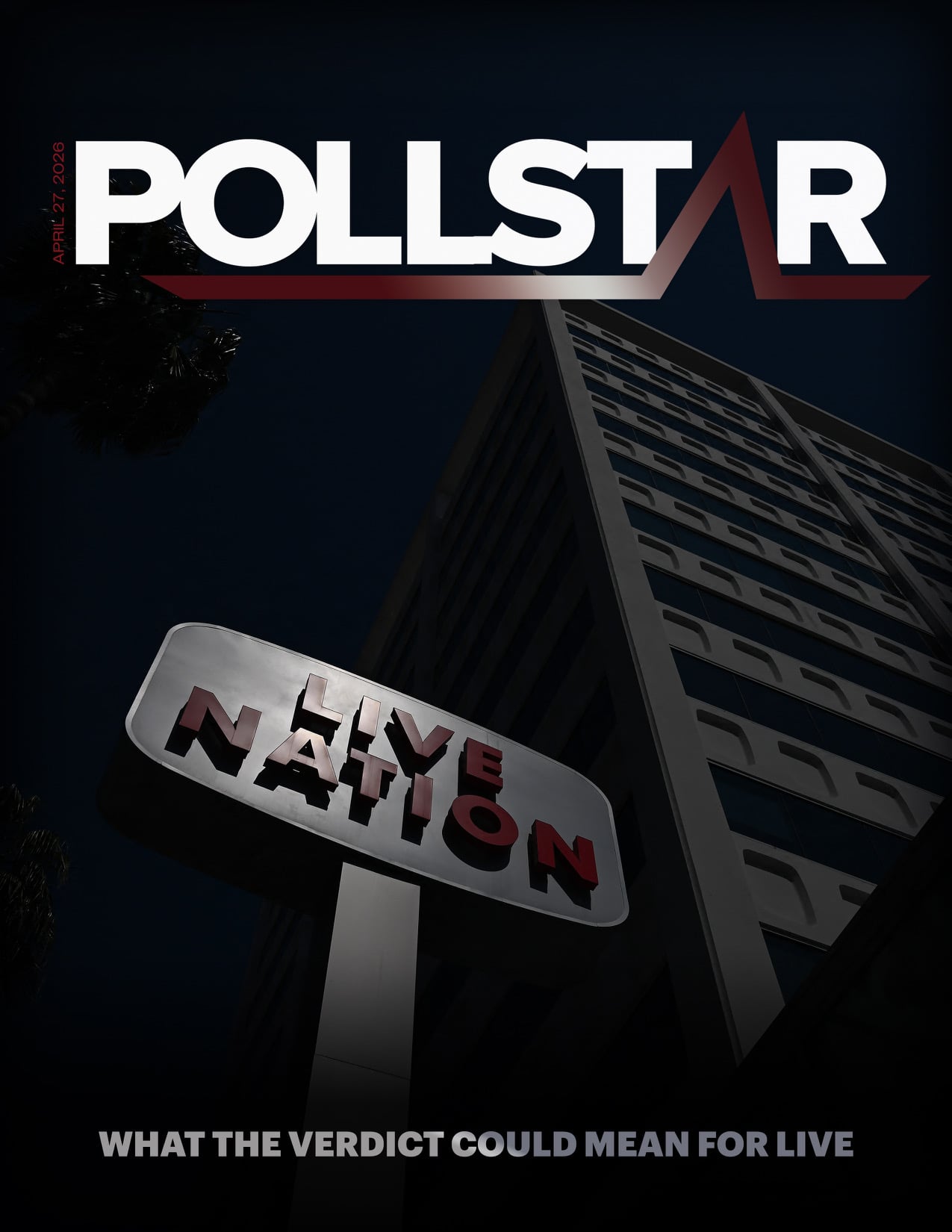
Sometimes big changes are announced with a bang, but sometimes it’s with a buzz.
Shortly before noon Pacific on April 15, murmurs and the telltale buzzing of smartphone alerts rippled through “The Power of Female Fandom” panel at the Pollstar Live! conference in Hollywood.
The jury in the Live Nation and Ticketmaster antitrust trial was back. There was a verdict.
The world’s largest promoter and its ticketing arm operated a monopoly with anticompetitive effects in violation of state and federal law. Officially — and legally — for those interested, the specifics are that Ticketmaster is a monopoly in primary ticketing at major concert venues and that Live Nation monopolized large amphitheaters and that Live Nation unlawfully tied artist promotion to the use of large amphitheaters.
Why Concert Ticket Prices Won’t Drop If Live Nation and Ticketmaster Are Split-Up
Those specifics are important but the top line news — the news that sent the phones buzzing — is what will reverberate: a jury of nine New Yorkers say that Live Nation and Ticketmaster operated an illegal monopoly.
Now what?
Now, we wait. U.S. District Court Judge Arun Subramanian — who did a laudable job keeping the case on the rails for more than two years and delivering it to a jury despite the sudden settlement just days into the trial by and subsequent retreat from the matter by the U.S. Department of Justice and a handful of states, leaving a rump of 33 states and the District of Columbia to fight on — will decide on the remedy.
The jury issued its recommendation for monetary damages, itself a bit of novelty. Most antitrust prosecutions seek only behavioral or structural remedies rather than monetary damages; the request for a payout meant the empaneling of a jury was a necessity. Historically, the vast majority of antitrust cases have been decided by a judge alone. The jurors agreed with the recommendation of the states, based on a model offered by an expert witness: $1.72 per ticket at 257 venues over the last five years. That doesn’t sound like much, though Live Nation’s estimate puts the figure around $150 million, which will then be trebled to somewhere in the neighborhood of $450 million.
That’s the easy part.
Before he even wrestles with that, Subramanian still has some legal mop-up work to do. Live Nation’s attorneys filed a motion before the case went to the jury to bar consideration of the testimony of the plaintiffs’ expert witness, Rosa M. Abrantes-Metz. Abrantes-Metz’s model was the one that developed the $1.72 figure. Live Nation said it ignored upfront payments to venues and considered that Ticketmaster and AEG’s AXS were essentially products of equal quality, a determination that was disputed by numerous witnesses at the trial, who testified that Ticketmaster is a far superior product.
How Live Nation Antitrust Penalties Could Disrupt The Live Business Ecosystem
Subramanian declined to rule on the motion ahead of the verdict and in the time since, has been asked in a rather terse letter by Live Nation’s attorneys to expedite his ruling. Subramanian declined and issued a blistering note in response, saying “counsel has already been cautioned for the tone of their filings. Not only is the kind of rhetoric in this letter inconsistent with the Court’s rule requiring civility, but it’s counterproductive, and can distract from the merits of a party’s argument.”
Live Nation also expects to file a separate motion asking Subramanian to make what’s called a judgment as a matter of law (officially, it would be a renewed motion to that effect and is generally referred to as a “judgment notwithstanding the verdict” since the jury has already made its finding). In essence, they’re asking Subramanian to rule that there was legally insufficient means to make a monopoly determination, wiping out the verdict.
“Of course, Live Nation can and will appeal any unfavorable rulings on these motions,” the company said in its post-verdict statement, to little surprise.
So then, after all that, Subramanian can determine the relief. Live Nation said it expects the general framework to reflect what was already agreed to in DOJ settlement: opening up some amphitheaters to rival promoters, loosening of exclusivity agreements and the outright termination of an exclusivity deal with Oak View Group (Pollstar‘s parent company).
And there’s still an open question whether the settlement will hold at all. Under the Nixon-era Tunney Act, the agreement is subject to Subramanian’s review and approval before it’s finalized and a group of Democratic senators urged him to treat it with deep skepticism given the unusual timing of it — Subramanian was, to put it mildly, displeased when news of it broke during the trial and he learned that it had been agreed to days before — and with reporting from the Wall Street Journal and others about lobbying from Trumpworld figures within the DOJ. Add to that the abrupt departure of former antitrust boss Abigail Slater — who was said to be at frequent loggerheads about the level of aggression in antitrust prosecution with then-AG Pam Bondi and others both at the DOJ and inside the White House — and the subsequent departure of many long-time DOJ career antitrust attorneys.
And of course it was the perceived laxness of that settlement that caused the 34 attorney generals who continued the case to balk at it in the first place in belief that going through with the trial would result in stiffer behavioral remedies.
Indeed in the week or so since the trial, many of them have said explicitly that Live Nation and Ticketmaster must be broken up, as was sought by the DOJ and the states when the case was filed in 2024. And it’s a remedy that has support across the political spectrum with New York’s very liberal AG Laetitia James and her very conservative counterpart in Tennessee, Jonathan Skrmetti both banging the drum for a full break-up.
“Live Nation and Ticketmaster have ripped off consumers for decades. Thanks to a relentless bipartisan coalition of states, they’re finally being held accountable,” Skrmetti said. “A jury determined that Live Nation and Ticketmaster are an illegal monopoly. Next up, the judge will decide the appropriate remedies, and a breakup is absolutely on the table. It’s been over 40 years since an antitrust case resulted in breaking up a company, and I think we’re due.”
But even that isn’t far enough for some stakeholders.
“In order to take away Live Nation’s leverage that, according to a jury, they have abused, you have to take away the tours,” National Independent Venue Association executive director Stephen Parker said. “While the illegal monopolization of the ticketing market is the headline, the true headline is that the way to fix monopolization of the ticketing market is to take away Live Nation’s leverage and Live Nation’s leverage is the tours.”
Parker says NIVA believes Live Nation and Ticketmaster should be broken up, plus the remaining Ticketmaster broken into primary and resale sectors. In addition, Parker said, because Live Nation’s leverage is their ability to book an entire tour, the judge should limit how much of a tour Live Nation promotes to 50%.
But would that even have its intended effect? Jarred Arfa, the EVP and Head of Global Music for Independent Artist Group, isn’t so sure there’d suddenly be a robust and wooly promotion industry.
“Live Nation has some of the best touring personnel in the business. Even if there were increased competition on promoter side you aren’t going to rush to trust promoters with your headline artists that don’t have the expertise and experience that Live Nation has,” he said.
There’s little argument that the foundation — at least the political and rhetorical foundation, if not the legal foundation — for the antitrust suit was the shambolic, high-profile onsale for Taylor Swift’s “Eras” tour, which prompted plenty of outrage — perhaps a bit performative — in the halls of Congress. The legal linkage is that because Ticketmaster so dominates the market, it has no incentive to improve to compete better and therefore the system failed under stress (that linkage ignores that SeatGeek handled ticketing for the “Eras” shows at State Farm Stadium in Glendale, Arizona, and AT&T Stadium in Arlington, Texas, and faced similar, if less-reported, problems).
And that may well be true but the inevitable rhetorical momentum and boot-strapping made the downstream discussion more about ticket prices rather than the ticket process. And even the bare math of the damage award shows that — at least on a microlevel — any overcharges as the result of monopolization were fairly minimal. Would anyone notice $1.72 on a ticket that’s $150 already?
We don’t know what we don’t know but we do, in fact, know that tickets are expensive because there’s only one Taylor Swift (or U2 or pick your favorite) at a time. And we know that artists and their teams have broad power to determine how the tickets are priced which could mean an act says sell it for $20 and the tickets end up on the secondary for $200. But it can also mean an artist or their team ask the promoter to figure out the right price to maximize revenue.
And that advice is unlikely to change much if Live Nation and Ticketmaster are broken up. Indeed, the great law of the market is all that’s going to keep prices in check, as Arfa said “The idea that possible breaking the companies up will have any impact on ticket prices is a fallacy.”
The buzzes from the phones during that Pollstar Live! panel have silenced. The murmurs continue as speculation. But the reverberations from whatever Subramanian (and the inevitable appeals) decide will be continue. And in this week, Pollstar looks at what those might be.
FREE
 Daily Pulse
Subscribe
Daily Pulse
Subscribe
 Daily Pulse
Subscribe
Daily Pulse
Subscribe